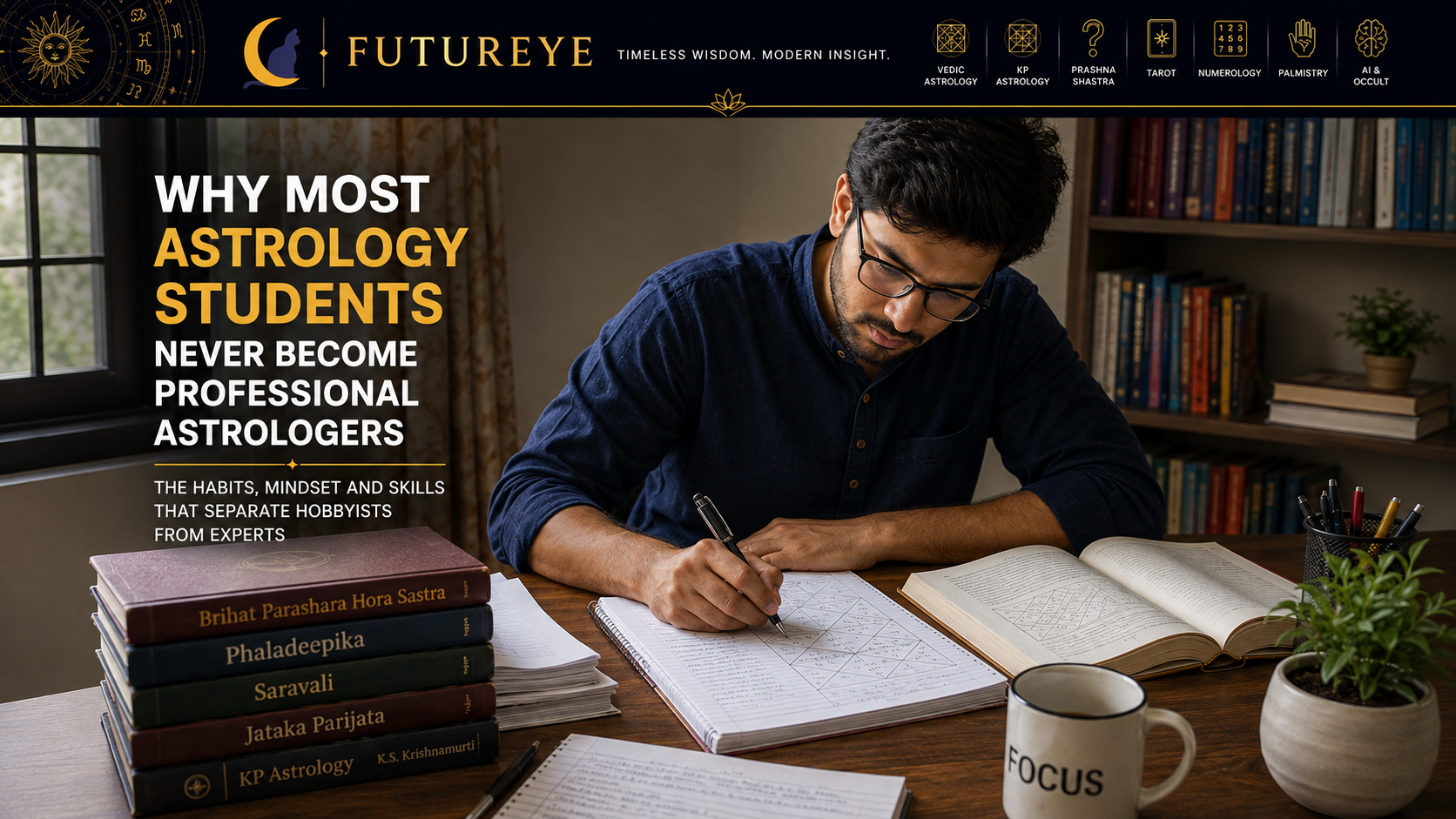
Most astrology students never become professional astrologers because they spend years collecting information instead of developing predictive ability.
Reading books, watching YouTube videos, and memorizing yogas create knowledge—but clients pay for accurate chart interpretation, confident predictions, and practical judgment. The astrologers who succeed analyse hundreds of real horoscopes, learn under experienced mentors, and develop a systematic approach instead of relying on isolated combinations.
Key Takeaways
- Information alone does not make someone a professional astrologer.
- Reading hundreds of charts is more valuable than reading hundreds of books.
- Memorizing yogas is not the same as understanding astrology.
- Prediction skills develop through deliberate practice and feedback.
- Classical texts remain the strongest foundation for serious astrologers.
- AI can improve productivity but cannot replace astrological judgment.
- Professional astrologers think in patterns—not isolated rules.
Every year, thousands of people decide to learn astrology.
Some are driven by curiosity.
Some want to understand themselves better.
Others dream of becoming professional astrologers and building a meaningful career helping people.
Yet something interesting happens.
Most students never reach that stage.
They continue learning for years...
Buying books.
Watching YouTube videos.
Attending workshops.
Collecting PDFs.
Joining Telegram and WhatsApp groups.
But when someone finally asks,
"Can you read my horoscope?"
They hesitate.
Not because they lack information.
But because information is not the same as confidence.
And confidence comes only through practice.
This is the biggest difference between someone who studies astrology and someone who practices it professionally.
Mistake #1: Collecting Information Instead of Reading Charts
The biggest trap in astrology is believing that one more book will finally make everything click.
It won't.
Books explain principles.
Charts teach application.
Imagine two students.
The first reads ten astrology books but has analysed only twenty horoscopes.
The second has read three good books but has analysed five hundred birth charts.
Who do you think will become the better astrologer?
Almost always, the second.
Professional astrologers don't simply recognise combinations.
They recognise patterns.
And patterns only emerge after studying hundreds of real charts.
Futureye Practice Rule
Spend at least 70% of your study time analysing charts and only 30% consuming theory.
Mistake #2: Memorising Yogas Instead of Understanding Them
Many beginners proudly memorise hundreds of Raj Yogas.
They can quote combinations from Brihat Parashara Hora Shastra or Phaladeepika.
Yet when they see those same combinations in a horoscope, they struggle to answer a simple question:
Will this yoga actually produce results?
Why?
Because no yoga works in isolation.
Every combination must be judged along with:
- Planetary strength
- House ownership
- Functional benefics and malefics
- Aspects
- Dasha
- Divisional charts
- Overall promise of the horoscope
Two people may have the same Raj Yoga.
One becomes a CEO.
The other becomes a respected school principal.
The yoga is the same.
Its expression is different.
Professional astrologers interpret combinations.
Beginners merely identify them.
Mistake #3: Never Making Predictions
This is where most students get stuck.
They keep studying because they don't feel "ready."
The reality is simple.
You never feel ready.
Every experienced astrologer has made incorrect predictions.
The difference is that professionals learn from them.
Students avoid them.
Prediction is uncomfortable.
It exposes gaps in your understanding.
But every prediction—right or wrong—teaches you something that no book can.
The sooner you begin analysing real charts, the faster your confidence grows.
Mistake #4: Ignoring the Classical Foundations
Modern astrology content is easier to consume.
Short videos.
Instagram posts.
Quick reels.
AI summaries.
These are useful for revision.
They should never replace the classics.
Every serious astrologer should spend time with foundational works such as:
- Brihat Parashara Hora Shastra
- Phaladeepika
- Saravali
- Jataka Parijata
- Brihat Jataka
These texts have survived for centuries because they teach principles—not shortcuts.
Modern teachers interpret them.
The classics remain the foundation.
A Simple Comparison
| Hobbyist Student | Professional Astrologer |
|---|---|
| Collects books | Collects case studies |
| Memorises yogas | Understands principles |
| Avoids predictions | Makes predictions and learns |
| Watches endless videos | Reads real charts daily |
| Looks for shortcuts | Builds systematic thinking |
| Waits to feel ready | Improves through practice |
The gap between these two isn't intelligence.
It's habit.
And habits can be changed.
Mistake #5: Learning Without Feedback
Imagine trying to learn cricket without a coach.
Or surgery without a senior doctor.
Or chess without analysing your games.
Astrology is no different.
Many students study alone for years.
They read charts.
They make notes.
They think they understand.
But nobody challenges their reasoning.
As a result, the same mistakes get repeated over and over again.
Feedback accelerates learning because it exposes blind spots that you cannot see yourself.
A mentor doesn't just tell you whether a prediction is right or wrong.
A good mentor asks:
- Why did you prioritise this yoga?
- Why did you ignore Saturn?
- Why is the Navamsa supporting—or contradicting—your conclusion?
- What if the current Dasha changes the result?
These questions transform an astrology student into an astrologer.
Mistake #6: Depending Completely on AI
Artificial Intelligence is one of the greatest tools available to modern astrologers.
But it is also one of the easiest tools to misuse.
Many beginners now paste a horoscope into ChatGPT and ask:
"Read my birth chart."
The answer often looks impressive.
It is well written.
Confident.
Structured.
Sometimes even inspiring.
But good writing is not the same as good astrology.
AI can:
- Explain concepts.
- Translate Sanskrit.
- Compare different interpretations.
- Draft consultation reports.
- Summarise classical texts.
- Create educational content.
What it cannot reliably do is replace the judgement of an experienced astrologer.
Professional astrologers use AI to improve efficiency.
Beginners often use AI to avoid learning.
That difference determines whether AI becomes your greatest advantage—or your biggest weakness.
The Futureye Professional Learning Framework
At Futureye, we teach astrology using a structured progression instead of random information consumption.
Stage 1 – Learn the Principles
Understand:
- Houses
- Signs
- Planets
- Nakshatras
- Yogas
- Dasha systems
Don't rush.
A strong foundation prevents years of confusion later.
Stage 2 – Read Real Charts
Theory only becomes meaningful when applied.
Read as many charts as possible.
Start with:
- Your own chart
- Family members
- Friends
- Historical personalities
Each horoscope teaches something new.
Stage 3 – Predict First, Verify Later
Before reading anyone else's interpretation, write down your own prediction.
Then compare.
This simple habit develops independent thinking.
Without it, you become dependent on other astrologers.
Stage 4 – Review Every Prediction
Maintain a journal.
For every horoscope record:
- What you predicted.
- What actually happened.
- Which combinations worked.
- Which assumptions were incorrect.
- What you learned.
This journal will eventually become more valuable than any astrology book you own.
A 90-Day Practice Plan
If you're serious about becoming a professional astrologer, here's a simple roadmap.
Month 1
- Master planetary significations.
- Understand the twelve houses.
- Read 30 birth charts.
Month 2
- Learn yogas and aspects.
- Begin studying Dasha.
- Read another 40 charts.
Month 3
- Start making complete predictions.
- Compare your work with experienced astrologers.
- Review every mistake honestly.
By the end of 90 days, your practical understanding will improve far more than if you simply watched another hundred videos.
The difference isn't talent.
It's deliberate practice.
Frequently Asked Questions
Can anyone become a professional astrologer?
Yes, provided they are willing to invest time in structured learning, consistent practice, and continuous improvement. Astrology is a skill that develops through disciplined study and chart analysis—not innate talent alone.
How long does it take to become a professional astrologer?
There is no universal timeline.
Someone studying casually may take many years.
A dedicated student who studies daily, analyses hundreds of charts, and learns under proper guidance can develop solid predictive skills much faster.
The focus should never be on finishing a course.
It should be on becoming capable of making accurate, well-reasoned predictions.
Is YouTube enough to learn astrology?
No.
YouTube is an excellent resource for discovering concepts and revising topics, but it rarely provides a structured curriculum or personalised feedback.
Professional astrology requires systematic learning and practical application.
Should I learn Vedic Astrology or KP Astrology first?
A strong foundation in classical Vedic Astrology (Parashari) makes learning KP Astrology significantly easier.
KP builds upon many traditional astrological concepts while introducing its own unique predictive framework.
Learning the fundamentals first helps you understand why KP techniques work rather than simply memorising rules.
How many birth charts should I analyse?
There is no magic number.
However, experienced astrologers often study hundreds—sometimes thousands—of charts throughout their careers.
Every chart reveals new combinations and strengthens pattern recognition.
Remember:
The quality of your predictions is directly proportional to the quality of your practice.
Can AI make me a better astrologer?
Absolutely.
When used correctly, AI can:
- Explain difficult concepts
- Summarise classical texts
- Draft consultation reports
- Generate practice questions
- Organise research
But AI cannot replace your judgment.
It should support your learning—not become your teacher.
Final Thoughts
Every successful astrologer eventually realises one simple truth.
Clients don't pay for information.
They pay for clarity.
The ability to look at a horoscope, identify what matters, ignore what doesn't, and communicate meaningful guidance is what separates a professional from a hobbyist.
That ability cannot be purchased.
It cannot be memorised.
It cannot be downloaded from an AI chatbot.
It is earned through years of observation, disciplined practice, honest self-reflection, and continuous learning.
If you truly want to become a respected astrologer, stop asking:
"Which book should I read next?"
Start asking:
"Which chart should I analyse next?"
That single shift in mindset can transform your journey.
Ready to Become a Professional Astrologer?
If your goal is to read charts with confidence—not just memorise combinations—it's time to move beyond scattered learning.
At Futureye, our live cohort-based programs are designed to help aspiring astrologers become skilled practitioners through structured education and guided practice.
You'll learn:
- Vedic Astrology (Parashari)
- KP Astrology
- Prashna Shastra
- AI-assisted Astrology workflows
- Practical chart interpretation
- Predictive techniques used in real consultations
More importantly, you'll learn how to think like an astrologer, not just how to remember astrological rules.
Download the relevant course prospectus today or contact Futureye to discover which program is right for your learning journey.
About Futureye
Futureye is a modern learning platform dedicated to helping aspiring and practicing astrologers master the occult sciences through structured, practitioner-focused education.
Our programs combine timeless wisdom with modern learning methods across:
- Vedic Astrology (Parashari)
- KP Astrology (Krishnamurti Paddhati)
- Prashna Shastra
- Tarot
- Numerology
- Palmistry
- AI for Astrologers
Our philosophy is simple:
Don't just learn astrology. Learn to read charts with confidence.
Whether you're beginning your journey or looking to refine years of experience, Futureye helps you move from theory to practical prediction through live cohorts, real chart discussions, and guided mentorship.
Visit https://thefutureye.com to explore courses, download prospectuses, and begin your journey toward becoming a professional astrologer.
Sources
Classical References
- Brihat Parashara Hora Shastra – Maharshi Parashara
- Phaladeepika – Mantreswara
- Saravali – Kalyana Varma
- Jataka Parijata – Vaidyanatha Dikshita
- Brihat Jataka – Varahamihira
- Krishnamurti Paddhati Readers (Volumes 1–6) – Prof. K. S. Krishnamurti
Modern References
- Indian Council of Astrological Sciences (ICAS)
- OpenAI Documentation (for AI workflow concepts)
- Anthropic Documentation (Claude)
- Google DeepMind Documentation (Gemini)
Ready to Learn the Secret Vidya?
Live cohort-based occult mastery — Vedic Astrology, Prashna Shastra, KP, Palmistry, Numerology, Tarot. Taught by Kushal Agarwal, ICAS faculty, with an AI practice agent that drills you on weak topics until they become second nature.
Or reach us at: info@thefutureye.com · +91 6290 273 797