Retrograde Planets in Jyotish: What Does Vakri Really Mean?
Look at almost any astrology discussion involving a retrograde planet and you will find the same language.
Delays.
Problems.
Reversals.
Confusion.
Bad results.
But is a retrograde planet really that simple?
The answer is no.
In Jyotish, a retrograde planet is called Vakri.
And Vakri does not simply mean "bad."
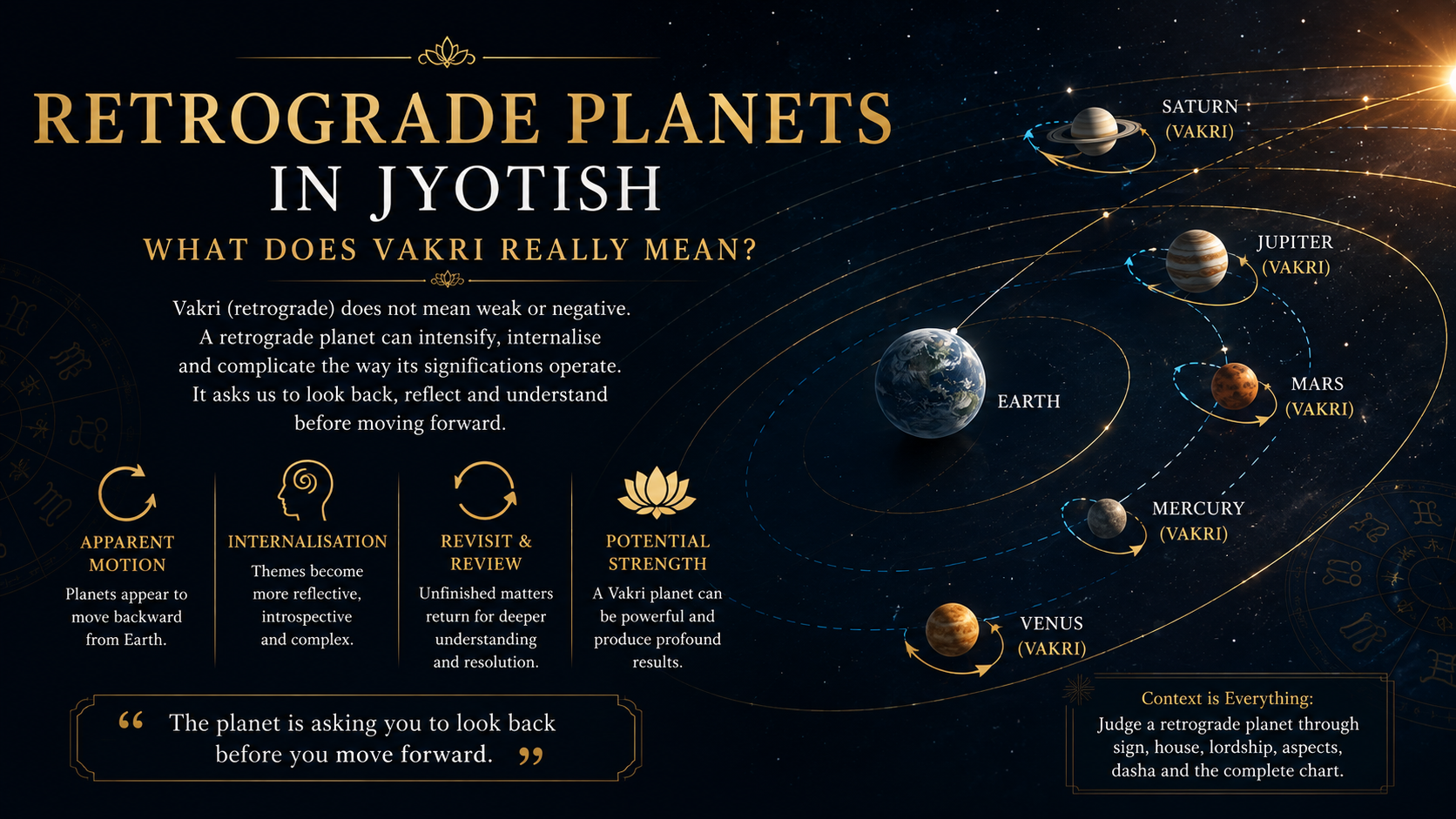
It describes a particular condition of planetary motion as observed from Earth.
More importantly, traditional Jyotish gives retrograde planets a much richer interpretive significance than simply labelling them difficult.
A Vakri planet can intensify its significations.
It can make those significations more internal.
It can produce unusual expressions of the planet.
It can create repetition.
It can bring a person back to unresolved matters.
And in some circumstances, a retrograde planet can actually become exceptionally powerful.
This is why saying:
"Saturn is retrograde, therefore Saturn is bad"
is not astrology.
It is a shortcut.
And shortcuts are particularly dangerous when interpreting a horoscope.
What Is Retrograde Motion?
From the perspective of Earth, planets normally appear to move forward through the zodiac.
Occasionally, however, a planet appears to slow down, stop and move backward against the background of the zodiac.
This apparent backward movement is called retrograde motion.
The planet itself has not literally reversed its orbital direction around the Sun.
The phenomenon is created by the relative motion of Earth and the other planet.
This is particularly easy to understand with the outer planets, because Earth periodically overtakes them in their orbits.
From our perspective, their apparent motion changes.
Astrologers use this apparent motion because astrology is fundamentally geocentric in its observational framework.
In other words:
What matters astrologically is how the planet appears to move from Earth.
What Is Vakri in Jyotish?
The Sanskrit term Vakri is generally translated as retrograde.
A Vakri Graha is therefore a planet that is moving retrograde from the geocentric perspective.
But the traditional interpretation goes beyond the astronomical description.
A planet that is moving in an unusual direction is often interpreted as functioning in an unusual way.
Its results may become:
More intense.
More complicated.
More internalised.
Less conventional.
Repeated.
Delayed and then accelerated.
Or expressed differently from what would normally be expected.
This is why Vakri should be treated as a modifying condition rather than a standalone prediction.
Does Retrograde Mean Weak?
This is one of the biggest misconceptions in astrology.
A retrograde planet is not automatically weak.
In fact, classical Jyotish contains traditions in which retrograde planets can possess considerable strength.
The important point is that strength and ease are not the same thing.
A planet can be powerful and still produce difficult experiences.
Mars can be powerful and create conflict.
Saturn can be powerful and create severe discipline.
Rahu can be powerful and create obsession.
Likewise, a powerful retrograde planet may produce very strong results without necessarily producing comfortable results.
Therefore, the correct question is not:
"Is the retrograde planet good or bad?"
The better questions are:
How strong is the planet?
What house does it occupy?
What houses does it rule?
What sign is it in?
Who aspects it?
What planets are associated with it?
What is its dignity?
What is happening in the Dasha?
And what does the rest of the horoscope say?
Retrogression Can Internalise a Planet
One useful way of understanding Vakri is through internalisation.
Suppose Mercury is retrograde.
Mercury represents communication, analysis, information, learning and discrimination.
A retrograde Mercury may make these processes more reflective.
The person may reconsider what they said.
Reanalyse information.
Question assumptions.
Think repeatedly about a problem.
Approach communication differently from others.
This does not necessarily mean poor communication.
In some cases, it may produce extraordinary analytical depth.
The same principle can apply to other planets.
Retrograde Jupiter may cause a person to repeatedly question beliefs.
Retrograde Saturn may create prolonged internal examination of responsibility and authority.
Retrograde Venus may make relationships and values subjects of deep reconsideration.
The exact result depends on the horoscope.
Retrograde Saturn
Saturn is particularly important because its retrograde cycle lasts for months.
In 2026, Saturn is retrograde from late July through December in the tropical ephemeris, and on August 30 it is retrograde in Aries in the tropical zodiac. In the sidereal zodiac used by Jyotish, Saturn is retrograde in Pisces. :contentReference[oaicite:1]{index=1}
Saturn represents:
Discipline.
Responsibility.
Time.
Structure.
Work.
Authority.
Limitations.
Persistence.
Consequences.
When Saturn becomes retrograde, these themes can become more reflective.
A person may reconsider their responsibilities.
Question an existing structure.
Return to unfinished work.
Re-examine authority.
Confront an old obligation.
Or discover that a structure they built is no longer sustainable.
This is why Saturn retrograde can feel like a period of review.
But review is not necessarily punishment.
Sometimes it is correction.
Saturn Retrograde and Karma
Saturn is naturally associated with Karma because Saturn represents consequences, responsibility and time.
This makes retrograde Saturn particularly interesting.
It can symbolically bring attention back to matters that were not properly resolved.
But this should not be interpreted as:
"Saturn retrograde means your past Karma is attacking you."
That is an overly dramatic interpretation.
Karma is not a punishment mechanism.
It is a framework for understanding causation and consequences.
A retrograde Saturn period may simply make a person more conscious of consequences that were already present.
The planet does not necessarily create the problem.
It may force us to look at it.
Retrograde Jupiter
Jupiter represents:
Wisdom.
Knowledge.
Teachers.
Dharma.
Faith.
Expansion.
Judgement.
Higher learning.
When Jupiter is retrograde, these subjects may become more internal.
A person may question the beliefs they inherited.
They may change teachers.
Reconsider their philosophy.
Return to an unfinished course of study.
Or discover that their previous understanding of spirituality no longer satisfies them.
This is not necessarily a loss of faith.
It can be a deepening of faith through questioning.
Blind belief is easy.
A belief that survives examination is much stronger.
Retrograde Mercury
Mercury is perhaps the planet most popularly associated with retrograde motion in modern astrology.
Mercury retrograde is often blamed for:
Communication problems.
Travel disruptions.
Technology failures.
Contract issues.
Misunderstandings.
But this interpretation has become so popular that it has almost turned into a cultural meme.
In Jyotish, Mercury should not be reduced to a generic "Mercury retrograde = communication problems" rule.
Mercury governs intelligence, speech, calculation, commerce, learning and analytical ability.
A retrograde Mercury can therefore manifest in many ways.
It may produce reconsideration.
Revision.
Recalculation.
Repeated analysis.
Unconventional thinking.
Or an unusual relationship with communication.
Sometimes the person thinks too much.
Sometimes they think differently.
Sometimes they notice things other people overlook.
Again, context determines the result.
Retrograde Venus
Venus represents:
Relationships.
Marriage.
Pleasure.
Beauty.
Art.
Luxury.
Values.
Money-related comforts.
When Venus becomes retrograde, these themes can enter a period of reconsideration.
A person may rethink a relationship.
Question what they actually value.
Return to an old artistic interest.
Reconsider spending.
Or discover that an external form of pleasure is no longer satisfying.
This does not automatically mean:
"Breakup."
That is another example of simplistic astrology.
Retrograde Venus may just as easily indicate a deeper examination of what love and value actually mean to the person.
Retrograde Mars
Mars represents action.
Courage.
Competition.
Energy.
Conflict.
Assertion.
Physical initiative.
A retrograde Mars can therefore produce an unusual relationship with action.
Sometimes the person acts after prolonged internal deliberation.
Sometimes anger is internalised.
Sometimes action gets repeated.
Sometimes a person returns to an old battle.
Sometimes they learn to control their impulses more effectively.
Mars retrograde can therefore be difficult if the energy becomes frustrated.
But it can also produce extraordinary persistence.
A person may refuse to give up because Mars continues to push toward completion.
Retrograde Planets Can Create Repetition
One of the most useful ways to understand Vakri is through repetition.
Something may return.
An old relationship.
An unfinished project.
A previous responsibility.
A forgotten subject.
A past decision.
A question that seemed settled.
Why?
Because retrograde motion symbolically moves attention backward.
This does not mean the past literally returns because the planet "caused" it.
Rather, the symbolism is one of revisiting.
The person is asked to examine something again.
And sometimes the second examination produces a completely different conclusion.
The Difference Between Delay and Reassessment
Astrology often uses the word "delay."
But delay is not always the best description.
Suppose someone plans to change careers.
They postpone the decision.
During the postponement, they discover that their original plan was wrong.
Was the delay harmful?
Or was it useful?
This is why retrogression should not automatically be equated with obstruction.
Sometimes the apparent delay creates the time required for a better decision.
A retrograde planet can therefore operate as a review mechanism.
Retrograde Does Not Mean Everything Goes Backward
Another common misunderstanding is that when one planet is retrograde, everything associated with it moves backward.
That is not how astrology works.
A retrograde Mercury does not mean communication literally reverses.
A retrograde Saturn does not mean life literally goes backward.
Retrogression modifies the planet's symbolic expression.
It does not turn the world upside down.
The distinction is important.
Astrology deals with symbolism and patterns.
It is not a mechanical claim that planets physically control every event on Earth.
Retrograde and the Natal Chart
There is also a major difference between:
Natal retrograde
and
Transit retrograde.
If a planet was retrograde at the time of your birth, that condition becomes part of your natal horoscope.
It describes something relatively stable in your psychological and experiential pattern.
If a planet becomes retrograde in transit, it is a temporary influence.
The two should not be interpreted in exactly the same way.
A natal retrograde planet can describe how the person naturally processes that planet's significations.
A transit retrograde can activate a period of review or reconsideration.
Natal Retrograde Saturn
Suppose Saturn is retrograde in a birth chart.
The person may develop an unusual relationship with authority and responsibility.
They may question conventional structures.
They may mature differently from their peers.
They may experience responsibility in a highly personal way.
They may need to develop their own understanding of discipline rather than simply accepting external rules.
But none of this can be concluded from Saturn retrograde alone.
House.
Sign.
Lordship.
Aspects.
Conjunctions.
Dasha.
Divisional charts.
All matter.
Natal Retrograde Jupiter
A natal retrograde Jupiter can similarly produce a distinctive relationship with knowledge and belief.
The person may not accept teachings simply because an authority says they are true.
They may investigate.
Question.
Compare.
Study.
Return to a subject repeatedly.
Sometimes this can produce deep scholarship.
The danger is endless questioning without conclusion.
The strength is intellectual independence.
Again:
Retrograde does not mean weak.
It means different.
Retrograde and Dasha
Dasha is critical.
A retrograde planet may sit quietly in a chart for years and become much more noticeable when its Dasha or Antardasha operates.
This is why interpreting a retrograde planet without looking at timing can produce misleading conclusions.
The natal chart tells us what exists.
The Dasha helps tell us when certain themes become active.
Transit then modifies the circumstances further.
This is the difference between a static reading and a dynamic reading of a horoscope.
Retrograde and Transit
Transit retrogression can also cause a planet to pass over the same zodiacal region multiple times.
Instead of one straightforward passage, the planet may appear to move:
Forward.
Backward.
Forward again.
Astrologers often pay attention to these repeated contacts.
A planet may therefore activate the same degree or house more than once.
This creates another reason retrograde periods are associated with revisiting matters.
The transit itself is literally revisiting territory from our geocentric perspective.
Why Are Outer Planets Retrograde So Often?
Saturn, Uranus, Neptune and Pluto spend long periods appearing retrograde.
This is because their orbital relationships with Earth produce long apparent retrograde periods.
In 2026, Saturn, Neptune and Pluto are all retrograde on August 30. Uranus is still direct and is scheduled to enter its own retrograde period later in the year. :contentReference[oaicite:2]{index=2}
For Western astrology, these planets are frequently interpreted psychologically or collectively.
Traditional Jyotish, however, does not include Uranus, Neptune and Pluto among the classical Navagraha.
This distinction matters.
Should Jyotish Use Uranus, Neptune and Pluto?
This is a subject of debate.
Classical Vedic astrology is based on the visible planets and the traditional Grahas.
The seven classical planets are:
Sun.
Moon.
Mars.
Mercury.
Jupiter.
Venus.
Saturn.
Rahu and Ketu are included as the lunar nodes.
Uranus, Neptune and Pluto were discovered much later and are not part of the classical Parashari framework.
Some modern Vedic astrologers experiment with them.
Others do not use them at all.
There is nothing wrong with studying alternative systems.
But it is important not to mix frameworks without acknowledging the difference.
What About Rahu and Ketu?
Rahu and Ketu deserve special attention.
The lunar nodes are always retrograde in their apparent zodiacal motion in the standard geocentric treatment.
Therefore, retrogression itself is not an unusual event for them.
This is why saying:
"Rahu is retrograde"
does not carry the same interpretive significance as saying:
"Saturn is retrograde."
For Rahu and Ketu, retrograde motion is essentially their normal direction through the zodiac.
Their interpretation comes from their nodal nature, sign, house, dispositors, conjunctions, aspects and broader chart context.
Vakri Is Not a Curse
Perhaps this is the most important point.
A retrograde planet is not a curse.
It is not proof of bad Karma.
It is not automatically responsible for delays.
It does not mean that everything ruled by the planet will fail.
And it certainly does not justify fear-based astrology.
A retrograde planet is a condition.
The astrologer has to interpret that condition within the complete horoscope.
That requires judgement.
Why Retrograde Planets Can Be Powerful Teachers
There is a philosophical reason retrograde planets can be useful.
Human beings often learn through repetition.
We make a mistake.
We encounter it again.
We understand something.
We repeat the lesson.
Eventually, the pattern changes.
Retrogression provides a beautiful astrological metaphor for this process.
We revisit.
We reconsider.
We understand.
We act differently.
The apparent backward movement can therefore produce forward development.
The Real Question Is Not "What Will Go Wrong?"
This is perhaps where astrology needs a change in language.
Instead of asking:
"What problems will retrograde Saturn cause?"
Ask:
"What responsibility am I being asked to reconsider?"
Instead of:
"What will Mercury retrograde destroy?"
Ask:
"What needs to be reviewed, corrected or communicated more carefully?"
Instead of:
"What will retrograde Venus do to my relationship?"
Ask:
"What do I actually value in this relationship?"
Instead of:
"Why is Jupiter retrograde delaying my growth?"
Ask:
"What belief or assumption about growth needs to be examined?"
The second set of questions is far more useful.
Retrogression and Self-Knowledge
Astrology is ultimately most useful when it increases awareness.
A retrograde planet can be viewed as an invitation to become conscious of something that normally operates automatically.
Saturn asks:
What responsibilities are you avoiding?
Jupiter asks:
What do you believe and why?
Mercury asks:
How do you think and communicate?
Venus asks:
What do you value?
Mars asks:
How do you use your energy?
The planet becomes a mirror.
What Is Happening in August 2026?
As August 2026 comes to an end, the sky contains a particularly strong retrograde emphasis.
Saturn is retrograde.
Neptune is retrograde.
Pluto is retrograde.
In the sidereal zodiac, Saturn is retrograde in Pisces, Neptune is also in Pisces, and Pluto is retrograde in Capricorn. :contentReference[oaicite:3]{index=3}
This does not mean that the entire world is "going backward."
It means that several slow-moving planetary cycles are in their retrograde phases simultaneously.
Because these planets move slowly, their effects—within systems that use them—are generally interpreted over longer periods rather than as sudden daily events.
The Jyotish Perspective
For a Jyotish practitioner, retrogression should therefore be treated as one layer of interpretation.
Start with the planet.
Then examine:
Its sign.
Its house.
Its lordship.
Its dignity.
Its conjunctions.
Its aspects.
Its Nakshatra.
Its relationship with the dispositor.
Its Shadbala and other strength measures where appropriate.
Its Dasha.
Its transit.
Then consider whether retrogression modifies the picture.
That is astrology.
Not:
"Retrograde = bad."
Final Thoughts
Retrograde motion is one of the most misunderstood ideas in astrology.
The planet is not literally travelling backward around the Sun.
From Earth, however, its apparent motion can reverse.
Jyotish calls this Vakri.
And Vakri is not synonymous with weakness, failure or misfortune.
A retrograde planet can intensify its significations.
Internalise them.
Make them unusual.
Create repetition.
Bring unfinished matters back into awareness.
Or force the native to develop a more personal relationship with the planet's themes.
Sometimes that process is uncomfortable.
But discomfort is not the same as harm.
A person may become wiser because they had to question.
More disciplined because they had to rebuild.
More thoughtful because they had to reconsider.
More independent because they could not simply accept what they inherited.
That is why retrograde planets can become powerful teachers.
They ask us to look again.
To think again.
To act again.
And sometimes, to become someone different before moving forward.
Perhaps the most useful definition of retrogression is therefore not:
"The planet is going backward."
It is:
"The planet is asking you to look back before you move forward."
That is the real value of Vakri in Jyotish.
Not prediction through fear.
But reflection through time.
Learn Jyotish Beyond Simple Planetary Keywords
Retrograde planets are a perfect example of why Jyotish cannot be reduced to isolated rules.
A Vakri Graha must be understood through house, sign, lordship, dignity, aspects, Nakshatra, Dasha and the overall structure of the horoscope.
At Futureye, we focus on learning astrology as an interpretive discipline—with context and judgement rather than fear-based planetary keywords.
Explore Futureye's astrology programs and learn how to interpret Jyotish systematically.
About Futureye
Futureye is a practitioner-focused learning platform for serious students of astrology and occult sciences.
Our programs cover:
- Vedic Astrology
- KP Astrology
- Prashna Shastra
- Palmistry
- Tarot
- Numerology
- AI + Occult
Don't just learn astrology. Learn how to interpret it.
Sources
Drik Panchang — Planetary Positions, August 30, 2026: https://www.drikpanchang.com/planet/position/planetary-positions-sidereal.html
Astrological Ephemeris — August 30, 2026: https://www.zodiac-astrology-horoscopes.com/ephemeris/year/2026/08/30/
Cafe Astrology — Retrograde Cycles and Stations: https://cafeastrology.com/retrogrades.html
OT LDR Astro — August 2026 Ephemeris: https://astro.otldr.com/ephemeris/2026-08
Suggested Internal Links
- Understanding Nakshatras in Jyotish
- The Moon in Vedic Astrology: Understanding Chandra
- Karma and Free Will in Vedic Astrology
- The 8th House in Vedic Astrology
- The 9th House in Vedic Astrology
- Panchang Is More Than a Calendar
- Janmashtami: Why Krishna Was Born at Midnight and What His Birth Means in Jyotish
Want to understand how retrograde planets actually work in a horoscope?
Explore Futureye's astrology programs and learn to interpret Vakri Grahas through the complete chart—not through simplistic "retrograde = bad" rules.
Ready to Learn the Secret Vidya?
Live cohort-based occult mastery — Vedic Astrology, Prashna Shastra, KP, Palmistry, Numerology, Tarot. Taught by Kushal Agarwal, ICAS faculty, with an AI practice agent that drills you on weak topics until they become second nature.
Or reach us at: info@thefutureye.com · +91 6290 273 797