Drishti in Jyotish: How Planets Influence Houses and Each Other
A planet does not operate only where it is sitting.
This is one of the first things a student of Jyotish must understand.
A planet occupies a particular house.
It occupies a particular sign.
It may be joined by another planet.
But it can also influence another part of the horoscope through Drishti.
Drishti literally means sight or glance.
In Jyotish, it refers to the aspect or influence that a Graha casts upon another house or, depending on the interpretive framework, another planet.
This concept is fundamental.
Without understanding Drishti, a horoscope can easily be read as a collection of isolated placements.
With Drishti, the chart begins to look more like a connected system.
A planet in one house can influence another.
A benefic can support a difficult area.
A malefic can place pressure on an otherwise promising house.
Two planets can interact even when they are not physically together.
And suddenly, the meaning of the horoscope becomes much more dynamic.
What Is Drishti?
The Sanskrit word Drishti comes from the idea of seeing.
In ordinary language, seeing is passive.
In Jyotish, however, the "sight" of a Graha represents influence.
A planet looks toward a particular house.
That house becomes part of the planet's field of influence.
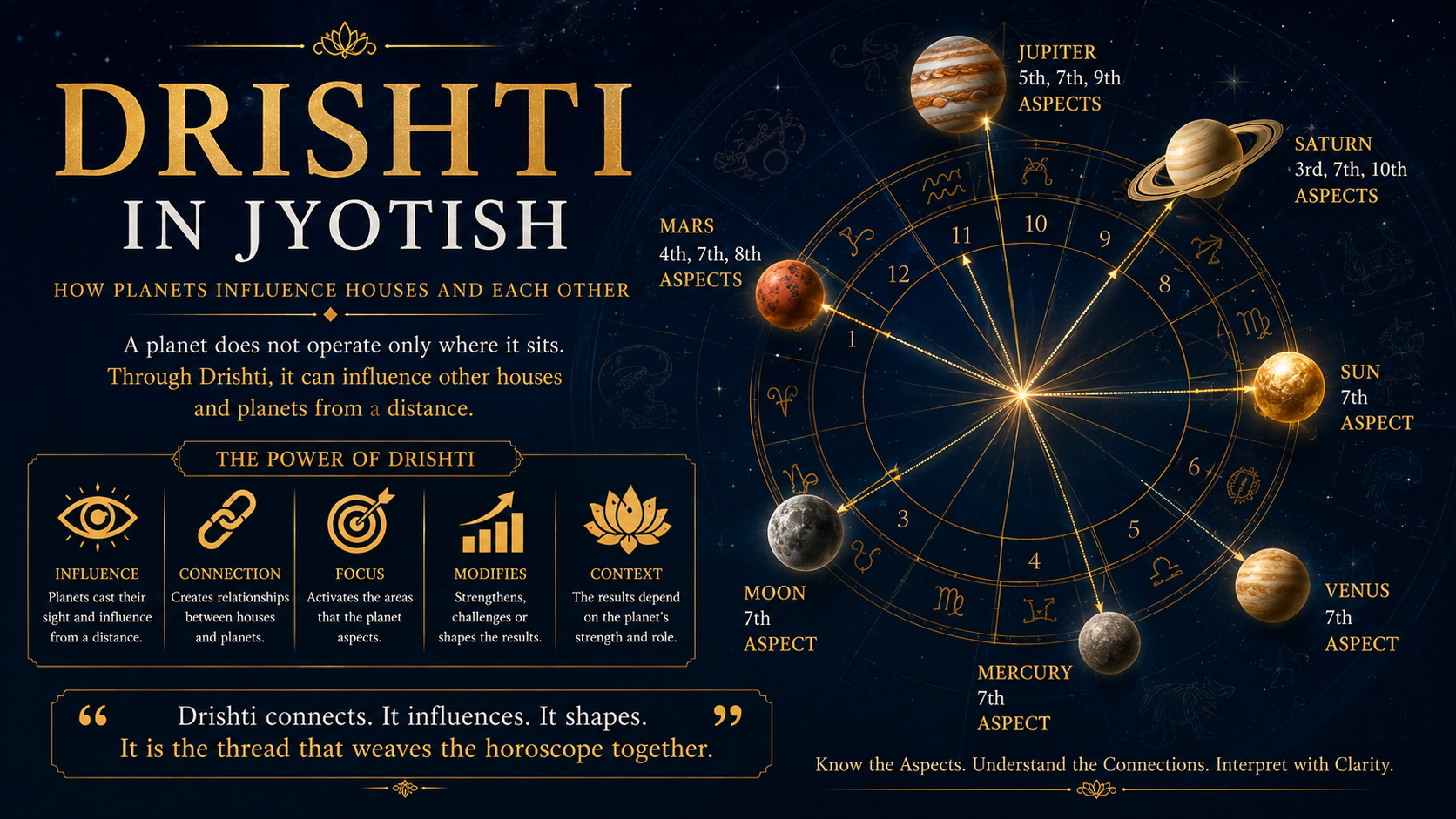
The most basic rule is that every classical planet aspects the 7th house from itself.
So if a planet occupies the 1st house, its 7th aspect falls on the 7th house.
If it occupies the 4th house, its 7th aspect falls on the 10th.
If it occupies the 10th, its 7th aspect falls on the 4th.
This creates a natural opposition across the horoscope.
Why the 7th Aspect?
The 7th house is directly opposite the 1st house.
It represents the point of complete opposition across the zodiac.
Therefore, the 7th aspect creates a direct line of relationship.
A planet "sees" the opposite house.
This is one reason the 7th house itself is so important in astrology.
It represents interaction with what is outside the self.
The 1st house represents the individual.
The 7th represents the other.
The 7th aspect therefore creates a symbolic relationship between the self and the external world.
Every Planet Has a 7th Aspect
The Sun.
Moon.
Mars.
Mercury.
Jupiter.
Venus.
Saturn.
All have a 7th aspect.
Rahu and Ketu are treated differently depending on the Jyotish tradition being followed, particularly regarding additional aspects.
For the classical seven visible Grahas, the 7th aspect is the basic Drishti.
But three planets have additional special aspects:
Mars
Jupiter
Saturn
These special aspects are among the most important things a Jyotish student learns.
Mars Has the 4th and 8th Aspects
Mars has:
7th aspect — general aspect.
4th aspect — special aspect.
8th aspect — special aspect.
This means Mars has a wider field of influence than the ordinary 7th aspect alone.
Mars represents:
Energy.
Courage.
Competition.
Conflict.
Action.
Physical strength.
Assertion.
When Mars aspects a house, it can energise that area.
But energy is not automatically positive or negative.
It depends on how the energy is expressed.
Mars influencing the 10th house, for example, may create tremendous ambition.
The same Mars may also create conflict with authority.
Both possibilities exist.
Why Does Mars Have Special Aspects?
Traditional Jyotish gives Mars its special aspects because Mars is considered a planet of force and action.
Its influence does not remain confined to a simple opposition.
The 4th and 8th aspects create additional relationships with the horoscope.
A Mars in the 1st house therefore aspects:
The 4th house.
The 7th house.
The 8th house.
This can create a strong impact on several areas simultaneously.
But again, the complete chart determines whether that influence becomes constructive, destructive or mixed.
Jupiter Has the 5th and 9th Aspects
Jupiter is especially important because it aspects:
5th house.
7th house.
9th house.
Jupiter represents:
Wisdom.
Knowledge.
Expansion.
Guidance.
Dharma.
Teachers.
Children.
Higher learning.
When Jupiter aspects a house, traditional Jyotish often considers that influence supportive.
For example, Jupiter's aspect on the 5th house may connect wisdom with learning, children, creativity or intelligence.
Its aspect on the 9th can reinforce themes of Dharma, higher knowledge and teachers.
But even Jupiter cannot be labelled universally beneficial.
Functional lordship matters.
Dignity matters.
Association matters.
The house matters.
Context matters.
Jupiter's 5th Aspect
The 5th aspect is especially interesting.
The 5th house represents intelligence, learning, children, creativity, mantra and Purva Punya.
Jupiter itself represents knowledge and wisdom.
Therefore, Jupiter's 5th aspect creates a natural symbolic relationship between wisdom and the 5th house.
A strong Jupiter influencing the 5th can support learning and intellectual development.
But this should not become a simplistic prediction such as:
"Jupiter's 5th aspect means you will definitely have intelligent children."
Astrology does not work through one-factor guarantees.
Jupiter's 9th Aspect
Jupiter's 9th aspect is equally significant.
The 9th house represents:
Dharma.
Guru.
Higher learning.
Father.
Fortune.
Pilgrimage.
Philosophy.
Jupiter naturally signifies many of these subjects.
Its 9th aspect can therefore create a strong connection between the planet of wisdom and the house of higher knowledge.
This is one reason Jupiter's Drishti is traditionally regarded as highly valuable.
It can expand the area it sees.
Saturn Has the 3rd and 10th Aspects
Saturn has:
3rd aspect.
7th aspect.
10th aspect.
Saturn represents:
Time.
Discipline.
Responsibility.
Work.
Structure.
Persistence.
Delay.
Limitations.
Consequences.
Its special aspects therefore deserve careful interpretation.
A Saturn aspect can create pressure.
But pressure is not necessarily failure.
Pressure can create discipline.
A Saturn influence on the 10th house may bring significant responsibility.
It may also produce professional delays.
Or it may create extraordinary endurance.
The result depends on the complete horoscope.
Saturn's 3rd Aspect
The 3rd house represents:
Courage.
Effort.
Communication.
Skills.
Younger siblings.
Initiative.
Saturn's 3rd aspect can therefore create a relationship between effort and discipline.
A person may have to work harder than others to develop a skill.
But that repeated effort can eventually create mastery.
This is an important Saturn principle.
What begins as difficulty can become strength through repetition.
Saturn's 10th Aspect
Saturn's 10th aspect is particularly important.
The 10th house represents:
Career.
Profession.
Action.
Authority.
Public role.
Responsibilities.
Saturn itself represents work and responsibility.
Its 10th aspect therefore creates a strong relationship between Saturnian themes and career.
A Saturn influence on the 10th can produce professional pressure.
But it can also produce longevity.
The person may build slowly.
But what they build may become durable.
Again:
Delay is not the same as denial.
Drishti Is Not Always "Good" or "Bad"
This is perhaps the most important principle.
A benefic aspect is not automatically good in every circumstance.
A malefic aspect is not automatically bad in every circumstance.
Consider Saturn.
Saturn can delay.
But Saturn can also stabilise.
Mars can create conflict.
But Mars can also create courage.
Jupiter can expand.
But excessive expansion can become excess.
Venus can bring pleasure.
But excessive attachment can become indulgence.
Therefore, planetary aspects must be interpreted through the nature of the planet and the subject being examined.
The House Being Aspected Matters
Suppose Mars aspects the 10th house.
The 10th represents career.
Mars represents action and competition.
The combination could indicate ambition.
It could indicate technical work.
It could indicate leadership.
It could indicate conflict at work.
It could indicate a highly competitive profession.
Which one is correct?
We cannot know from Drishti alone.
We must examine:
Mars's sign.
Mars's house.
Mars's lordship.
Mars's dignity.
The 10th lord.
Planets occupying the 10th.
Other aspects on the 10th.
Dasha.
Divisional charts.
Only then does interpretation become meaningful.
Aspects Create Relationships Between Houses
This is where Drishti becomes especially powerful.
Suppose the 2nd lord aspects the 11th house.
The houses of wealth and gains become connected.
Suppose the 5th lord aspects the 10th.
Intelligence, creativity or education may become connected with career.
Suppose the 9th lord aspects the 5th.
Dharma and intelligence become connected.
These relationships can be more informative than simply looking at isolated planetary placements.
Jyotish is fundamentally about relationships.
Drishti is one of the mechanisms that creates those relationships.
Aspects and House Lords
A common mistake is to look only at the planet casting the aspect.
But the planet receiving the aspect also matters.
Suppose Jupiter aspects the 10th house.
We should ask:
Who rules the 10th?
Where is the 10th lord?
What is its condition?
What planets occupy the 10th?
Is Jupiter itself strong?
What is Jupiter's functional role for this Ascendant?
What Dasha is operating?
The same Jupiter aspect can therefore produce different results in different charts.
Functional Benefic and Functional Malefic
This is one of the places where advanced Jyotish differs from generic astrology.
A planet has its natural characteristics.
But its functional role changes according to the Ascendant.
A planet may be naturally benefic but become functionally challenging for a particular Lagna.
Another planet may be naturally malefic but become useful through house lordship.
Therefore, one cannot simply say:
"Jupiter aspects this house, so everything is good."
Nor:
"Saturn aspects this house, so something bad will happen."
The Ascendant changes the equation.
Drishti and Conjunction Are Different
Two planets sitting together are in conjunction.
Two planets influencing one another through aspect are not necessarily conjunct.
This distinction matters.
A conjunction combines energies in the same spatial location.
An aspect creates a relationship across the chart.
For example, Mars in the 1st and Saturn in the 7th are directly opposing each other.
They are not conjunct.
But they strongly interact through their 7th aspects.
The psychological and predictive implications can therefore be very different from a Mars-Saturn conjunction.
Mutual Aspect
A particularly important configuration occurs when two planets aspect each other.
This is called mutual aspect.
Suppose Mars is in the 1st house and Saturn in the 7th.
Mars aspects the 7th.
Saturn aspects the 1st.
Both planets therefore influence one another.
This creates a much stronger relationship than a one-way aspect.
Mutual aspects can create tension.
But they can also create integration.
Mars provides energy.
Saturn provides discipline.
The person may experience frustration.
Or they may develop extraordinary endurance.
Again, the chart decides.
Jupiter and Saturn Mutual Aspect
Consider another example.
Suppose Jupiter and Saturn mutually aspect each other.
Jupiter represents expansion.
Saturn represents limitation.
Jupiter says:
"Grow."
Saturn says:
"Build carefully."
The resulting tension can be productive.
It can create someone who wants expansion but insists upon structure.
Or someone who repeatedly experiences tension between optimism and caution.
This is an excellent example of why astrology should not reduce planets to good and bad labels.
Contradictory principles can produce sophisticated outcomes.
Drishti and Timing
A natal aspect exists throughout life.
But its significance becomes more visible during certain Dashas and transits.
Suppose Saturn aspects the 10th house in the natal chart.
That influence exists from birth.
But during Saturn Dasha, career-related Saturn themes may become much more prominent.
If a major transit simultaneously activates the same house, the theme can become even more noticeable.
This is where natal promise and timing come together.
Transit Aspects
Drishti also matters during transits.
A transiting planet can aspect a natal house or planet.
For example, a transiting Saturn can cast its traditional aspects onto different houses from its current position.
A transiting Jupiter can similarly influence houses through its 5th, 7th and 9th aspects.
The astrologer can therefore track not only where a planet is transiting, but also what it is seeing.
This creates a more complete transit analysis.
Why Transit Drishti Matters
Imagine Saturn transiting a particular house.
It is easy to focus only on that house.
But Saturn is simultaneously aspecting other houses.
Those houses may also experience Saturnian themes.
Therefore, a transit analysis that looks only at the occupied house can miss important developments.
The planet's position tells us where it is.
Its Drishti tells us where it is also looking.
Drishti and the Moon
The Moon deserves special attention.
The Moon represents:
Mind.
Emotions.
Memory.
Habits.
Psychological experience.
Therefore, planets aspecting the Moon can become particularly important psychologically.
Mars influencing the Moon may create intensity.
Saturn influencing the Moon may create seriousness or emotional restraint.
Jupiter influencing the Moon may provide wisdom or optimism.
But once again, these are tendencies, not automatic diagnoses.
The sign, house, dignity and broader chart remain essential.
Drishti and the Ascendant
The Ascendant represents the physical and psychological orientation of the individual.
Planets aspecting the Lagna can therefore become especially influential.
Mars aspecting the Lagna may increase assertiveness.
Saturn aspecting the Lagna may increase seriousness and responsibility.
Jupiter aspecting the Lagna may support wisdom and guidance.
The result depends upon the planet's strength and role.
A planet influencing the Lagna often becomes highly visible in the native's way of approaching life.
Drishti and Marriage
The 7th house is naturally important for partnership and marriage.
Therefore, planets aspecting the 7th house deserve attention.
Mars influencing the 7th can increase passion and conflict.
Saturn can bring seriousness, delay or endurance.
Jupiter can provide guidance, wisdom or support.
Venus can strengthen relationship themes.
But there is no responsible rule that says:
"One malefic aspect means divorce."
Marriage analysis requires far more.
The 7th lord.
Venus.
Jupiter where relevant.
Navamsha.
The condition of the Lagna.
Relevant Dashas.
Transits.
And the overall relationship between the horoscope factors.
Drishti and Career
The 10th house is another area where aspects become highly significant.
A planet aspecting the 10th can influence professional expression.
Mars may bring competition and initiative.
Saturn may bring responsibility and endurance.
Jupiter may bring teaching, advisory or knowledge-oriented themes.
Mercury may connect career with communication or commerce.
Venus may connect it with aesthetics, relationships or luxury.
But the planet's own house and lordship remain essential.
The aspect describes influence.
It does not single-handedly determine profession.
Drishti and Wealth
The 2nd and 11th houses are frequently examined for financial themes.
Planets aspecting these houses can modify how wealth is acquired, stored or experienced.
Jupiter's influence may support expansion.
Saturn may create slow accumulation.
Mars may encourage aggressive financial action.
Mercury may connect wealth with trade or analytical work.
But again, wealth cannot be predicted from one aspect.
The 2nd lord, 11th lord, relevant Dashas and overall financial combinations must be considered.
Drishti Is About Interaction
This may be the simplest way to understand the entire concept.
A planet is never truly isolated.
It occupies a place.
It rules houses.
It receives influences.
It casts influences.
It interacts with other planets.
It operates through a sign and Nakshatra.
It becomes active through Dasha.
And it moves through transit.
Drishti is one part of this larger network.
The horoscope is therefore better understood as a system of relationships rather than twelve isolated boxes.
A Simple Example
Imagine Jupiter in the 1st house.
Jupiter will aspect:
The 5th house.
The 7th house.
The 9th house.
Now imagine Saturn in the 10th.
Saturn will aspect:
The 12th house.
The 4th house.
The 7th house.
Immediately, the 7th house receives influence from both Jupiter and Saturn.
This does not mean:
"Jupiter good + Saturn bad = mixed marriage."
It means the 7th house has competing influences.
Jupiter may expand and guide.
Saturn may structure and restrict.
The final expression depends on the condition of both planets and the 7th house itself.
That is how interpretation should work.
Why Beginners Often Misread Aspects
The most common mistake is to memorise aspect rules without understanding what they do.
A student learns:
Mars → 4th, 7th, 8th.
Jupiter → 5th, 7th, 9th.
Saturn → 3rd, 7th, 10th.
And then starts predicting.
But the rule itself is only the beginning.
The next question is:
What is Mars doing in this horoscope?
Then:
What does Mars rule?
Where is it?
How strong is it?
What does it signify?
What is receiving its aspect?
What other influences are present?
This is where memorisation becomes interpretation.
The Difference Between Seeing and Owning
There is another subtle point.
A planet aspecting a house does not "own" that house.
Ownership comes from lordship.
Drishti creates influence.
Lordship creates rulership.
These are different concepts.
A planet may aspect the 10th house without ruling it.
The 10th lord may be somewhere completely different.
Both factors matter.
Confusing ownership with aspect is a common beginner error.
Drishti and Strength
A weak planet's aspect and a strong planet's aspect should not necessarily be interpreted identically.
This is why planetary strength matters.
Dignity.
Shadbala.
Combustion.
Retrogression.
Avastha.
Conjunction.
Sign placement.
All can modify how a planet operates.
Therefore, before interpreting a planet's Drishti, it is useful to understand the planet itself.
A planet can only express its nature through the condition in which it exists.
Drishti and Retrograde Planets
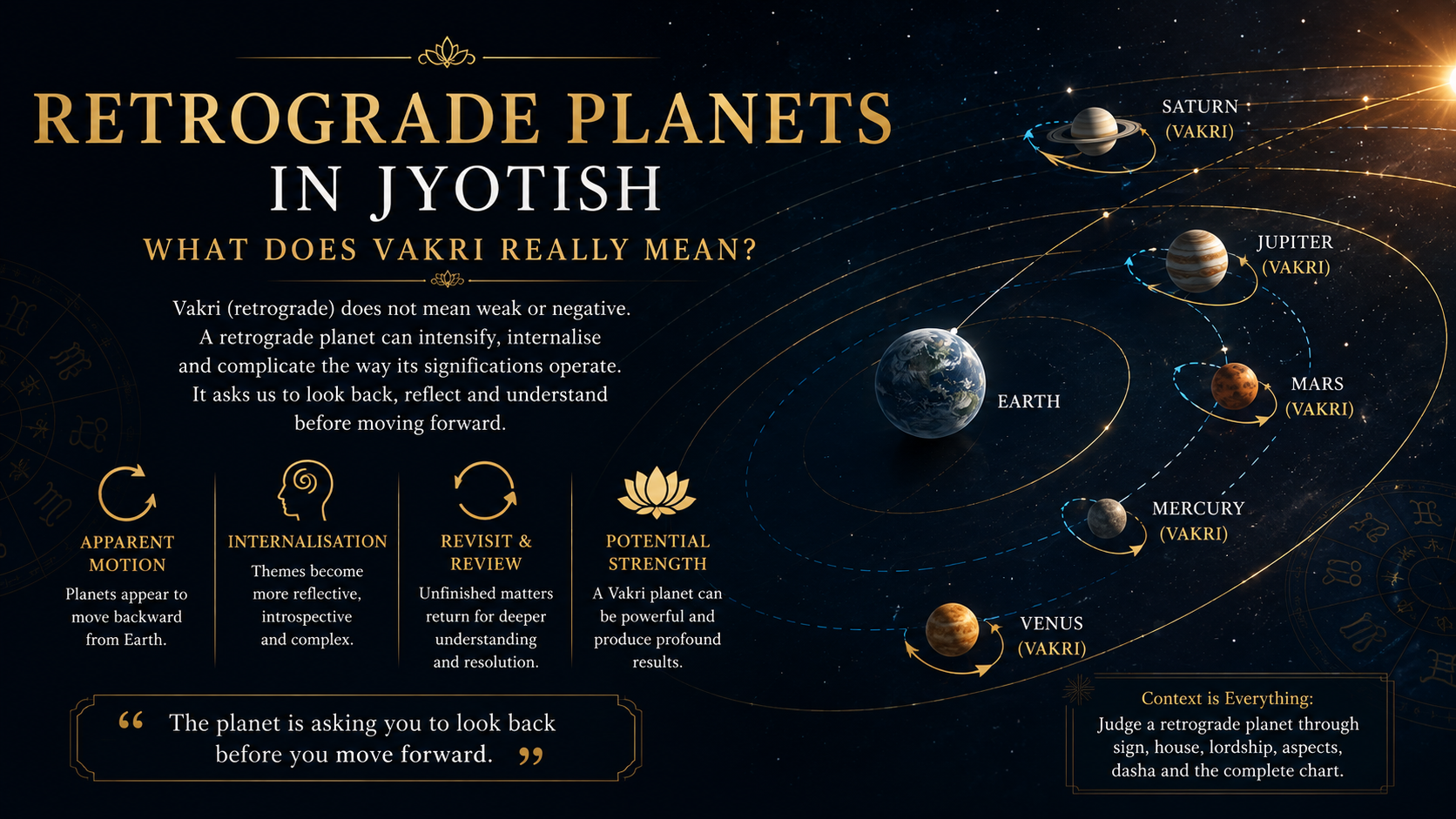
This connects directly with our previous discussion of Vakri Grahas.
A retrograde planet still casts its traditional aspects.
Retrogression does not erase Drishti.
Instead, it modifies the way the planet itself may operate.
Suppose Saturn is retrograde and aspects the 10th house.
The Saturnian themes of responsibility, work and structure remain.
But the retrograde condition may make those themes more reflective, repetitive or unconventional.
This is why multiple chart factors must be integrated.
Drishti Is Not a Standalone Prediction
If there is one rule worth remembering, it is this:
Never make a major prediction from one aspect alone.
A Jupiter aspect does not guarantee success.
A Saturn aspect does not guarantee failure.
A Mars aspect does not guarantee conflict.
A Venus aspect does not guarantee marriage.
Astrology becomes meaningful when multiple independent factors converge.
When the same theme appears repeatedly through different parts of the chart, confidence in the interpretation increases.
The Principle of Repetition
One of the most useful principles in Jyotish is repetition.
Suppose a person's career appears connected with:
The 10th lord.
The 10th house.
A strong planetary influence on the 10th.
The Dasha.
The Navamsha or relevant divisional chart.
And the transit.
Then the career theme becomes much stronger.
One aspect alone is weak evidence.
Multiple converging indications are stronger.
This is how responsible astrological judgement is developed.
What Drishti Teaches Us About Jyotish
Drishti teaches a larger lesson.
Everything in a horoscope is connected.
A planet can influence something without occupying it.
A house can be activated without containing a planet.
A planet can influence another planet from across the zodiac.
This means that the chart cannot be read simply by looking at occupied houses.
Empty houses matter.
Their lords matter.
Their aspects matter.
Their significators matter.
Nothing is truly "empty" in a horoscope.
Final Thoughts
Drishti is one of the foundations of Jyotish.
The word means sight.
And that is an excellent metaphor.
A planet does not merely occupy a place.
It looks.
It influences.
It creates relationships.
The classical planets all cast a 7th aspect, while Mars, Jupiter and Saturn have additional special aspects.
Mars sees the 4th and 8th.
Jupiter sees the 5th and 9th.
Saturn sees the 3rd and 10th.
But memorising these numbers is not the real skill.
The real skill is understanding what happens when a particular planet looks at a particular house.
A strong Mars may give the courage to act.
A difficult Mars may create conflict.
A strong Saturn may create endurance.
A difficult Saturn may create excessive restriction.
A strong Jupiter may provide wisdom and expansion.
An afflicted Jupiter may exaggerate.
The aspect does not exist in isolation.
The planet matters.
The house matters.
The sign matters.
The lordship matters.
The strength matters.
The Dasha matters.
The rest of the horoscope matters.
That is why good Jyotish cannot be reduced to:
"Jupiter aspects this house, so good."
Or:
"Saturn aspects this house, so bad."
The question is more sophisticated:
What is this planet seeing, and what does that planet have the capacity to do?
Once you begin asking that question, Drishti stops being a memorisation exercise.
It becomes one of the ways you learn to see the horoscope as a living network of relationships.
And perhaps that is the real lesson of Drishti.
In Jyotish, what a planet sees can matter almost as much as where it stands.
Learn Jyotish Beyond Simple Planetary Keywords
Drishti is one of the clearest examples of why Jyotish cannot be learned through isolated rules.
Knowing that Mars aspects the 4th, 7th and 8th houses is only the beginning.
The real skill lies in understanding the planet's strength, lordship, dignity, house placement and the condition of the house receiving its aspect.
At Futureye, we focus on learning astrology as an interpretive discipline—with context and judgement rather than mechanical predictions.
Explore Futureye's astrology programs and learn how to interpret planetary relationships systematically.
About Futureye
Futureye is a practitioner-focused learning platform for serious students of astrology and occult sciences.
Our programs cover:
- Vedic Astrology
- KP Astrology
- Prashna Shastra
- Palmistry
- Tarot
- Numerology
- AI + Occult
Don't just learn astrology. Learn how to interpret it.
Suggested Internal Links
- Retrograde Planets in Jyotish: What Does Vakri Really Mean?
- Understanding Nakshatras in Jyotish
- The 12 Houses in Vedic Astrology
- The Moon in Vedic Astrology: Understanding Chandra
- Karma and Free Will in Vedic Astrology
- Panchang Is More Than a Calendar
- How to Read a Birth Chart: A Structured Approach to Jyotish
Want to understand how planetary aspects actually work in a complete horoscope?
Explore Futureye's astrology programs and learn to interpret Drishti through planets, houses, lordship, strength and timing—not through isolated rules.
Ready to Learn the Secret Vidya?
Live cohort-based occult mastery — Vedic Astrology, Prashna Shastra, KP, Palmistry, Numerology, Tarot. Taught by Kushal Agarwal, ICAS faculty, with an AI practice agent that drills you on weak topics until they become second nature.
Or reach us at: info@thefutureye.com · +91 6290 273 797