Janmashtami: Why Krishna Was Born at Midnight and What His Birth Means in Jyotish
On Friday, September 4, 2026, millions of devotees across India and around the world will observe Krishna Janmashtami.
Temples will remain open late into the night.
Devotees will fast.
Bhajans and kirtans will continue for hours.
Stories from Krishna's life will be recited.
A small image of Krishna will be placed in a cradle.
And at midnight, the atmosphere will change.
Conches will sound.
Bells will ring.
The doors of the sanctum will open.
And devotees will celebrate the appearance of Krishna.
But why midnight?
Why the eighth Tithi?
Why Rohini Nakshatra?
And why does the story of Krishna begin in a prison?
These are not merely details of a religious festival.
They form a symbolic framework through which Indian tradition presents one of its most important ideas:
Dharma can emerge even in the darkest circumstances.
Janmashtami therefore is not simply a celebration of Krishna's birth.
It is a meditation on darkness and light, bondage and freedom, fear and courage, action and surrender, and ultimately the relationship between human choice and Dharma.
When Is Janmashtami in 2026?
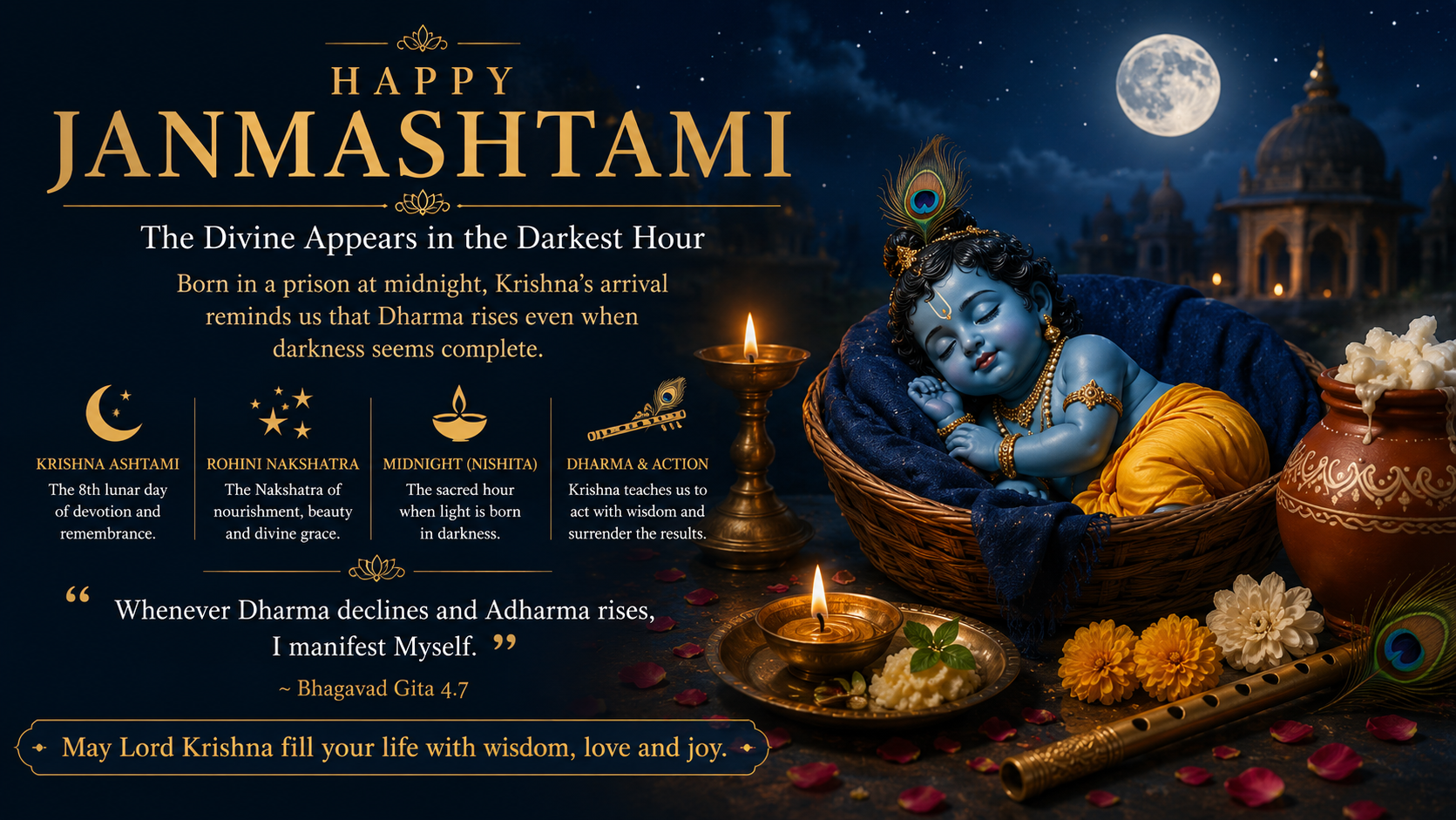
Krishna Janmashtami will be observed on Friday, September 4, 2026.
According to the 2026 Panchang calculations, Krishna Ashtami Tithi begins at approximately 2:25 AM on September 4 and ends shortly after midnight on September 5.
Rohini Nakshatra begins at approximately 12:29 AM on September 4 and continues until around 11:04 PM.
The Nishita period, the traditional midnight period associated with Krishna's appearance, falls around midnight between September 4 and 5. Exact timings vary by location. :contentReference[oaicite:1]{index=1}
This distinction matters.
Hindu festivals are determined through the Panchang.
The Gregorian date tells us which day appears on the civil calendar.
The Tithi, Nakshatra and local sunrise and midnight determine the traditional observance.
What Is Janmashtami?
Janmashtami commemorates the appearance of Lord Krishna, traditionally regarded as an avatar of Vishnu and, in several Vaishnava traditions, the Supreme Personality of Godhead.
The word itself is straightforward.
"Janma" means birth.
"Ashtami" refers to the eighth lunar day.
Krishna is said to have appeared on the eighth Tithi of the dark fortnight.
The festival therefore carries the name Janmashtami because of its connection with Krishna's appearance on Ashtami.
But Krishna's "birth" is understood differently from an ordinary human birth in Vaishnava theology.
The Bhagavad Gita describes Krishna's birth and actions as divine.
This is why many devotional traditions use the word appearance rather than simply birth.
The distinction is philosophical.
A human being is born into circumstances.
Krishna, according to the devotional tradition, chooses to appear within them.
Krishna Was Born in a Prison
The circumstances of Krishna's appearance are extraordinary.
His parents, Devaki and Vasudeva, were imprisoned by Devaki's brother, Kamsa.
A prophecy had warned Kamsa that Devaki's eighth son would be responsible for his death.
Terrified by the prophecy, Kamsa imprisoned the couple.
Their first children were killed.
And then came the eighth child.
Krishna.
He appeared at midnight.
The circumstances could hardly have been darker.
A prison.
A tyrannical ruler.
Fear.
Death.
A helpless family.
And yet this is where Krishna appears.
That setting is not incidental.
It is one of the central symbols of Janmashtami.
Why Does Krishna Appear at Midnight?
Midnight is the darkest point of the night.
It is also the transition between one day and another.
That makes it symbolically powerful.
Krishna's appearance at midnight can therefore be read as a profound metaphor:
Light does not always appear after darkness has disappeared.
Sometimes it appears within darkness itself.
This is an important distinction.
We often imagine that life must first become peaceful before transformation can begin.
Krishna's story suggests otherwise.
Transformation can begin in the middle of crisis.
Courage can emerge while fear is still present.
Dharma can be restored while disorder still surrounds us.
Midnight and the Nishita Period
The traditional midnight period is known as Nishita Kaal.
It is the period around the middle of the night and is particularly significant for Janmashtami worship.
This is why many devotees remain awake until midnight.
The fast.
The prayers.
The chanting.
The reading.
The anticipation.
All of it builds toward the moment associated with Krishna's appearance.
The ritual therefore mirrors the story itself.
The devotee moves through darkness toward a moment of revelation.
Why Is Krishna Associated With Rohini Nakshatra?
One of the most interesting astrological details surrounding Krishna's traditional birth is Rohini Nakshatra.
Traditional accounts associate Krishna's birth with Rohini.
Rohini is the fourth Nakshatra in the classical 27-Nakshatra system and lies within Taurus in sidereal Jyotish.
It is ruled by the Moon.
This creates a fascinating connection between Krishna and Chandra.
The Moon represents the mind.
Rohini is traditionally associated with fertility, growth, beauty, attraction and manifestation.
Its symbolism is strongly connected with nourishment and the creative force of life.
This makes Rohini a particularly interesting Nakshatra for the appearance of Krishna.
Krishna and the Moon
The Moon has a special place in Krishna symbolism.
Krishna's childhood is filled with imagery of Vrindavan, cows, music, nature, affection and the emotional intimacy of relationships.
These are all themes that resonate naturally with the lunar principle.
The Sun represents illumination.
The Moon reflects illumination.
The Sun can be associated with identity, authority and consciousness.
The Moon represents receptivity, emotion, memory and experience.
Krishna's teaching does not ask us to destroy the emotional mind.
Instead, the Bhagavad Gita repeatedly addresses the mind as something that must be understood, trained and directed.
That makes the lunar symbolism particularly interesting.
Rohini and the Idea of Attraction
The word Rohini is associated with growth and rising.
In Jyotish symbolism, Rohini is often connected with fertility, beauty, creativity, attraction and material manifestation.
This is worth remembering when thinking about Krishna.
Krishna is one of the most attractive figures in Indian religious literature.
His flute.
His childhood.
His relationships.
His humour.
His beauty.
His wisdom.
His ability to attract people toward him.
Even the name Krishna is traditionally interpreted in devotional traditions as relating to one who attracts.
This does not mean Rohini "caused" Krishna's personality.
Rather, the Nakshatra provides a symbolic language through which devotees and astrologers interpret the circumstances associated with his appearance.
The Eighth Tithi and Transformation
Why the eighth day?
Ashtami has a distinctive place in Hindu sacred calendars.
It is the eighth Tithi.
It occurs in both the waxing and waning halves of the lunar cycle.
Krishna's Janmashtami is associated with Krishna Paksha Ashtami, the eighth day of the dark fortnight.
The Moon is decreasing in visible illumination.
Again, the symbolism is striking.
Krishna appears when the Moon is moving toward darkness.
The story therefore combines:
Dark fortnight.
Midnight.
Prison.
Fear.
And divine appearance.
The visual language is unmistakable.
Something luminous is appearing in a period of darkness.
Krishna and Dharma
The most important reason Krishna appears, according to the Bhagavad Gita, is connected with Dharma.
In the famous passage of the Gita, Krishna describes his recurring manifestation when Dharma declines and disorder rises.
This is one of the foundational ideas behind the festival.
Krishna does not appear merely to perform miracles.
He appears to restore balance.
But there is an important point here.
Dharma is not simply "good versus evil."
Dharma is about right order.
Right action.
Right responsibility.
Right conduct within circumstance.
And that is why Krishna's life becomes so important to Jyotish and Indian philosophy.
He does not teach a single formula for every situation.
He teaches discernment.
Krishna's Greatest Teaching Is Not About Escaping Action
The Bhagavad Gita is often remembered as a spiritual text.
But it begins with a crisis of action.
Arjuna stands on the battlefield.
He does not want to fight.
He is emotionally overwhelmed.
He sees family members, teachers and friends on both sides.
His problem is not lack of courage.
His problem is uncertainty about Dharma.
What should he do?
Krishna does not simply say:
"Follow your emotions."
He does not simply say:
"Do what society expects."
He takes Arjuna through a philosophical examination of action, duty, knowledge, desire, attachment, meditation and devotion.
The battlefield becomes a classroom.
The Meaning of Nishkama Karma
One of Krishna's most influential teachings is the idea of Nishkama Karma.
Action should be performed without attachment to its fruits.
This does not mean:
"Do not care about results."
It means:
Do what is yours to do.
Perform the action properly.
Do not make your entire psychological stability dependent upon the outcome.
This is an extraordinarily practical idea.
A student can apply it to examinations.
An entrepreneur can apply it to business.
An athlete can apply it to competition.
A professional can apply it to work.
A person can act with full effort while recognising that the final outcome is never entirely under individual control.
Krishna and Free Will
This creates an interesting connection with the question of free will.
If Karma influences circumstances, what freedom remains?
Krishna's teaching suggests that action still matters.
We may not control the entire field of circumstances.
But we have responsibility for how we act within that field.
This is one of the most useful ways to think about Karma.
Karma does not have to mean fatalism.
It can instead mean:
Circumstances may be given. Response remains meaningful.
This is particularly relevant to Jyotish.
What Does Astrology Actually Do?
A horoscope can describe tendencies, circumstances and periods.
But it should not be treated as a prison.
If astrology were simply a statement that everything is predetermined, there would be little reason for wisdom.
Krishna's teaching gives a different perspective.
Understand your situation.
Understand your nature.
Understand your responsibilities.
Then act.
That is much closer to the spirit of serious Jyotish.
Krishna as the Charioteer
One of the most powerful images of Krishna is not Krishna as king.
It is Krishna as charioteer.
He sits in front of Arjuna.
He guides.
He does not fight the battle for Arjuna.
This is a profound distinction.
A guide does not eliminate the student's responsibility.
A teacher does not perform the student's work.
A counsellor does not live another person's life.
Krishna gives knowledge.
Arjuna must act.
That relationship between guidance and responsibility is central to the Gita.
The Chariot as a Metaphor
The chariot itself has become a powerful metaphor in Indian thought.
Arjuna represents the individual facing confusion.
Krishna represents higher wisdom and guidance.
The battlefield represents life and its conflicts.
The chariot moves only when action occurs.
Knowledge without action remains incomplete.
Action without wisdom becomes dangerous.
The two must work together.
This is one reason Krishna remains such a compelling figure for students of astrology.
Jyotish can describe the field.
But the person still has to drive.
Krishna's Childhood Is Completely Different
There is another fascinating dimension to Krishna.
The Krishna of the Bhagavad Gita is a philosopher, strategist and statesman.
The Krishna of Vrindavan is playful.
He steals butter.
He plays the flute.
He runs through the village.
He plays with his friends.
He teases the Gopis.
He is adored by Yashoda.
These two images appear radically different.
But they belong to the same Krishna.
This is important.
Indian tradition does not always insist that the divine must be serious.
Joy can be spiritual.
Play can be sacred.
Love can be a path.
Why Is Krishna Called Makhan Chor?
The image of Krishna stealing butter is one of the most beloved aspects of his childhood.
At the literal level, it is a playful childhood story.
At the devotional level, it becomes symbolic.
Butter is something refined from milk.
It can therefore be interpreted as something precious hidden within the ordinary.
The child Krishna "steals" what is most precious.
Devotional traditions often reinterpret these stories as expressions of divine intimacy.
The devotee does not simply fear God.
The devotee loves God.
That is one of Krishna's distinctive contributions to Indian devotional culture.
From Fear to Love
Kamsa represents fear.
He knows Krishna is destined to destroy him.
His relationship with Krishna is therefore defined by anxiety.
Vrindavan represents something completely different.
Krishna is loved as a child.
People run toward him.
They worry about him.
They laugh with him.
They complain about him.
They miss him.
The same divine figure produces completely different relationships depending on the consciousness of the person encountering him.
This is a profound psychological insight.
We can relate to the sacred through fear.
Or through love.
Krishna and Bhakti
This leads directly to Bhakti.
Bhakti is devotion.
But devotion is not merely ritual.
It is relationship.
Krishna's traditions allow people to relate to him through different emotional modes.
As a child.
As a friend.
As a beloved.
As a teacher.
As a guide.
As the divine.
This emotional range is one reason Krishna became so central to Bhakti traditions across India.
Why Do Devotees Fast on Janmashtami?
Fasting is a common Janmashtami practice.
Some devotees observe a strict fast.
Others take fruits or milk.
Some observe a waterless fast.
Practices differ according to tradition, health and personal capacity.
The deeper purpose is not simply hunger.
Fasting creates intentional restraint.
The devotee reduces ordinary consumption and redirects attention toward prayer, remembrance and contemplation.
It also creates anticipation.
The entire day builds toward midnight.
The ritual therefore turns waiting itself into a devotional practice.
Why Do People Stay Awake at Night?
The night vigil is closely connected with the traditional account of Krishna's midnight appearance.
But staying awake also changes the experience of the festival.
Instead of treating Janmashtami like an ordinary daytime celebration, the devotee remains conscious through the night.
The hours become a period of chanting, reading, singing and contemplation.
And then comes midnight.
The birth is celebrated.
The fast may be broken according to the practitioner's tradition.
The baby Krishna is placed in a cradle.
The atmosphere changes from anticipation to joy.
Nandotsav: The Celebration After Birth
The day following Janmashtami is associated with Nandotsav, the celebration of Krishna's arrival in Gokul.
The contrast is beautiful.
Janmashtami is the midnight of crisis.
Nandotsav is the morning of celebration.
The child who was born in a prison is now surrounded by joy.
This movement from fear to celebration is central to Krishna's story.
From Mathura to Gokul
Immediately after Krishna's appearance, Vasudeva carries the infant across the Yamuna to Gokul, where he is raised by Nanda and Yashoda.
This movement is essential to Krishna's childhood story.
Mathura represents danger.
Gokul represents simplicity.
The palace and prison disappear.
The divine child becomes part of village life.
This is where Krishna's childhood unfolds.
Cows.
Flutes.
Friends.
Trees.
Rivers.
Butter.
Festivals.
Love.
The divine enters the ordinary.
Krishna and the Yamuna
The journey across the Yamuna is another enduring image.
Vasudeva carries the newborn Krishna through the night.
The river is swollen.
The circumstances are dangerous.
Yet the journey succeeds.
Symbolically, the river can be understood as another boundary.
Vasudeva moves from captivity toward freedom.
From fear toward safety.
From Mathura toward Gokul.
The story therefore contains a recurring movement:
Bondage → movement → freedom.
Krishna and the Prison Within
This idea can be brought into modern life.
Most people are not literally imprisoned.
But people can become psychologically imprisoned.
Fear.
Addiction.
Anger.
Social expectations.
Ego.
Past trauma.
The need for approval.
Attachment to identity.
These can become invisible prisons.
Krishna's birth in a physical prison therefore provides a powerful metaphor.
Sometimes the first step toward freedom is recognising the prison.
The Darkness Is Part of the Story
This is perhaps the most important point.
Janmashtami does not begin with a bright sky.
It begins at night.
Krishna does not appear after Kamsa has been defeated.
He appears while Kamsa is still powerful.
The danger has not disappeared.
The circumstances have not yet changed.
Yet something has changed.
Hope has appeared.
That is a powerful spiritual idea.
You do not always need the entire problem to disappear before taking the next step.
Krishna and the Meaning of Hope
Hope is often misunderstood as optimism.
But Krishna's story suggests something stronger.
Hope is not:
"Everything will be easy."
Hope is:
"There is still a path forward."
Vasudeva still has to cross the river.
The child still has to be protected.
Kamsa still has to be confronted.
Dharma still has to be restored.
The appearance of Krishna does not eliminate responsibility.
It creates the possibility of meaningful action.
Janmashtami Through the Lens of Jyotish
For Jyotish students, Janmashtami is especially interesting because the traditional birth symbolism combines several important factors:
Krishna Paksha
The waning Moon.
Ashtami
The eighth Tithi.
Rohini
A Moon-ruled Nakshatra.
Midnight
The Nishita period.
The combination creates a symbolic environment dominated by the lunar principle.
The Moon is associated with mind, emotion, memory and receptivity.
And Krishna's teachings repeatedly return to the question of the mind.
Krishna and the Mind
The Bhagavad Gita does not pretend that the mind is easy to control.
Arjuna himself says that the mind is restless and difficult to restrain.
Krishna acknowledges the difficulty.
But he does not say that control is impossible.
He recommends practice and detachment.
This is one of the most practical psychological teachings in the Gita.
The mind does not become disciplined in one day.
It becomes disciplined through repetition.
Attention.
Practice.
And conscious redirection.
Why Krishna's Flute Matters
The flute is one of Krishna's most recognisable symbols.
A flute is hollow.
It produces music precisely because there is empty space inside it.
This creates a beautiful devotional metaphor.
The more the individual becomes filled with ego, the less space there is for divine direction.
The flute does not create music by itself.
It becomes an instrument.
This is why the flute has become such a powerful symbol of surrender in Krishna Bhakti.
Not passivity.
But availability.
Krishna and the Ego
The Gita repeatedly challenges attachment to the ego.
The problem is not simply having an identity.
The problem is becoming completely identified with:
"I am the doer."
"I am the owner."
"I am the achiever."
"I control the outcome."
Krishna's teaching introduces a different relationship with action.
Act fully.
But recognise that you are part of a larger order.
This can reduce the psychological burden of trying to control everything.
The Meaning of Krishna's Name
The name Krishna is traditionally interpreted in devotional traditions as "all-attractive."
This is not merely a statement about physical beauty.
Krishna attracts through many dimensions.
Wisdom.
Playfulness.
Courage.
Beauty.
Compassion.
Strategy.
Love.
Detachment.
The same figure can be a mischievous child and a profound philosopher.
That complexity is part of Krishna's appeal.
Krishna Is Not a One-Dimensional God
Krishna cannot easily be reduced to one quality.
He is:
Child.
Friend.
Lover.
Warrior.
Strategist.
Teacher.
King.
Charioteer.
Philosopher.
Divine.
This is why Krishna's story is so rich for contemplation.
Different stages of life may reveal different aspects.
A child may see the playful Krishna.
A person in love may see another Krishna.
A person facing a difficult decision may discover the Krishna of the Gita.
A person studying Dharma may discover the strategist.
The deity remains the same.
The relationship changes.
What Janmashtami Can Teach Us Today
The modern relevance of Janmashtami is not difficult to find.
We live with uncertainty.
Fear.
Polarisation.
Information overload.
Career pressure.
Relationship difficulties.
Questions about purpose.
The Gita does not promise a life without conflict.
Instead, Krishna teaches Arjuna how to act within conflict.
That may be more useful.
Life will not always become peaceful before we have to make a decision.
Sometimes we have to find clarity while the battlefield is still around us.
The Real Meaning of "Victory of Good Over Evil"
Janmashtami is often described as the triumph of good over evil.
That is true at one level.
But the deeper lesson is more subtle.
Kamsa's greatest problem is not simply that he is cruel.
It is that he is ruled by fear.
His fear of prophecy drives his actions.
He tries to control destiny by killing children.
And in doing so, he creates more suffering.
This is a powerful lesson.
Fear-driven control often creates the very disorder we are trying to prevent.
Krishna and Destiny
Kamsa knows the prophecy.
He tries to defeat it.
He fails.
The story therefore raises the question of destiny.
Can destiny be escaped?
Can human beings change outcomes?
Indian philosophy does not offer one simplistic answer.
There is Karma.
There is Dharma.
There is choice.
There are circumstances.
And there is divine order.
Krishna's teaching to Arjuna does not say:
"Do nothing because destiny has already decided everything."
It says:
Act.
That is significant.
The Astrology Lesson
For students of Jyotish, perhaps the most important lesson from Krishna is this:
A horoscope is not a substitute for action.
The chart describes a field of possibilities, tendencies and circumstances.
The native still has to act within that field.
The same Mars can become courage or aggression.
The same Saturn can become discipline or fear.
The same Moon can become sensitivity or instability.
Interpretation requires context.
And choice still matters.
What Should We Do on Janmashtami?
Traditional observances vary.
Devotees may:
Observe a fast.
Visit a Krishna temple.
Read the Bhagavad Gita or Srimad Bhagavatam.
Chant Krishna's names.
Sing bhajans and kirtans.
Perform Abhisheka.
Decorate a Krishna murti.
Keep a midnight vigil.
Offer food.
Perform Aarti.
The important point is not to turn devotion into a checklist.
The ritual should create remembrance.
Janmashtami as a Day of Inner Birth
Perhaps the most interesting way to approach Janmashtami is metaphorically.
Krishna is born in a prison.
What if the prison is also within us?
What is imprisoning you?
Fear?
Ego?
Attachment?
Anger?
The need for control?
The inability to forgive?
The need for approval?
Then ask:
What would it mean for Krishna to be "born" there?
Perhaps it means allowing wisdom to appear inside the very place where confusion has been strongest.
That is a much deeper interpretation of Janmashtami.
The Birth of Clarity
We often wait for circumstances to become perfect before making a change.
But Krishna's story suggests that clarity can arise before circumstances change.
The prison remains.
The danger remains.
The night remains.
Yet Krishna appears.
That is the essential symbolism.
The inner transformation can begin before the outer transformation is complete.
Final Thoughts
Krishna Janmashtami will be observed on Friday, September 4, 2026. The festival is associated with Krishna Ashtami and the Nishita period around midnight, while the traditional birth narrative connects Krishna with Rohini Nakshatra. Exact timings vary by location. :contentReference[oaicite:2]{index=2}
But Janmashtami is more than the celebration of a divine birth.
It is a story about darkness.
A prison.
Fear.
Prophecy.
Courage.
Movement.
Freedom.
And finally, Dharma.
Krishna does not appear in a palace.
He appears in a prison.
He does not wait for the world to become peaceful.
He appears while danger still surrounds him.
And that may be the most relevant lesson of Janmashtami.
We often imagine that transformation will begin when our circumstances improve.
Krishna's story suggests the opposite.
Sometimes transformation is what allows us to move through the circumstances.
The battlefield does not disappear for Arjuna.
Krishna teaches him how to face it.
The prison does not disappear immediately for Vasudeva.
He still has to carry the child across the Yamuna.
The darkness does not disappear before Krishna appears.
He appears within it.
That is why Janmashtami continues to matter.
Not simply because Krishna was born.
But because his story reminds us that Dharma, clarity and hope can emerge even when the circumstances around us appear to say otherwise.
Perhaps the most meaningful way to celebrate Janmashtami is therefore not merely to wait for midnight.
It is to ask:
Where in my own life is Krishna still waiting to be recognised?
Where am I imprisoned by fear?
Where am I confusing control with responsibility?
Where am I avoiding an action because I am afraid of its result?
Where do I need greater clarity?
And what would it mean to act according to Dharma even before the outcome becomes certain?
Krishna's answer to Arjuna was not escape.
It was action guided by wisdom.
And perhaps that is the message Janmashtami leaves with us:
**Find clarity in the darkness.
Act without surrendering to fear.
Do what Dharma asks of you.
And let the result belong to something larger than the ego.**
Learn Jyotish Beyond Simple Planetary Keywords
Janmashtami also offers a fascinating window into the relationship between Tithi, Nakshatra, the Moon, Dharma and the symbolic language of Jyotish.
At Futureye, we focus on learning astrology as an interpretive discipline—not simply memorising planetary keywords or making isolated predictions.
Explore Futureye's astrology programs and learn how to interpret Jyotish with structure, context and judgement.
About Futureye
Futureye is a practitioner-focused learning platform for serious students of astrology and occult sciences.
Our programs cover:
- Vedic Astrology
- KP Astrology
- Prashna Shastra
- Palmistry
- Tarot
- Numerology
- AI + Occult
Don't just learn astrology. Learn how to interpret it.
Sources
Drik Panchang — Krishna Janmashtami 2026: https://www.drikpanchang.com/dashavatara/lord-krishna/krishna-janmashtami-date-time.html
ISKCON — Festivals and Janmashtami: https://iskcon.org/festival/
ISKCON Bangalore — Why Do We Celebrate Sri Krishna Janmashtami?: https://www.iskconbangalore.org/blog/why-do-we-celebrate-sri-krishna-janmashtami/
BAPS — Janmashtami: https://www.baps.org/cultureandheritage/Traditions/AnnualCelebrationsandFestivals/Janmashtami.aspx
Suggested Internal Links
- Onam and Mahabali: The Deeper Meaning of a King Who Was Asked to Give Everything Away
- Raksha Bandhan: The Deeper Meaning of a Thread That Was Never Just About Protection
- The Fourth Shravan Somwar: Why Monday Holds a Special Place in Shiva Worship
- Mangala Gauri Vrat: Why Tuesdays of Shravan Are Dedicated to Gauri
- Panchang Is More Than a Calendar
- Karma and Free Will in Vedic Astrology
- Understanding Nakshatras in Jyotish
- The Moon in Vedic Astrology: Understanding Chandra
Want to understand how Jyotish connects Tithi, Nakshatra, the Moon, Dharma and the deeper patterns of human life?
Explore Futureye's astrology programs and learn how to interpret these connections systematically—not through isolated planetary keywords.
Ready to Learn the Secret Vidya?
Live cohort-based occult mastery — Vedic Astrology, Prashna Shastra, KP, Palmistry, Numerology, Tarot. Taught by Kushal Agarwal, ICAS faculty, with an AI practice agent that drills you on weak topics until they become second nature.
Or reach us at: info@thefutureye.com · +91 6290 273 797