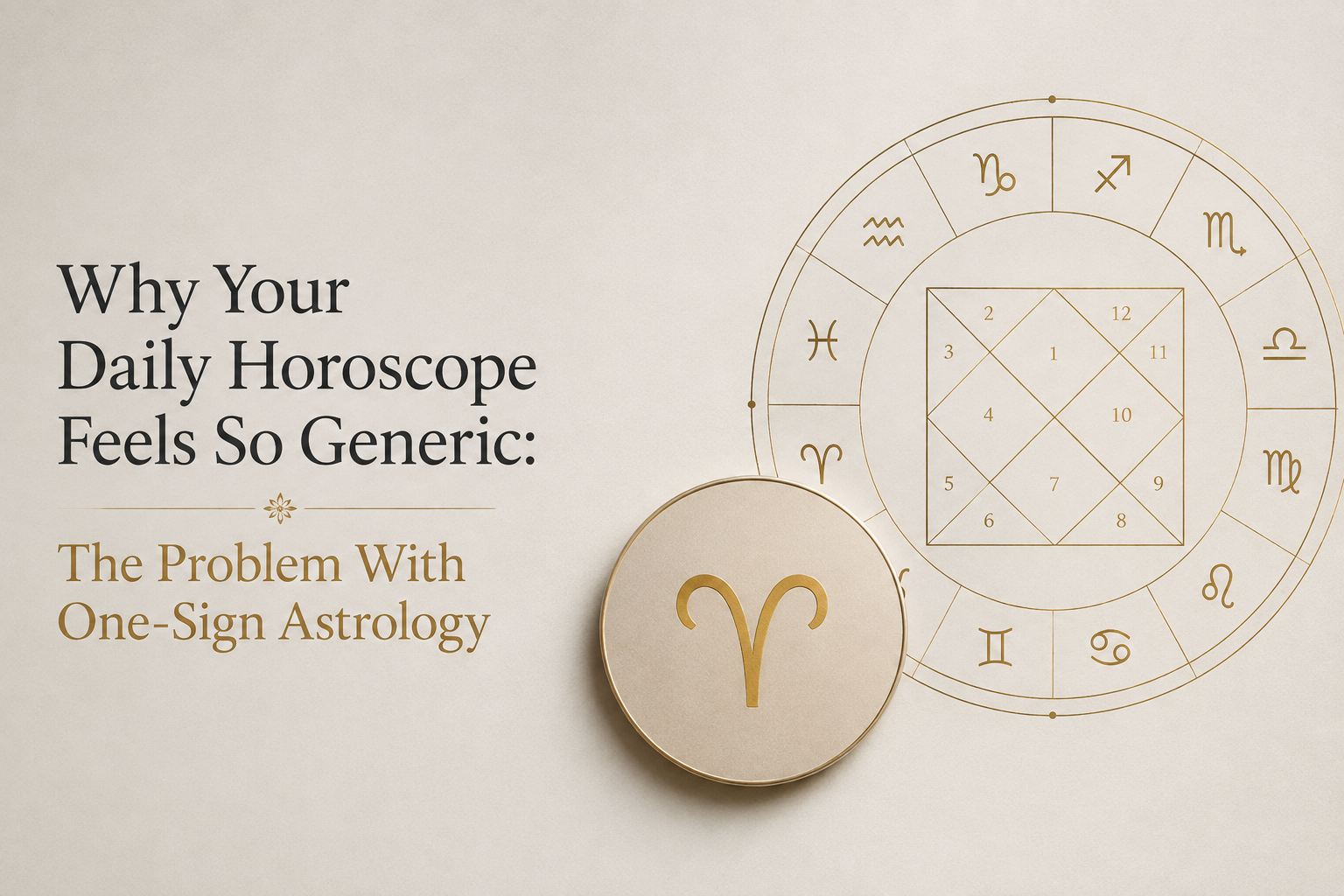
Why Does Your Daily Horoscope Sound Like It Was Written for Everyone?
Every morning, millions of people open their phones and read their horoscope.
Career may improve.
A conversation could change a relationship.
An unexpected opportunity may appear.
Be careful with expenses.
Someone from the past may return.
The language changes, but the structure is remarkably similar.
And then comes the obvious question:
If astrology is supposed to be personal, why does my horoscope sound like it could apply to millions of other people?
This is not necessarily a problem with astrology itself.
It is often a problem with how astrology is being presented.
A modern daily horoscope is usually built around a very limited amount of information. Sometimes it uses only the Sun sign. Sometimes it uses the Moon sign. In Vedic astrology, some daily predictions are based on the Moon sign or Janma Rashi.
But a complete birth chart contains far more information.
There is an Ascendant.
There are twelve houses.
There are planetary lordships.
There are planetary strengths and relationships.
There are nakshatras.
There are dashas.
There are transits.
And there is the specific arrangement of all these factors at the moment of birth.
So when a horoscope gives the same message to everyone born under one sign, what exactly is it measuring?
That is the question worth asking.
The Rise of the Daily Horoscope
Astrology publishers continue to produce enormous amounts of daily horoscope content.
On August 14, 2026 alone, major Indian publications are carrying daily horoscope predictions covering career, relationships, money, health and personal decisions for all twelve signs. :contentReference[oaicite:0]{index=0}
This tells us something important.
People clearly want astrology to help them make sense of everyday life.
The demand is real.
But popularity creates a temptation.
The easiest way to produce a daily horoscope is to divide the population into twelve groups and write a prediction for each group.
It is efficient.
It is easy to understand.
And it is easy to publish every day.
But it also creates an enormous loss of information.
Imagine taking the entire population of the world and dividing it into twelve categories.
Then attempting to describe everyone's career, relationships, finances and emotional state using twelve paragraphs.
That should immediately make us suspicious.
Twelve Signs Cannot Describe Twelve Different Lives
Suppose two people are both born with the same Moon sign.
Does that mean their careers will develop in exactly the same way?
Of course not.
One may be an entrepreneur.
Another may be a doctor.
Another may be a teacher.
Another may be unemployed.
Another may have just retired.
Their lives are shaped by different birth charts.
The Moon sign is one variable.
It cannot contain the entire horoscope.
This is why a serious student of Jyotish should learn to distinguish between a general transit indication and a personal prediction.
They are not the same thing.
So What Is the Moon Sign Actually Good For?
The Moon sign is not useless.
Far from it.
In Jyotish, the Moon has an extremely important role.
The Moon is associated traditionally with the mind, perception, emotional responsiveness and one's subjective experience.
The Janma Rashi, or Moon sign, therefore provides an important reference point for transit analysis.
This is one reason many traditional Indian horoscope systems use the Moon sign prominently.
But "important" does not mean "complete."
A Moon-sign horoscope can tell you something about how current planetary movements may interact with the lunar framework.
It cannot automatically tell you everything about:
- Career
- Marriage
- Wealth
- Property
- Children
- Education
- Foreign travel
- Spiritual development
- Health
- Business
Those questions require a much broader analysis.
Then There Is the Ascendant
The Ascendant, or Lagna, is one of the most important anchors of a Vedic birth chart.
It determines the arrangement of the twelve houses.
And houses are where life becomes specific.
The tenth house can relate to career and public responsibilities.
The seventh can relate to partnerships and marriage.
The fourth can relate to home, property and emotional foundations.
The fifth can relate to education, creativity, children and intelligence.
The eleventh can relate to gains, networks and fulfilment of ambitions.
The twelfth can relate to expenditure, isolation, foreign environments and retreat.
Now imagine a transit occurring in a particular sign.
For one Ascendant, that sign may be the tenth house.
For another, it may be the fourth.
For another, the seventh.
The planet has not changed.
The person's horoscope has.
That is why the same transit cannot reasonably produce the same prediction for everyone.
This Is Where "Rashi" Creates Confusion
There is a linguistic problem as well.
In popular astrology, "your zodiac sign" can mean different things.
Western astrology often refers to the Sun sign.
Indian astrology frequently gives considerable importance to the Moon sign.
Then there is the Ascendant.
So when someone says:
"I am a Leo."
An astrologer may reasonably ask:
"Leo according to what?"
Sun sign?
Moon sign?
Ascendant?
The answer matters.
A great deal.
This is one reason beginners can become confused when they read one horoscope based on their Sun sign and another based on their Moon sign and receive completely different predictions.
They are not necessarily contradictory.
They may simply be using different reference points.
The House Changes the Story
Consider Jupiter entering a particular sign.
A generic horoscope might say:
"Jupiter brings growth."
That sounds positive.
But growth in what?
If the transit activates the second house, the astrologer might investigate themes involving wealth, family and speech.
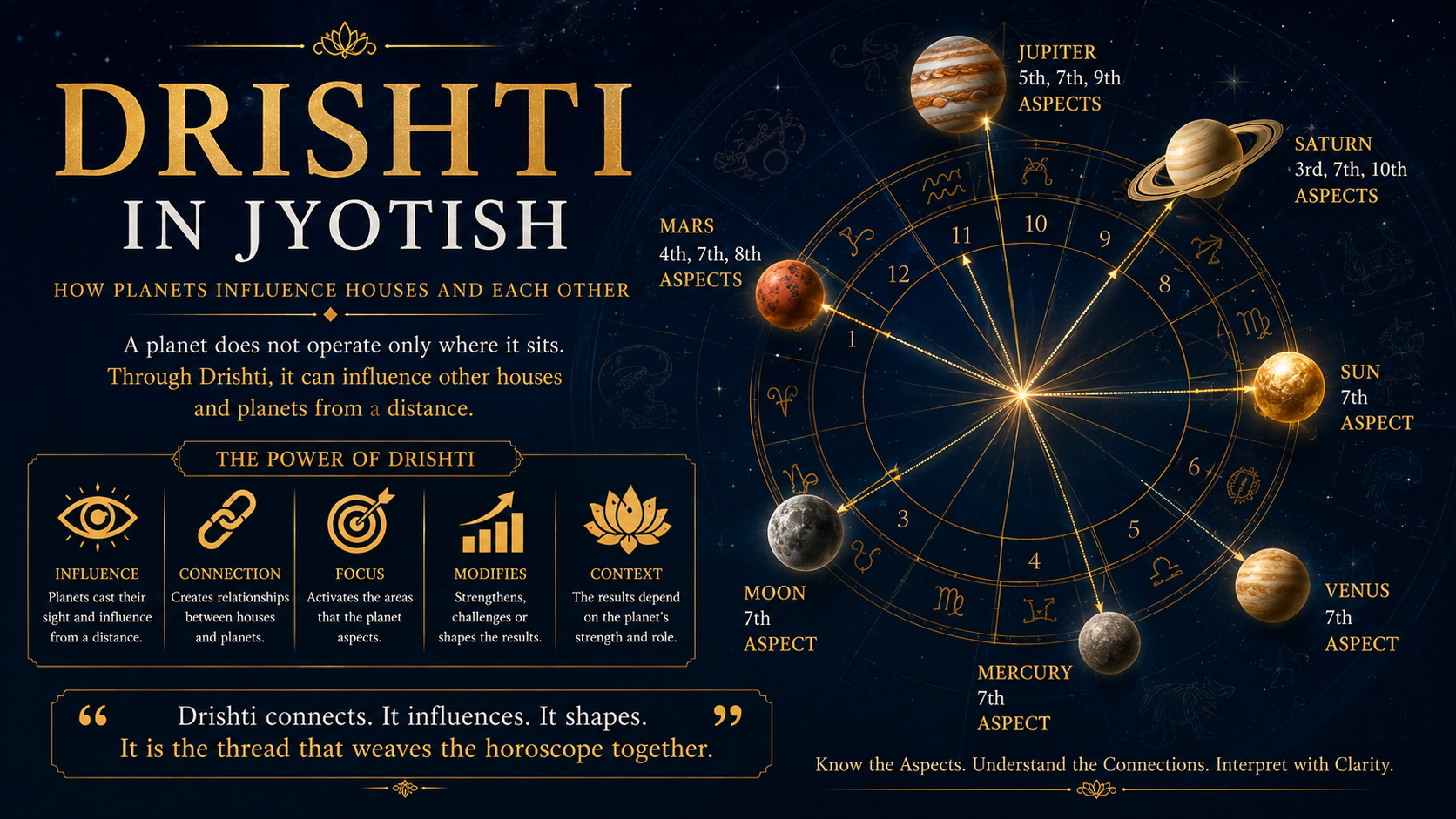
If it activates the seventh, partnerships and relationships become relevant.
If it activates the tenth, professional matters become more prominent.
If it activates the twelfth, expenditure, foreign connections or retreat may become more important.
"Jupiter brings growth" is therefore not a complete prediction.
It is only the beginning of an interpretation.
The house tells us where to look.
The natal chart tells us why that area matters.
And Then Comes Planetary Lordship
This is one of the places where serious Jyotish becomes much more interesting.
A planet does not only signify its natural meanings.
It also rules houses in a particular horoscope.
That changes the interpretation.
The same Jupiter can behave differently depending on the Ascendant because its house lordships change.
The same Saturn can become connected with completely different areas of life in different charts.
Therefore, a transit should not be judged only by:
"What does this planet naturally signify?"
The astrologer should also ask:
"What does this planet signify in this particular horoscope?"
That is the difference between generic astrology and chart-specific astrology.
Why Some Predictions Feel Uncomfortably Accurate
This raises another interesting question.
If daily horoscopes are so general, why do people sometimes find them surprisingly accurate?
There are several possible explanations.
First, many horoscope statements are deliberately broad.
"An old issue may return."
"You may receive an opportunity."
"You could feel more emotional today."
These statements have a very large range of applicability.
Second, humans naturally notice information that confirms their existing expectations.
Third, astrology sometimes uses genuine astronomical and astrological configurations as the starting point for interpretation.
A person may therefore find a broad transit description meaningful even though it is not a complete personalised reading.
The existence of this phenomenon does not prove or disprove astrology.
It simply reminds us to distinguish between general relevance and specific prediction.
What a Personal Horoscope Actually Adds
Suppose two people read the same daily horoscope:
"Career opportunities may emerge."
For Person A, the tenth lord is strongly activated by current transits and the person is running a relevant dasha.
For Person B, there is no comparable activation.
The same sentence has very different significance.
For Person A, it may deserve investigation.
For Person B, it may simply be generic horoscope language.
This is why predictive astrology depends on convergence.
One indication is rarely enough.
A stronger judgment comes when several independent factors point toward the same theme.
Dasha Is One of the Missing Pieces
This is perhaps the biggest difference between popular daily astrology and deeper Jyotish.
The dasha system introduces a timing framework.
Instead of simply asking:
"What is happening in the sky today?"
the astrologer asks:
"What planetary period is this person actually living through?"
This matters enormously.
A transit can activate a particular area of the chart.
But whether that activation becomes a major event can depend on the planetary periods operating at the time.
This gives us a much more useful model:
Natal Promise + Dasha + Transit = Predictive Context
Not:
Today's Transit = Today's Destiny
That distinction should be taught much more often.
Why Daily Horoscopes Still Have Value
This does not mean daily horoscopes are worthless.
They can be useful as:
- General transit commentary
- Cultural astrology
- A daily reflection tool
- An introduction to planetary symbolism
- A way for beginners to become familiar with astrological vocabulary
The problem begins when a general horoscope is presented as if it were equivalent to a complete personal prediction.
It isn't.
A weather forecast saying "rain is possible in the region" is not the same as knowing exactly what the weather will be at your front door.
Similarly, a transit indication is not the same thing as a personalised horoscope.
What Should You Read If You Want Better Astrology?
If you're new to Jyotish, don't necessarily stop reading daily horoscopes.
Instead, read them differently.
When you see:
"Jupiter brings career growth."
Ask:
For whom?
Which house?
Which Ascendant?
Which Moon sign?
What is the natal condition of Jupiter?
Which houses does Jupiter rule?
What dasha is operating?
Which other planets are involved?
That habit changes everything.
You stop consuming astrology.
You start analysing it.
A Simple Exercise for Astrology Students
Take today's horoscope.
Choose one prediction.
For example:
"Career opportunities may improve."
Now take ten different birth charts.
Ask:
- Which house is currently being activated?
- What is the condition of that house?
- Who rules it?
- Where is the lord placed?
- What dasha is operating?
- Is the relevant planet transiting an important natal position?
- Is Jupiter or Saturn providing additional support?
- Is there a corresponding natal promise?
You will quickly discover that the same sentence can have completely different levels of relevance.
This is one of the best ways to move from horoscope reading to actual chart interpretation.
The Future of Astrology Should Be More Personal, Not Less
Astrology is entering an interesting phase.
Artificial intelligence can generate thousands of horoscope paragraphs almost instantly.
A system can take a planetary transit and produce twelve predictions in seconds.
That makes generic astrology cheaper than ever.
But it also makes interpretation more valuable.
If anyone can generate:
"Today may bring opportunities in your career"
in two seconds, that sentence has very little differentiation.
The future belongs to systems that can explain:
Why this particular transit matters to this particular chart.
That is where technology can potentially assist astrology without replacing the astrologer's reasoning.
The machine can calculate.
The astrologer still has to interpret.
The Real Question Is Not "Does My Horoscope Work?"
Perhaps the better question is:
"What kind of horoscope am I reading?"
A twelve-sign daily horoscope is one thing.
A Moon-sign transit reading is another.
A Lagna-based transit analysis is another.
A complete natal reading incorporating dashas and transits is something else entirely.
They should not be judged as if they are the same product.
Once you understand that hierarchy, many apparent contradictions in astrology become easier to understand.
A Better Way to Read Your Daily Horoscope
The next time you open your horoscope in the morning, try this:
Step 1: Identify the reference point
Is the prediction based on your Sun sign, Moon sign or Ascendant?
Step 2: Identify the transit
Which planet is being discussed?
Step 3: Find the house
Where does that transit fall in your natal chart?
Step 4: Check the planet's role
What houses does that planet rule for you?
Step 5: Check your dasha
Is the planet connected with your current planetary period?
Step 6: Look for confirmation
Are other transits pointing toward the same theme?
Step 7: Only then interpret
This turns a five-minute horoscope habit into a genuine learning exercise.
The Problem Isn't That Astrology Is Too Complicated
It is that astrology is often made too simple.
The desire for simplicity is understandable.
People want quick answers.
Publishers want content that can be consumed quickly.
Apps want instant results.
But simplicity should not become distortion.
A map of a city is useful.
A single street name is not the city.
Likewise, a zodiac sign is part of astrology.
It is not the whole horoscope.
Final Thoughts
Your daily horoscope may feel generic because, quite literally, it is designed to speak to a large group of people.
That does not automatically make it meaningless.
But it does mean you should understand its limits.
If you want genuinely personalised Jyotish, you need more than one sign.
You need the horoscope.
You need the Ascendant.
You need the houses.
You need planetary lordships.
You need the Moon and nakshatras.
You need dashas.
You need transits.
And most importantly, you need synthesis.
The real skill of astrology is not knowing what Jupiter means.
It is knowing what Jupiter means here.
Not knowing what Saturn means.
Knowing what Saturn means in this chart, at this time, for this person.
That is the difference between reading a horoscope and reading a horoscope properly.
Ready to Go Beyond Daily Horoscopes?
If you want to learn how professional Jyotish analysis moves from generic planetary meanings to individual chart interpretation, explore the astrology programs at Futureye.
Learn how to work with the Ascendant, houses, planetary lordships, dashas, transits and predictive techniques—and understand not just what is happening, but why it matters in a particular horoscope.
Explore Futureye's astrology programs and start learning Jyotish as a practitioner.
About Futureye
Futureye is a practitioner-focused learning platform for serious students of astrology and occult sciences.
Our programs cover:
- Vedic Astrology
- KP Astrology
- Prashna Shastra
- Palmistry
- Tarot
- Numerology
- AI + Occult
Our philosophy is simple:
Don't just learn astrology. Learn how to interpret it.
Sources
- Times of India, Horoscope Today, August 14, 2026 — illustrating the current popularity of daily zodiac-based horoscope publishing.
- Economic Times, Horoscope Today, August 14, 2026 — contemporary examples of daily predictions organised around zodiac signs.
- Times of India, Weekly Panchang, August 10–16, 2026 — current planetary, festival and muhurta context for the week.
Suggested Internal Links
- How to Read a Vedic Birth Chart Step by Step
- What Is the Ascendant in Vedic Astrology?
- Moon Sign vs Ascendant: Which One Should You Follow?
- Dasha vs Transit: Which One Predicts Events?
- What Is a Nakshatra in Vedic Astrology?
- How Jupiter Transits Affect Different Houses
- How Saturn Transits Should Actually Be Read
Want to stop reading generic zodiac predictions and learn how to analyse a real birth chart?
Explore Futureye's astrology programs and learn how to turn planetary positions into structured astrological interpretation.
Ready to Learn the Secret Vidya?
Live cohort-based occult mastery — Vedic Astrology, Prashna Shastra, KP, Palmistry, Numerology, Tarot. Taught by Kushal Agarwal, ICAS faculty, with an AI practice agent that drills you on weak topics until they become second nature.
Or reach us at: info@thefutureye.com · +91 6290 273 797