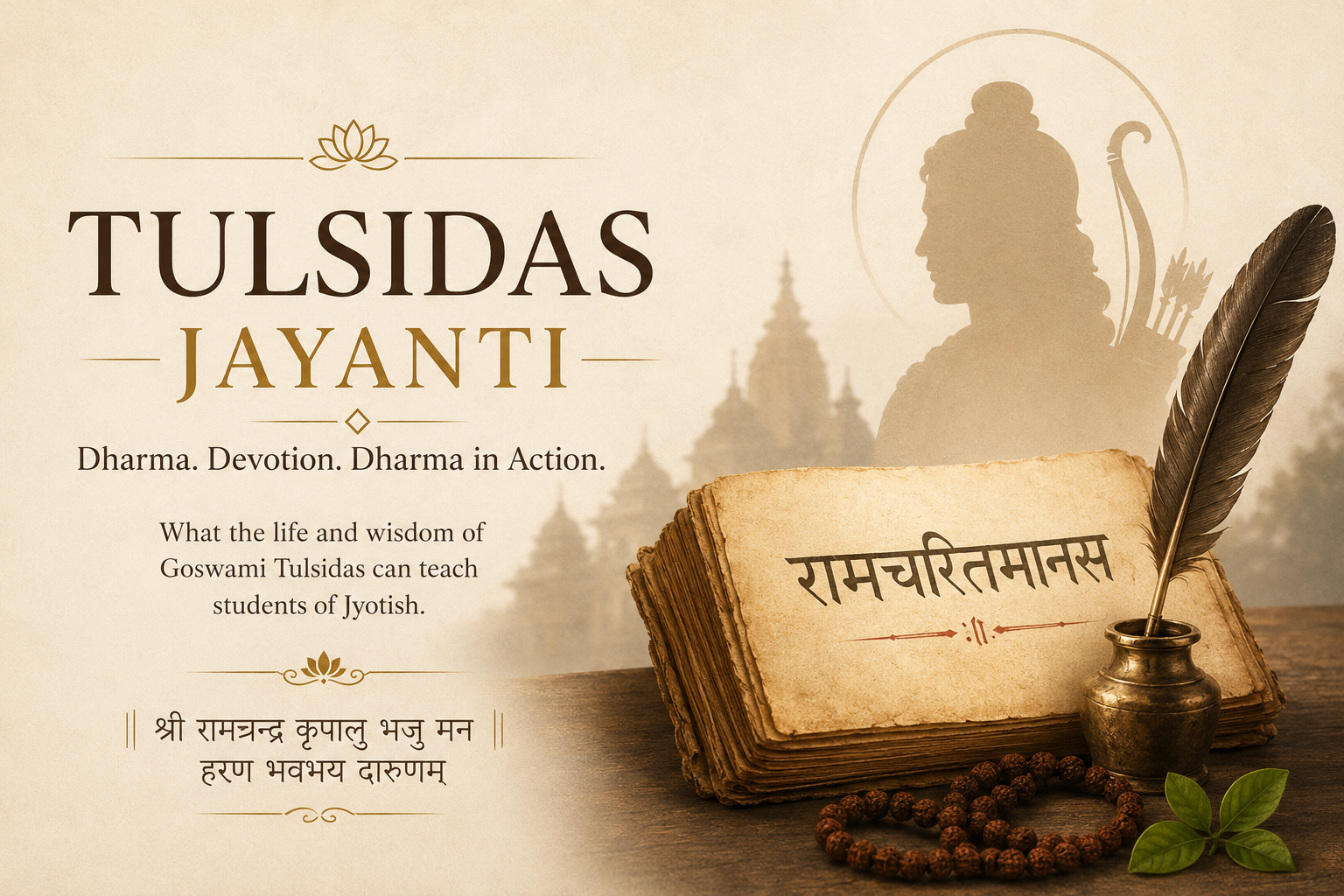
Tulsidas Jayanti: What Astrology Can Learn From the Poet Who Made Dharma Accessible
There are people who write books.
And then there are people whose words become part of the way an entire civilisation thinks.
Goswami Tulsidas belongs to the second category.
For centuries, his retelling of the Ramayana has been read, recited, sung and performed across India. The Ramcharitmanas did not merely retell the story of Rama.
It brought the story into the everyday language of ordinary people.
And that matters.
Because Tulsidas was not simply interested in telling people what Rama did.
He was interested in showing people how a human being should live.
That makes Tulsidas Jayanti particularly interesting for students of Jyotish.
Astrology is often presented as a system for predicting events.
Will I get married?
Will I get a promotion?
Will I make money?
Will I travel abroad?
When will my difficult period end?
These are legitimate questions.
But there is another question that is much harder:
What should I do with the life I have been given?
That question takes us from prediction into Dharma.
And this is where Tulsidas becomes relevant.
Who Was Tulsidas?
Goswami Tulsidas is traditionally regarded as one of the greatest poet-saints of the Bhakti tradition.
He is best known for the Ramcharitmanas, his Awadhi retelling of the Ramayana.
Rather than presenting Rama only through the formal language of Sanskrit scholarship, Tulsidas brought the story into a language that ordinary people could understand, recite and remember.
That transformation was enormous.
The Ramayana became not merely something to study.
It became something to live.
The stories of Rama, Sita, Lakshmana, Hanuman and Ravana became vehicles through which people could think about duty, loyalty, temptation, courage, sacrifice and devotion.
This is one reason Tulsidas remains relevant centuries after his time.
His subject was not merely mythology.
It was human behaviour.
Tulsidas Jayanti Falls During Shravan
Tulsidas Jayanti is traditionally observed on Shravana Shukla Saptami.
In the North Indian calendar, August 19, 2026 falls on Shravana Shukla Saptami and is observed as Tulsidas Jayanti. :contentReference[oaicite:1]{index=1}
The timing itself is interesting.
We have just spent weeks discussing Shravan as a month associated with Shiva, devotion, discipline and introspection.
Tulsidas Jayanti appears within that same lunar framework.
This reminds us that Hindu calendars are not simply lists of unrelated festivals.
Different observances sit inside larger cycles of lunar time, seasons, religious traditions and cultural memory.
The calendar itself becomes a framework for reflection.
Tulsidas Was Not Teaching Astrology
This distinction is important.
Tulsidas was not an astrologer in the sense in which the word is commonly used today.
The purpose of studying his work through the lens of Jyotish is therefore not to turn him into an astrologer.
It is to ask a different question:
What can the philosophy expressed through his work teach an astrologer about the purpose of astrology?
That is a much more interesting question.
Because the greatest danger in astrology is not always incorrect calculation.
Sometimes it is incorrect purpose.
The Problem With Astrology That Only Predicts
Imagine an astrologer tells you:
"You will face a difficult period next year."
What have you actually learned?
Perhaps you have learned something about timing.
But you still have another question:
How should I live through that period?
Suppose the astrologer instead says:
"This is a period in which responsibilities may increase. You may need patience, discipline and restraint."
Now the prediction has become guidance.
The difference is subtle but profound.
Prediction tells us what may happen.
Dharma asks what we should do.
Jyotish becomes much more meaningful when these two questions are allowed to coexist.
Rama and the Idea of Dharma
The central figure of Tulsidas's greatest work is Rama.
Rama is often described as Maryada Purushottama—the ideal embodiment of righteous conduct and disciplined living.
The important word here is Maryada.
It refers broadly to boundaries, propriety, conduct and the limits within which one should live.
That idea creates an interesting contrast with modern discussions about destiny.
We often ask:
"Is my life predetermined?"
But Dharma asks:
"Given my circumstances, what is the right action?"
These are not the same question.
You may not control every event.
But you still have to decide how you respond to the event.
That distinction is central to any serious discussion of Karma and free will.
Astrology Does Not Have to Mean Fatalism
One of the most common misunderstandings about astrology is that believing in a birth chart means believing that everything is predetermined.
But a horoscope can be approached differently.
A chart can be viewed as a description of tendencies, circumstances, capacities, pressures and timing.
It does not necessarily follow that every response to those circumstances is predetermined.
Consider a simple example.
Two people may experience the same difficult Saturn period.
One becomes bitter.
The other becomes disciplined.
One blames everyone.
The other accepts responsibility.
One becomes fearful.
The other becomes patient.
The planetary period may be the same.
The human response is not necessarily the same.
This is where Dharma enters the conversation.
Karma Is Not Simply "Good Things and Bad Things"
Karma is frequently reduced to a simplistic formula:
Do good things and good things happen.
Do bad things and bad things happen.
Reality is considerably more complicated.
Karma is fundamentally connected with action and its consequences.
Human beings act.
Actions create consequences.
Those consequences influence future circumstances.
And new circumstances create new choices.
This means life can be understood as a continuous interaction between:
Past causes, present circumstances and present choices.
Jyotish attempts to describe some of the patterns within that field.
But the existence of a pattern does not automatically eliminate agency.
Tulsidas and Bhakti
Perhaps the most important concept associated with Tulsidas is Bhakti.
Bhakti is often translated simply as devotion.
But devotion is not merely emotional attachment.
At its deepest level, Bhakti involves directing oneself toward the divine with surrender, trust and love.
This has an important implication for astrology.
If a person becomes obsessed with knowing the future, astrology can increase anxiety.
Every transit becomes frightening.
Every retrograde becomes a warning.
Every difficult dasha becomes a disaster.
But if astrology is placed within a larger spiritual framework, prediction can become secondary.
The question changes from:
"What terrible thing is going to happen to me?"
to:
"How can I meet whatever comes with greater awareness?"
That is a much healthier relationship with astrology.
Hanuman Is Another Important Part of the Tulsidas Tradition
Anyone discussing Tulsidas inevitably encounters Hanuman.
The Hanuman Chalisa, attributed to Tulsidas, has become one of the most widely recited devotional compositions associated with Hanuman.
Hanuman represents another fascinating dimension of Dharma.
He is powerful.
But his power is not centred on himself.
His strength is placed in service.
That is an important distinction.
Power without purpose becomes ego.
Power placed in service becomes Dharma.
This idea has relevance beyond religious philosophy.
It also applies to knowledge.
An astrologer can possess extraordinary technical knowledge.
But what is that knowledge being used for?
To frighten people?
To create dependency?
To sell remedies?
Or to help someone understand their circumstances with greater clarity?
The technical skill may be the same.
The Dharma behind its use is different.
The Astrologer Has a Responsibility
This is an uncomfortable subject that deserves more attention.
People who consult astrologers often arrive at moments of uncertainty.
A marriage is failing.
A business is struggling.
A career decision has to be made.
A child is facing difficulties.
A person is worried about health.
Someone is grieving.
Someone is afraid of the future.
That creates an enormous imbalance of trust.
The astrologer has information that the client does not have.
And the client may be emotionally vulnerable.
This makes ethical conduct extremely important.
An astrologer should not deliberately manufacture fear simply because fear makes a client easier to sell to.
"Your chart is dangerous."
"You have a terrible dosha."
"Something bad will happen unless you perform this expensive ritual."
Such statements can turn astrology into exploitation.
Tulsidas's emphasis on Dharma provides a useful counterpoint.
Knowledge should be accompanied by character.
The Difference Between Prediction and Guidance
A mature astrologer should ideally be capable of doing both.
Prediction asks:
What is likely to happen?
Guidance asks:
How should I respond?
The first requires technical astrology.
The second requires judgement.
And judgement requires something astrology textbooks cannot completely provide.
Wisdom.
A person can memorise hundreds of combinations and still give terrible advice.
Another person may understand fewer techniques but possess greater sensitivity, honesty and responsibility.
This is why the development of the astrologer matters as much as the development of the astrology.
Tulsidas and the Human Problem
The Ramcharitmanas remains powerful because its characters experience problems that remain recognisable.
Love.
Loss.
Jealousy.
Ambition.
Duty.
Loyalty.
Anger.
Temptation.
Sacrifice.
Power.
Exile.
Grief.
These are not ancient problems.
They are human problems.
That is why mythology continues to matter.
The story gives us a mirror.
And perhaps this is one reason astrology and mythology have historically lived so comfortably alongside one another in Indian culture.
Astrology describes patterns in life.
Stories show us how human beings respond to those patterns.
What Does Rama Teach an Astrologer?
Rama's story contains an uncomfortable lesson.
Sometimes doing the right thing does not produce the easiest immediate outcome.
Dharma does not guarantee convenience.
This is important because modern astrology often sells the opposite idea.
"Do this remedy and everything will become easy."
But spiritual traditions rarely promise that life will become free of difficulty.
Instead, they ask us to become capable of meeting difficulty.
That distinction matters.
The goal is not necessarily a life without Saturn.
It may be the development of Saturn-like qualities when Saturn becomes relevant:
Patience.
Responsibility.
Endurance.
Discipline.
Humility.
What Does Hanuman Teach an Astrologer?
Hanuman provides another lesson.
Knowledge without devotion can become arrogance.
Power without service can become ego.
And intelligence without humility can become dangerous.
For an astrologer, this is especially relevant.
The more someone studies astrology, the easier it becomes to feel that they "know" another person's life.
But a horoscope is not a licence to dominate someone's decisions.
The astrologer interprets.
The individual decides.
That boundary should remain clear.
What Tulsidas Can Teach Us About Free Will
This brings us back to one of the oldest questions in astrology:
If the chart shows destiny, where is free will?
Perhaps the answer is not that one completely cancels the other.
Think of a river.
The river creates a direction.
But a person travelling on the river can still choose how to navigate.
There may be currents.
There may be obstacles.
There may be favourable stretches.
There may be storms.
The existence of the river does not mean that every movement of the boat is predetermined.
This analogy is not a literal astrological doctrine.
It is simply a useful way of thinking about the relationship between circumstances and choice.
The horoscope may describe the river.
Human agency still matters in how we navigate it.
Why This Matters for Students of Jyotish
Astrology students often spend years learning rules.
Planet in house.
Planet in sign.
Lord of house.
Aspect.
Dasha.
Transit.
Nakshatra.
Yoga.
Divisional chart.
The technical structure is enormous.
But there is a danger.
The student can become very good at calculating and very poor at understanding.
Tulsidas offers a reminder that the purpose of knowledge is not merely accumulation.
Knowledge should transform conduct.
The astrologer should therefore ask:
Has studying Jyotish made me more perceptive?
More patient?
More honest?
More compassionate?
Less fearful?
Less arrogant?
If the answer is no, perhaps the technical learning has not yet become wisdom.
Astrology Should Increase Agency, Not Reduce It
This may be one of the most important principles for modern astrology.
A consultation should ideally leave the person with greater clarity.
Not greater fear.
The client should understand:
What the chart suggests.
What period they are entering.
What areas may require attention.
What choices are available.
What limitations may exist.
And what they can do constructively.
A prediction that makes someone feel completely powerless has questionable value.
A good interpretation should help a person engage with reality more intelligently.
Tulsidas Was Making Philosophy Accessible
This may ultimately be Tulsidas's greatest contribution.
He took an enormous philosophical and mythological tradition and expressed it in a language people could live with.
That is an important lesson for astrology educators today.
Astrology should not become unnecessarily obscure.
Technical language has its place.
But if the student cannot understand what the technique means in real life, technical complexity becomes performance.
The best teacher does not merely demonstrate knowledge.
The best teacher makes knowledge usable.
That is precisely what makes Tulsidas's literary legacy so remarkable.
The Relevance of Tulsidas Today
We live in a period where information is abundant.
You can find thousands of astrological rules online.
AI can generate horoscope interpretations instantly.
Apps can calculate charts in seconds.
Videos can explain planetary combinations in minutes.
The problem is no longer access to information.
The problem is discernment.
What should we believe?
What should we ignore?
Which interpretation is technically sound?
Which prediction is exaggerated?
Which astrologer is genuinely helping?
Which one is creating fear?
This is where Dharma becomes relevant again.
Technical capability without ethical direction is not enough.
A Better Question to Ask Your Astrologer
Instead of asking only:
"When will this happen?"
Try asking:
"What does my chart suggest I should understand about this period?"
Instead of:
"Will I become successful?"
Ask:
"What strengths does my chart suggest I should develop?"
Instead of:
"Will this relationship survive?"
Ask:
"What is this relationship teaching me, and what patterns should I become conscious of?"
The first questions seek certainty.
The second seek understanding.
Astrology cannot always provide certainty.
But it can potentially provide a framework for reflection.
Tulsidas Jayanti Is Not Just About Remembering a Poet
It is tempting to treat Jayantis as commemorative dates.
Today is Tulsidas Jayanti.
So we post a quotation.
Read a few verses.
Visit a temple.
And move on.
But perhaps the better approach is to ask:
Why did his words survive?
Why did generations continue to recite them?
Why did his interpretation of Rama become so deeply embedded in cultural life?
Because the questions he addressed did not disappear.
Human beings still struggle with Dharma.
We still struggle with desire.
We still struggle with fear.
We still struggle with responsibility.
We still want to know whether our suffering has meaning.
And we still want to know how we should live.
The Astrology Lesson Hidden in Tulsidas
There is a simple lesson here for anyone studying Jyotish.
Do not confuse knowing someone's future with understanding someone's life.
A chart can contain indications.
A dasha can indicate timing.
A transit can activate a theme.
A yoga can describe potential.
But none of these, by themselves, answer the deepest human question:
What should I do with this life?
That question belongs to Dharma.
And that is where astrology meets philosophy.
Final Thoughts
Tulsidas Jayanti is an opportunity to remember a poet-saint who transformed the story of Rama into a living language of devotion and Dharma.
For students of astrology, his legacy offers an important reminder.
The purpose of Jyotish should not be reduced to predicting events.
Prediction matters.
Timing matters.
Technical accuracy matters.
But the person sitting across from the astrologer matters more.
If astrology tells someone that a difficult period is coming, the next question should not be:
"How do I scare this person?"
It should be:
"How do I help this person understand and navigate it?"
If the chart shows strength, the question should not be:
"How do I inflate their ego?"
It should be:
"How can that strength be used responsibly?"
And if the chart shows difficulty, the answer should not automatically be:
"You are doomed."
It should be:
"Here is what may require awareness, discipline and courage."
That is where astrology becomes more than prediction.
It becomes guidance.
And perhaps that is one of the deepest lessons we can take from Tulsidas.
Dharma is not merely knowing what is right.
It is choosing to live by it.
On Tulsidas Jayanti, perhaps that is worth remembering.
Not only as a lesson for devotees.
But as a lesson for astrologers too.
Ready to Study Jyotish Beyond Prediction?
At Futureye, we believe astrology should be more than memorising planetary meanings and producing generic predictions.
It should teach you how to read a chart, understand patterns, work with timing and interpret what those patterns mean in the context of a real human life.
Explore Futureye's astrology programs and learn Jyotish as a practitioner—not merely as a horoscope reader.
About Futureye
Futureye is a practitioner-focused learning platform for serious students of astrology and occult sciences.
Our programs cover:
- Vedic Astrology
- KP Astrology
- Prashna Shastra
- Palmistry
- Tarot
- Numerology
- AI + Occult
Our philosophy is simple:
Don't just learn astrology. Learn how to interpret it.
Sources
Drik Panchang — Shravana 2026 festival calendar and Tulsidas Jayanti: https://www.drikpanchang.com/festivals/lunar-month/festivals-shravana.html
Drik Panchang — August 19, 2026 Panchang: https://www.drikpanchang.com/panchang/day-panchang.html?date=19/08/2026
Suggested Internal Links
- What Is Vedic Astrology? A Beginner's Guide
- Karma and Free Will in Vedic Astrology
- How to Read a Vedic Birth Chart
- What Are Dashas in Vedic Astrology?
- Why Astrology Should Not Be About Fear
- Dharma, Karma and Destiny: Understanding the Difference
Want to understand astrology beyond prediction and learn how to interpret a birth chart with structure, context and judgement?
Explore Futureye's astrology programs and learn how to turn Jyotish knowledge into genuine astrological interpretation.
Ready to Learn the Secret Vidya?
Live cohort-based occult mastery — Vedic Astrology, Prashna Shastra, KP, Palmistry, Numerology, Tarot. Taught by Kushal Agarwal, ICAS faculty, with an AI practice agent that drills you on weak topics until they become second nature.
Or reach us at: info@thefutureye.com · +91 6290 273 797