The Solar Eclipse Has Passed. Now Comes the More Interesting Question.
The August 12, 2026 solar eclipse has passed.
For most people, that means the astronomical event is over.
For an astrologer, however, the more interesting question begins here:
What was the eclipse actually activating?
This is where astrology often becomes oversimplified.
A major celestial event occurs, and suddenly the internet fills with predictions:
"This zodiac sign will become wealthy."
"This sign should be careful."
"Three signs will experience career changes."
"Your relationship may end."
Such predictions may attract attention, but they are not how a serious horoscope should be analysed.
A solar eclipse is not interpreted in isolation.
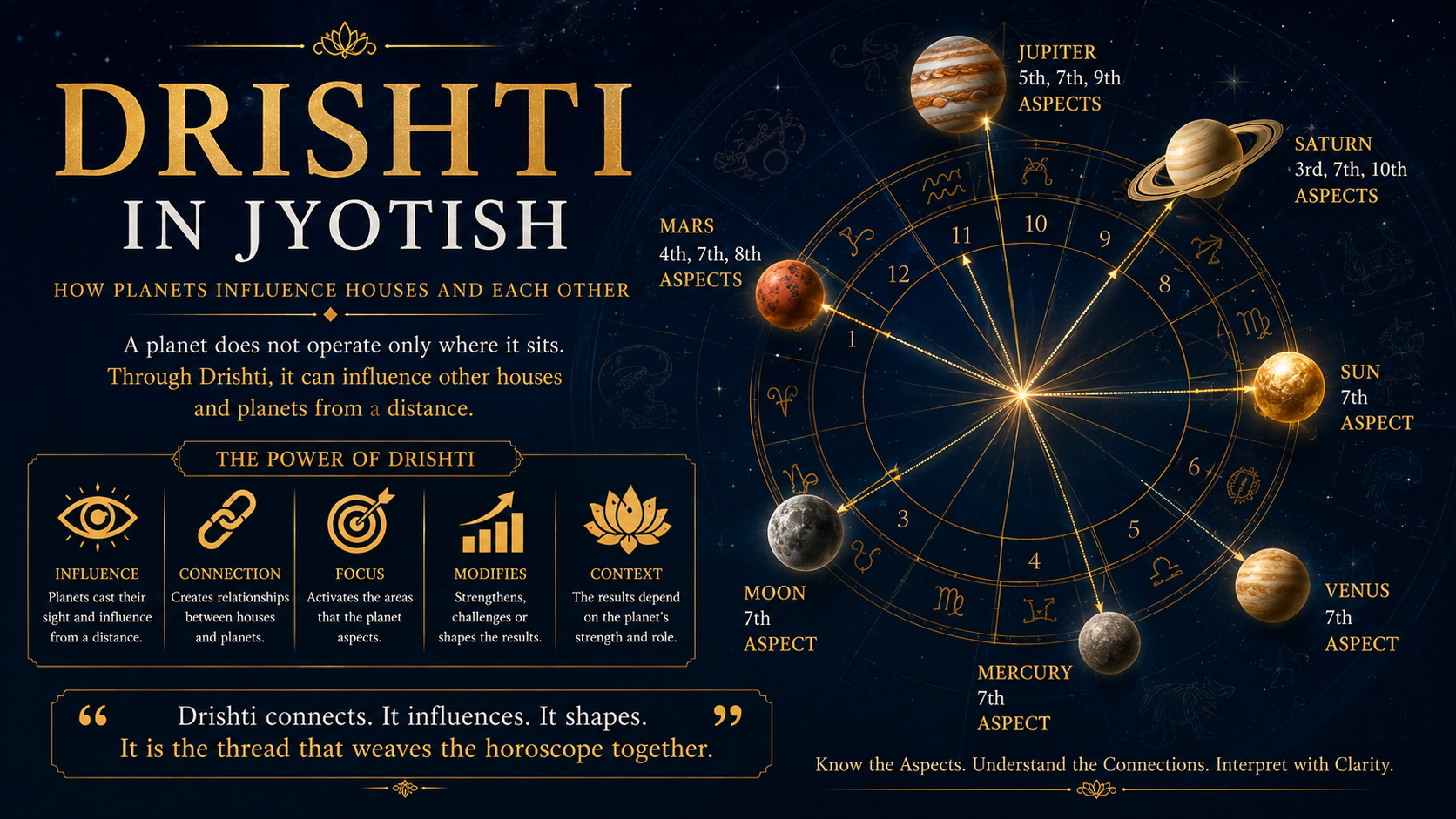
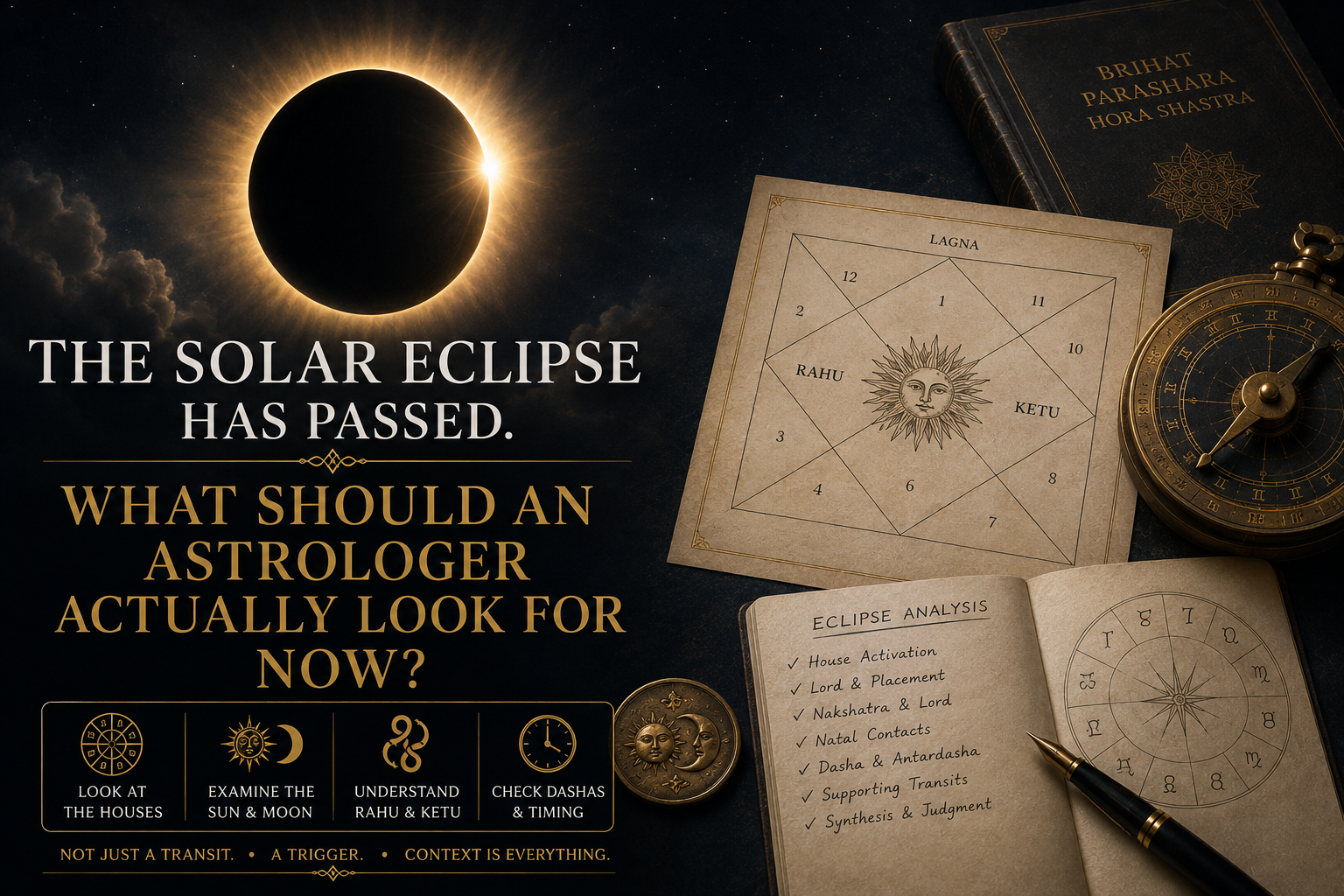
In Vedic astrology, the astrologer should examine the eclipse through the natal horoscope, its houses, planetary lordships, nakshatra, degree-level contacts, dashas and supporting transits.
The real question is not:
"What does this eclipse mean for my zodiac sign?"
It is:
"What does this eclipse activate in my horoscope?"
What Actually Happened on August 12, 2026?
The August 12, 2026 event was a total solar eclipse.
According to NASA, the path of totality crossed parts of Greenland, Iceland, the Atlantic Ocean, northern Spain, a small part of Portugal and areas of Russia. The total phase lasted less than two and a half minutes even near the centre of the path.
India was outside the path of visibility.
Astronomically, this is straightforward.
The Moon passed between Earth and the Sun and temporarily obscured the Sun for observers along the path of totality.
Astrology approaches the same event differently.
The astronomical event is measurable.
The astrological interpretation is symbolic and belongs to a traditional interpretive framework.
That distinction is important.
Studying Jyotish does not require us to pretend that astrological interpretations have the same scientific status as astronomical observations.
The eclipse itself is a scientific fact.
What an astrologer believes that eclipse signifies in a horoscope is a matter of astrological interpretation.
Why the Zodiac Sign Alone Is Not Enough
Suppose an eclipse occurs in a particular zodiac sign.
A simplistic horoscope might say:
"People with this Moon sign should expect career changes."
But which house does that sign occupy in the individual's birth chart?
That question immediately changes the analysis.
For one person, the eclipse may fall in the tenth house.
For another, the seventh.
For another, the fourth.
For another, the twelfth.
The same celestial event can therefore activate completely different areas of life.
This is one of the most important principles for anyone learning predictive astrology:
A transit must be interpreted through the natal chart.
The transit provides the movement.
The birth chart provides the context.
Start With the House
The first practical question should be:
Which house is being activated?
If an eclipse activates the tenth house, an astrologer may examine themes involving:
- Career
- Profession
- Authority
- Reputation
- Responsibilities
- Public position
- Relationship with institutions
But even then, it would be irresponsible to immediately predict:
"You will lose your job."
The tenth house can represent many different experiences.
A person could receive a promotion.
Change employers.
Take on a new responsibility.
Leave a profession.
Start a business.
Become more visible.
Or simply begin reconsidering what professional success means to them.
The house tells you the field of activation.
It does not automatically tell you the event.
The Fourth House Gives a Different Story
Now imagine the same eclipse activating the fourth house.
The emphasis could shift toward:
- Home
- Property
- Mother
- Domestic circumstances
- Emotional foundations
- Vehicles
- Inner security
Again, an eclipse does not automatically mean something negative.
A fourth-house activation could coincide with buying property.
It could coincide with moving.
It could coincide with renovation.
It could coincide with a change in family circumstances.
It could even coincide with a psychological shift in what the person considers "home."
The astrologer has to determine which interpretation fits the rest of the horoscope.
Then Examine the Sun and Moon
This is especially important because a solar eclipse directly involves both luminaries.
The Sun and Moon have major symbolic importance in Jyotish.
The Sun is traditionally associated with identity, authority, vitality, confidence, visibility and one's relationship with power and recognition.
The Moon is associated with the mind, emotions, perception, responsiveness and one's subjective experience.
Therefore, an eclipse deserves greater attention when it comes into close contact with the natal Sun or Moon.
For example, an eclipse close to the natal Sun may make questions around identity, authority, recognition or direction more prominent.
An eclipse closely affecting the natal Moon may bring greater emphasis to psychological or emotional themes.
But these should be treated as areas for investigation, not guaranteed predictions.
Degree Matters
Another major difference between casual astrology and serious chart analysis is the importance of degrees.
It is not enough to say:
"The eclipse is in the same sign as my natal planet."
The astrologer should examine the exact degrees.
A very close conjunction deserves more attention than a loose sign-based relationship.
This becomes particularly important when the eclipse is close to:
- The Ascendant
- The Ascendant lord
- Natal Sun
- Natal Moon
- A relevant house lord
- Rahu
- Ketu
- Another planet directly connected to the question being analysed
The closer the contact, the stronger the reason to investigate it.
This does not mean that every close contact produces a dramatic event.
It means that the contact deserves analytical weight.
Don't Ignore the Nakshatra
This is where Vedic astrology can become considerably more detailed.
Two eclipses can occur in the same zodiac sign but in different nakshatras.
The nakshatra introduces another interpretive layer.
An astrologer can examine:
- The nakshatra itself
- Its planetary lord
- The placement of that lord in the natal chart
- Houses ruled by that planet
- Connections with the natal Moon
- The active dasha of that planet
This allows the astrologer to move beyond generic sign-based predictions.
Instead of asking:
"What happens when an eclipse occurs in this sign?"
we can ask:
"What happens when this eclipse activates this house, through this nakshatra, whose lord occupies this particular position in the natal horoscope?"
That is a much more useful question.
Where Do Rahu and Ketu Come In?
Eclipses are traditionally connected with Rahu and Ketu in Jyotish.
The nodes are not physical planets in the astronomical sense.
They are mathematical points representing the intersection of the apparent paths of the Sun and Moon.
Yet they have enormous importance in Jyotish.
Rahu and Ketu are traditionally associated with eclipse phenomena and are given symbolic meanings involving obscuration, amplification, detachment, unusual experiences and shifts in perception.
But even here, simplistic interpretations are dangerous.
It is not enough to say:
"Rahu is bad."
Or:
"Ketu causes loss."
Their expression depends on the chart.
A Rahu activation of the tenth house is not the same as Rahu activation of the seventh.
Ketu affecting the fourth house is not automatically the same as Ketu affecting the eleventh.
Planetary symbolism needs context.
An Eclipse Does Not Override the Natal Chart
This is perhaps the most important principle.
An eclipse is a transit.
The natal horoscope is the foundation.
A transit should not be used to manufacture an event that has no meaningful connection with the natal chart.
Suppose someone says:
"This eclipse is activating your tenth house, so you will definitely get a new job."
That is an enormous leap.
A better analysis asks:
Is there a natal promise connected with career change?
What is the condition of the tenth lord?
What planets occupy or aspect the tenth house?
What dasha is operating?
Is the eclipse activating the tenth lord?
Are Jupiter, Saturn or other relevant transits reinforcing the same theme?
Only after considering these factors should an astrologer attempt a judgement.
Dasha and Transit Must Be Read Together
For Vedic astrology, dashas are particularly important.
A transit may indicate a period of activation, but the dasha helps establish which planetary themes are currently operating in the person's life.
Imagine an eclipse activating the tenth house.
That is interesting.
But if the person is simultaneously running a dasha connected with the tenth lord, the activation becomes much more significant.
Likewise, if the eclipse activates the seventh house while a relevant relationship-related dasha is operating, the astrologer has another independent indicator pointing toward the same area.
This produces a much stronger analytical framework:
Natal Promise → Dasha → Transit → Event
rather than:
Transit → Guaranteed Event
That distinction is fundamental.
What If the Eclipse Was Not Visible in India?
This is particularly relevant to the August 12 eclipse.
India was outside the path of visibility.
So does that mean the eclipse has no astrological relevance for an Indian horoscope?
There is no single answer that every astrological school would necessarily accept.
Different traditions apply different rules regarding eclipse visibility, geographical relevance and interpretation.
Therefore, the correct approach is not to invent an absolute rule.
An astrologer should state which methodology is being used.
Astronomical visibility and astrological significance are related questions, but they are not identical questions.
A celestial event can be calculated globally, while an astrological tradition may apply additional rules concerning where it is visible and how it should be interpreted.
Why Generic Eclipse Predictions Are Often Weak
There is a temptation to make eclipse astrology dramatic.
That is understandable.
"Eclipse may encourage reflection around your career" is not nearly as exciting as:
"Your career will completely change."
But responsible astrology should favour the first kind of statement unless the horoscope provides strong evidence for the second.
Prediction is a discipline of weighing evidence.
If three or four independent techniques point toward the same theme, confidence increases.
If only one transit suggests something, the astrologer should be more cautious.
This is particularly important with eclipses because their symbolism can easily be exaggerated.
A Practical Eclipse Analysis Framework
If you are studying Jyotish, use a structured sequence.
Step 1: Find the Eclipse Degree
Identify the exact longitude of the eclipse.
Step 2: Identify the Natal House
Determine which house the eclipse occupies.
Step 3: Examine the House Lord
Where is the lord placed?
What houses does it rule?
What planets influence it?
Step 4: Examine the Nakshatra
Identify the nakshatra and its lord.
Then examine the nakshatra lord in the natal chart.
Step 5: Check Natal Contacts
Look for close contacts with:
- Sun
- Moon
- Ascendant
- Ascendant lord
- Relevant house lords
- Rahu
- Ketu
Step 6: Check the Dasha
What planetary period is operating?
Does it connect with the eclipse-activated area?
Step 7: Check Supporting Transits
Look at Jupiter, Saturn, Mars and the nodes.
Are they reinforcing or contradicting the same theme?
Step 8: Make the Judgment
Only after all of this should the astrologer formulate a prediction.
What Does an Eclipse Actually "Do"?
Perhaps the better question is whether an eclipse "does" anything at all.
From the astronomical perspective, it does something very specific:
The Moon temporarily blocks the Sun from certain observers on Earth.
From the astrological perspective, an eclipse is traditionally treated as a moment of unusual planetary configuration and symbolic disturbance.
That distinction should be preserved.
Astrology does not need exaggerated claims to remain interesting.
In fact, the more precisely we define what the system is actually doing, the more intellectually interesting it becomes.
The Real Lesson of the August Eclipse
The August 12 eclipse is a useful reminder that astrology is not simply about collecting meanings.
Anyone can memorise:
"Sun means authority."
"Moon means mind."
"Rahu means desire."
"Saturn means delay."
That is the beginning of astrology, not the end.
The real skill is synthesis.
You have to determine how multiple factors interact.
A planet.
A house.
A lordship.
A nakshatra.
A dasha.
A transit.
A natal promise.
And sometimes several competing indications.
The astrologer's job is to weigh them.
Don't Read the Eclipse. Read the Eclipse Through the Horoscope.
This is perhaps the simplest way to remember the entire methodology.
Don't read the eclipse in isolation.
Read the eclipse through the horoscope.
A useful formula is:
Eclipse → House → Lord → Nakshatra → Natal Contact → Dasha → Supporting Transits → Judgment
The longer analytical chain prevents the astrologer from jumping from one astronomical event to an exaggerated prediction.
And sometimes the conclusion may be surprisingly simple:
"This eclipse is not strongly connected to the native's chart."
That is a perfectly valid astrological judgment.
A good astrologer should be comfortable saying that.
Not every transit has to become a life-changing event.
Frequently Asked Questions
Is a solar eclipse always negative in Vedic astrology?
No. Eclipses are traditionally regarded as unusual or disruptive configurations, but that does not mean every eclipse produces negative results. The natal chart determines how the activation should be interpreted.
Does a solar eclipse affect everyone?
Everyone experiences the astronomical event differently depending on geographical location, while astrological traditions interpret its symbolic relevance through individual horoscopes. A generic prediction cannot capture that individual variation.
Should I read an eclipse from my Moon sign?
The Moon sign can be useful, particularly in transit-based Jyotish approaches, but it should not replace a complete natal-chart analysis.
What if the eclipse is close to my natal Sun?
That deserves closer examination because the eclipse directly involves the Sun. The astrologer should consider the Sun's house, lordship, dignity, associations and the dasha operating at the time.
What if the eclipse falls in my tenth house?
Career and public-life themes may become more relevant for investigation, but the eclipse alone does not guarantee a promotion, job loss or career change.
Does an eclipse guarantee an event?
No. A transit should be interpreted alongside the natal promise, dasha and other supporting factors.
How long do eclipse effects last?
Different astrological traditions use different methods for judging eclipse duration. There is no scientifically established period during which an eclipse produces personal effects, so any specific astrological duration should be understood as a traditional rule rather than a scientific measurement.
Final Thoughts
The August 12, 2026 solar eclipse has passed.
The internet will continue producing lists of zodiac signs that supposedly experienced the eclipse "strongly."
But if you are learning astrology seriously, there is a better question to ask.
Not:
"Which sign was affected?"
But:
"Which horoscope was actually activated, and how?"
Look at the house.
Look at the lord.
Look at the Sun and Moon.
Look at the nakshatra.
Look at the degree.
Look at the natal contacts.
Look at the dasha.
Then examine the supporting transits.
Only then make a judgment.
The sky provides the event.
The horoscope provides the context.
The astrologer provides the interpretation.
That is the discipline.
Ready to Learn Predictive Astrology?
If you want to move beyond generic horoscope predictions and learn how natal promise, dashas, transits, nakshatras and planetary relationships can be combined into a structured predictive method, explore the astrology programs at Futureye.
Learn astrology as a practitioner—not merely as a reader of zodiac predictions.
Visit Futureye and explore the courses designed for serious students of Jyotish and occult sciences.
About Futureye
Futureye is a practitioner-focused learning platform for serious students of astrology and occult sciences.
Our programs cover:
- Vedic Astrology
- KP Astrology
- Prashna Shastra
- Palmistry
- Tarot
- Numerology
- AI + Occult
Our philosophy is simple:
Don't just learn astrology. Learn how to interpret it.
Sources
NASA Science — Total Solar Eclipse of August 12, 2026: https://science.nasa.gov/eclipses/future-eclipses/total-solar-eclipse-on-august-12-2026/
NASA — August 2026 Eclipse Coverage: https://www.nasa.gov/news-release/nasa-sets-coverage-for-august-northern-hemisphere-total-solar-eclipse/
Times of India — August 12, 2026 Solar Eclipse: https://timesofindia.indiatimes.com/astrology/planets-transits/solar-eclipse-august-12-2026-date-time-sutak-kaal-visibility-and-all-you-need-to-know/articleshow/133147926.cms
Suggested Internal Links
- What Is Vedic Astrology? A Beginner's Guide
- How Transits Actually Work in Vedic Astrology
- Rahu and Ketu: Understanding the Lunar Nodes
- What Is a Nakshatra in Vedic Astrology?
- Dasha vs Transit: Which One Predicts Events?
- How to Read a Birth Chart Step by Step
- Prashna Astrology: How a Question Becomes a Chart
Want to learn how professional astrologers actually combine natal charts, dashas, transits and timing techniques?
Explore Futureye's astrology programs and start learning Jyotish as a practitioner.
Ready to Learn the Secret Vidya?
Live cohort-based occult mastery — Vedic Astrology, Prashna Shastra, KP, Palmistry, Numerology, Tarot. Taught by Kushal Agarwal, ICAS faculty, with an AI practice agent that drills you on weak topics until they become second nature.
Or reach us at: info@thefutureye.com · +91 6290 273 797