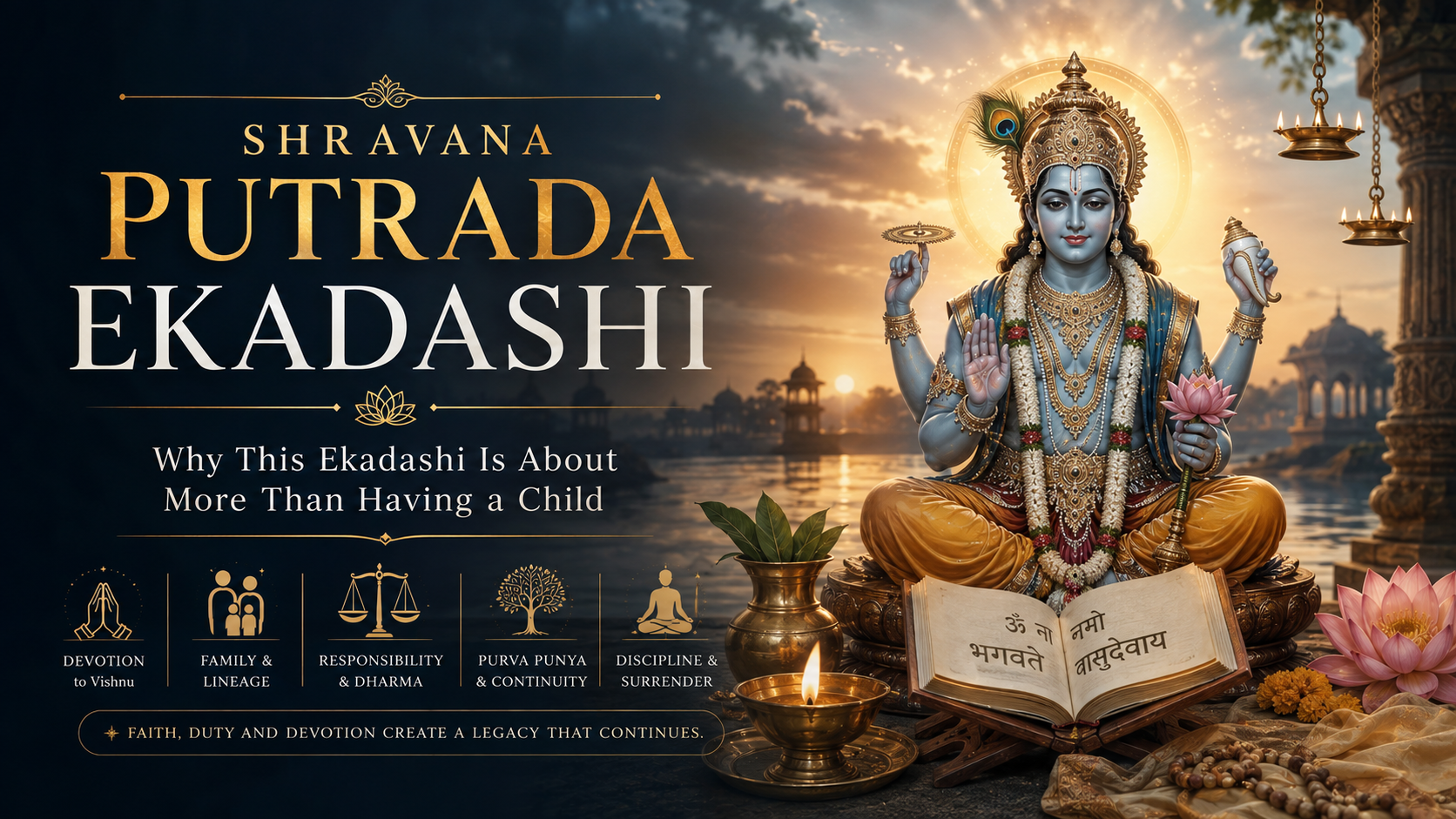
Shravana Putrada Ekadashi: Why This Ekadashi Is About More Than Having a Child
Tomorrow, Sunday, August 23, 2026, will be observed as Shravana Putrada Ekadashi in the North Indian calendar.
It is the Ekadashi of the bright fortnight of Shravan and is traditionally associated with Lord Vishnu, devotion, fasting and the blessing of children.
The name itself appears straightforward.
Putrada means "giver of a son" or, more broadly in contemporary understanding, the giver of offspring.
And this is where the festival is often reduced to a single idea:
"Putrada Ekadashi is for people who want children."
That interpretation is not entirely wrong.
But it is incomplete.
Because the deeper question is not simply:
How do I have a child?
It is:
What does it mean to become responsible for another life?
And once we ask that question, Putrada Ekadashi becomes much more interesting.
It takes us into the territory of Vishnu, Dharma, family, continuity, responsibility, lineage and the relationship between desire and duty.
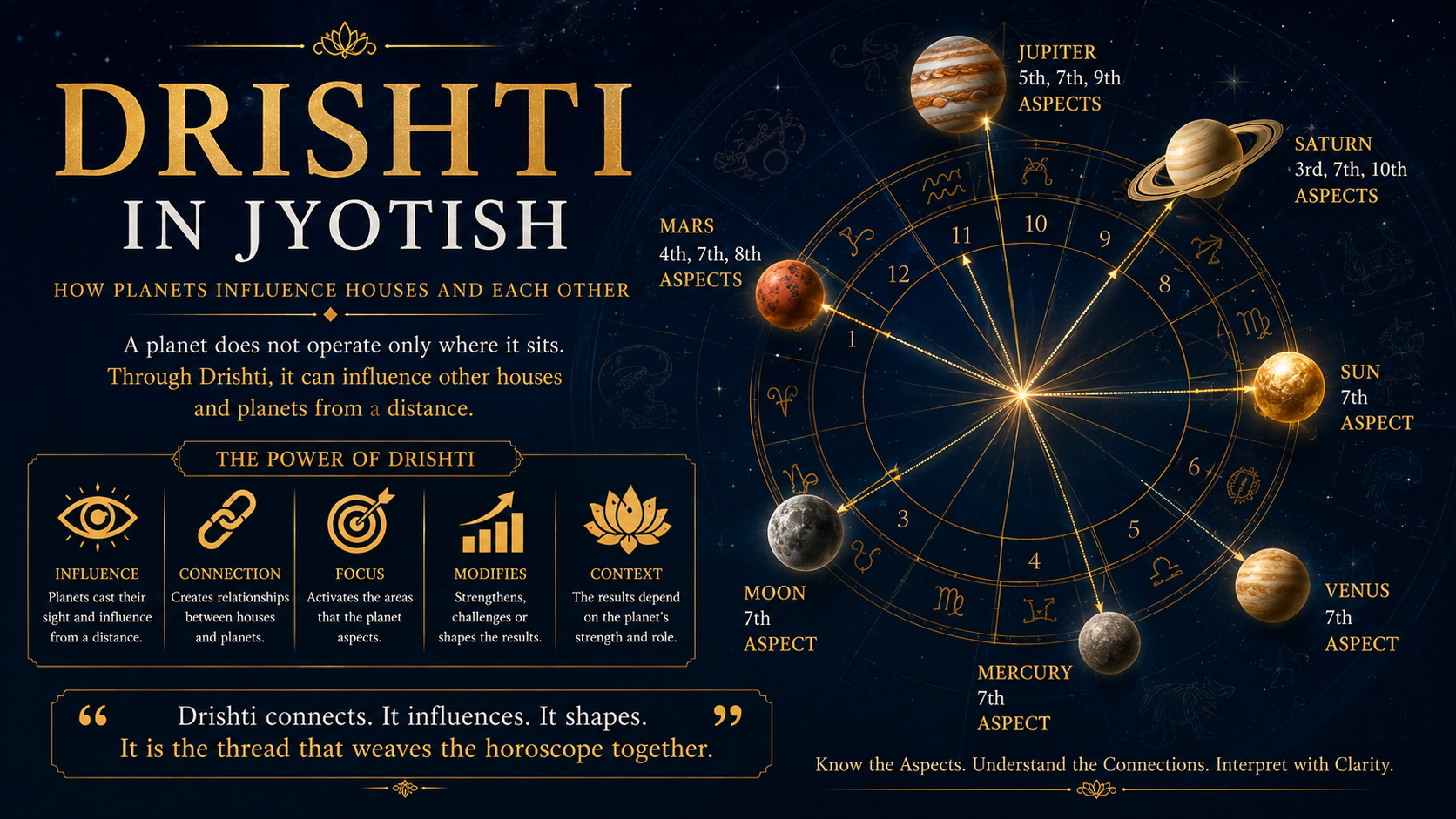
For students of Jyotish, it also opens a fascinating discussion about the 5th house, children, Purva Punya and the difference between a planetary indication and a spiritual guarantee.
What Is Shravana Putrada Ekadashi?
Ekadashi is the 11th Tithi of either the waxing or waning half of the lunar month.
There are traditionally two Ekadashis in each lunar month.
Shravana Putrada Ekadashi occurs during Shukla Paksha Ekadashi of Shravan.
In the 2026 North Indian calendar, it falls on Sunday, August 23. The Ekadashi Tithi begins around 2:00 AM on August 23 and ends around 4:18 AM on August 24 in the cited Indian calculations. A separate Vaishnava observance is listed for August 24 in some calendars. Exact observance and Parana timings can vary by location and tradition. :contentReference[oaicite:0]{index=0}
This is another reason Hindu festival dates should not always be treated as fixed Gregorian dates.
The festival is determined by the lunar Tithi.
And the local sunrise and regional calendar tradition can influence the observance.
Why Is It Called Putrada?
The word Putrada is traditionally understood as "giver of a son."
Historically, this reflects a social world in which sons were strongly associated with lineage, inheritance and certain religious responsibilities.
Modern readers should be careful about transferring that historical framework unchanged into the present.
The deeper principle can be understood more broadly:
Putrada Ekadashi concerns the blessing of offspring and the continuity of family life.
A child is not merely an achievement.
A child is a responsibility.
A child changes the structure of a family.
A child creates a relationship that continues for decades.
And therefore the spiritual question behind the festival can be understood as much larger than conception itself.
It is about the ability to receive, protect, nurture and guide another life.
Why Is Vishnu Associated With Putrada Ekadashi?
Ekadashi is strongly associated with Lord Vishnu.
Vishnu represents preservation, sustenance and the maintenance of cosmic order.
This is particularly relevant to a festival concerned with family and offspring.
Creation is only the beginning.
Something that has been created must also be sustained.
A child can be born in a moment.
Raising that child takes years.
Protection.
Education.
Discipline.
Affection.
Values.
Security.
Patience.
Responsibility.
This is why the connection between Putrada Ekadashi and Vishnu is symbolically meaningful.
The festival is not simply about creation.
It is also about preservation.
The Difference Between Wanting a Child and Being Ready for a Child
This is perhaps the most important distinction.
A person may deeply desire a child.
But desire and readiness are not identical.
Wanting a child is an emotional aspiration.
Parenthood is a long-term responsibility.
Putrada Ekadashi provides an interesting opportunity to think about that distinction.
Instead of asking only:
"Will I have a child?"
One can also ask:
"Am I prepared for the responsibilities that come with parenthood?"
"Can I provide emotional stability?"
"Can I create a safe environment?"
"Can I accept that the child will eventually become an independent individual?"
These questions take the conversation from astrology into Dharma.
The 5th House and Children in Jyotish
This is where Putrada Ekadashi becomes particularly relevant to astrology.
In Vedic astrology, the 5th house is traditionally associated with children.
It is also associated with intelligence, creativity, education, mantra, speculation and Purva Punya.
The 5th house is therefore much larger than the subject of childbirth.
Why do children belong to the 5th house?
One interpretation is that a child represents something that emerges from us and carries our creative and biological continuity forward.
But the 5th house also represents what we create in a broader sense.
A child.
A work of art.
An idea.
A teaching.
A legacy.
A body of knowledge.
This is why the 5th house has such a rich symbolic meaning.
Putrada Ekadashi and Purva Punya
The connection between the 5th house and Purva Punya is especially interesting.
Purva Punya is often translated as merit from previous lives.
Whether someone accepts literal reincarnation or interprets the concept philosophically, the astrological idea is that some aspects of life appear to arrive with a quality of inherited advantage or accumulated potential.
Children can be examined through this framework.
But this should not be interpreted simplistically.
It does not mean:
"Having a child proves you have good Karma."
Nor does infertility imply bad Karma.
That kind of interpretation can be deeply insensitive and is not justified by simply looking at one astrological factor.
A horoscope is a complex system.
And human fertility is also a biological reality involving many factors beyond astrology.
Children Are Not an Astrological Reward
This distinction is important.
Sometimes astrology is presented as though children are rewards handed out by the universe according to planetary merit.
That creates unnecessary moral judgement.
A person who has children is not automatically more virtuous.
A person who does not have children is not automatically less fortunate or spiritually deficient.
Life does not work that neatly.
The 5th house can be interpreted as a field of creativity, intelligence, learning and continuity in addition to children.
And parenthood itself is not the only possible expression of a meaningful life.
This is an important principle for ethical astrology.
Do not turn a traditional symbolism into a moral judgement about someone's worth.
Why Ekadashi Involves Fasting
Ekadashi is traditionally associated with fasting and restraint.
Different traditions prescribe different levels of fasting.
Some devotees observe a complete fast.
Others consume only water or specific fasting foods.
Others observe a simpler dietary restriction.
The practice is meant to cultivate restraint and devotion.
But the deeper principle is interesting.
Human beings are creatures of appetite.
We want food.
Comfort.
Pleasure.
Recognition.
Security.
Possessions.
Relationships.
Fasting creates a temporary interruption in that pattern.
It says:
I do not have to satisfy every impulse immediately.
That is spiritually significant.
Desire and Discipline
Putrada Ekadashi is particularly interesting because it concerns a very strong human desire.
The desire to have a child.
Desire itself is not necessarily the problem.
But desire without discipline can become anxiety.
Someone desperately wants a particular outcome.
They become obsessed.
They consult multiple astrologers.
They perform increasingly expensive remedies.
Every menstrual cycle becomes a source of fear.
Every delay becomes interpreted as a planetary punishment.
The spiritual purpose of Ekadashi offers a different possibility.
Desire can be acknowledged without allowing desire to control the entire mind.
That is what discipline can do.
Vishnu and the Principle of Preservation
If Shiva is often understood through transformation and dissolution, Vishnu is strongly associated with preservation.
That makes Vishnu particularly appropriate for a festival connected with family continuity.
But preservation does not mean keeping everything unchanged.
A child grows.
A family changes.
A person becomes independent.
Relationships evolve.
The role of a parent changes over time.
Preservation therefore means maintaining what is essential while allowing life to develop.
This is a subtle but important lesson.
What Does Parenthood Have to Do With Dharma?
Everything.
Dharma is often translated as duty or righteousness, but it is much richer than either word.
It concerns the responsibilities appropriate to one's circumstances and role.
Parenthood introduces an enormous field of Dharma.
A parent has responsibilities toward a child.
But those responsibilities are not simply financial.
They include:
Protection.
Education.
Emotional support.
Boundaries.
Values.
Independence.
And eventually, letting go.
This last part is particularly important.
A parent spends years protecting a child.
But eventually, the parent must allow that child to become an adult.
That is another form of preservation through change.
The Astrological Meaning of Children Goes Beyond Birth
When an astrologer examines children, the analysis should not stop at:
"Will you have a child?"
The horoscope can potentially be examined for questions involving:
Relationship with children.
Responsibilities toward children.
Creativity.
Education.
Intelligence.
Legacy.
Parenting tendencies.
The experience of raising children.
And periods in which these themes become prominent.
This is why the 5th house cannot be treated as a simple fertility switch.
The entire horoscope matters.
The 5th lord matters.
Jupiter is traditionally an important significator for children.
The relevant divisional charts may be examined.
Dasha periods matter.
Transits matter.
And the specific question being asked matters.
Why Jupiter Is Important
In Jyotish, Jupiter is traditionally considered a significant natural significator for children.
Jupiter represents expansion, wisdom, teaching, nourishment, guidance and growth.
These qualities naturally resonate with parenthood.
A parent is not merely producing another human being.
A parent is, ideally, helping another human being grow into maturity.
This is why Jupiter's symbolism becomes relevant.
But once again, Jupiter should not be treated as a magical "child planet."
No single planet guarantees or denies an outcome.
Astrology works through combinations and context.
The 5th House Is Also the House of Creation
This may be one of the most beautiful ways to understand Putrada Ekadashi from a broader perspective.
Not everyone expresses the 5th house through biological children.
Some people create companies.
Some create books.
Some create music.
Some create institutions.
Some teach.
Some mentor.
Some create ideas that continue long after they are gone.
This is also continuity.
A person leaves something behind.
The 5th house therefore becomes connected with the question:
What will you create that outlives the moment?
That question makes the concept of "Putrada" much more philosophically interesting.
What Does "Legacy" Really Mean?
Legacy is often associated with wealth.
Property.
Business.
Family name.
But legacy can be much simpler.
A teacher's legacy may be a student.
A parent's legacy may be a value.
A writer's legacy may be a book.
A scientist's legacy may be an idea.
A spiritual teacher's legacy may be a practice.
The physical body eventually disappears.
But what we create can continue.
This is one reason children are traditionally connected with lineage.
They represent continuity.
But continuity can also happen through knowledge, values and contribution.
Putrada Ekadashi and the Idea of Continuity
Seen this way, Putrada Ekadashi is not merely about asking for a child.
It is about continuity.
What comes after us?
What do we preserve?
What do we pass forward?
What values survive us?
What knowledge survives us?
What kind of human beings are we helping create?
That is a much deeper question than fertility alone.
Why Astrology Should Be Careful With Fertility Questions
Fertility is an area where astrologers should exercise particular responsibility.
A person asking about children may already be emotionally vulnerable.
A careless prediction can cause enormous distress.
Statements such as:
"You definitely cannot have children."
"You will certainly have a son."
"You have bad Karma."
"You must perform this expensive remedy."
should never be made casually.
Astrology should not replace medical advice.
Nor should a chart be used to create fear.
A responsible astrologer should understand the limits of the system and communicate uncertainty honestly.
The Son-Daughter Question
The traditional name Putrada Ekadashi reflects historical emphasis on sons.
But modern interpretation should not turn the festival into a hierarchy between sons and daughters.
A child is a child.
The spiritual responsibility of raising a human being does not depend upon gender.
The more meaningful modern reading of Putrada is therefore:
the blessing of offspring and family continuity.
Tradition can be respected without reproducing every historical social assumption uncritically.
The Story Behind Putrada Ekadashi
Traditional accounts associated with Putrada Ekadashi describe a king who is distressed because he has no son.
The story ultimately turns toward devotion, fasting and the grace of Vishnu.
Such stories are not merely historical reports.
They function as teaching narratives.
The king's problem is external.
But the solution involves internal transformation:
Faith.
Discipline.
Devotion.
Surrender.
The story therefore reinforces a recurring principle in Hindu spiritual literature:
Action matters, but action is not the same as control.
We can make an effort.
We cannot command the universe to produce the exact outcome we want.
The Role of Surrender
This is where Ekadashi becomes spiritually interesting.
Fasting is an act of effort.
Prayer is an act of effort.
Ritual is an act of effort.
But after the effort comes surrender.
There is a point where the individual must accept that the outcome is not completely within personal control.
This is true far beyond parenthood.
We can work hard.
We can prepare.
We can make intelligent decisions.
But we cannot control every outcome.
Ekadashi creates a ritual environment in which this tension between effort and surrender can be experienced consciously.
Karma, Effort and Grace
This leads directly into one of the central philosophical questions of Jyotish.
If Karma influences our circumstances, what is the role of effort?
The answer cannot simply be:
"Everything is predetermined."
If that were true, effort would be meaningless.
Nor can we say:
"Everything is under our control."
Experience clearly contradicts that.
A more nuanced understanding is possible.
Past actions may influence circumstances.
Present actions influence future possibilities.
And some aspects of life remain outside individual control.
Different Indian philosophical traditions explain this relationship in different ways.
But the practical lesson is simple:
Do what is within your control, and learn to release what is not.
This Is Why Putrada Ekadashi Matters to Jyotish
The festival sits at the intersection of several important astrological ideas.
The lunar Tithi.
The 5th house.
Children.
Jupiter.
Dharma.
Karma.
Desire.
Discipline.
Surrender.
Continuity.
That makes it much richer than a festival that is simply labelled "for having a child."
It becomes a reminder that astrology should examine the whole human situation.
Not just the desired event.
A Better Question for Astrology
Suppose someone asks:
"When will I have a child?"
A technically oriented astrologer may immediately start searching for combinations.
But before doing so, there is another question:
What does this question mean to the person asking it?
Are they worried about fertility?
Are they under family pressure?
Are they trying to understand timing?
Are they grieving a previous loss?
Are they simply curious?
Are they considering whether parenthood is right for them?
The chart may be the same.
The human question is not.
Good astrology begins by understanding the question behind the question.
What Putrada Ekadashi Can Teach Everyone
Even someone who has no desire for children can find meaning in this Ekadashi.
Because continuity is not limited to parenthood.
Ask yourself:
What am I creating?
What am I preserving?
What am I teaching?
What am I passing forward?
What will remain because I was here?
These questions are deeply connected with the 5th-house principle of creation and legacy.
And they are relevant to every human being.
How to Observe Putrada Ekadashi
Those who observe the festival traditionally may:
- Keep an Ekadashi fast according to their health, tradition and capacity.
- Worship Lord Vishnu.
- Recite Vishnu mantras or prayers.
- Read or listen to stories associated with Vishnu and Ekadashi.
- Practise restraint and simplicity.
- Avoid grains and cereals according to the fasting tradition being followed.
- Donate or perform acts of service.
- Spend time in prayer rather than treating the day purely as a wish-fulfilment ritual.
Fasting practices vary significantly between traditions.
People with medical conditions, pregnancy, medication requirements or other health considerations should not undertake restrictive fasting without appropriate professional guidance.
Don't Turn Putrada Ekadashi Into a Guarantee
This is worth saying clearly.
Putrada Ekadashi is a sacred observance.
It should not be marketed as a guaranteed fertility treatment.
A spiritual practice can have profound personal meaning.
But that is different from claiming that a particular ritual guarantees conception.
Similarly, astrology cannot responsibly promise a child merely because a person performs a particular puja.
Faith and medical reality should not be placed in opposition.
They operate in different domains.
The Deeper Meaning of "Putrada"
Perhaps the word can be understood in a broader way today.
"Putrada" is traditionally connected with offspring.
But offspring represents continuity.
And continuity is one of the deepest human desires.
We want something of ourselves to continue.
Our genes.
Our name.
Our values.
Our knowledge.
Our work.
Our stories.
But the spiritual traditions of India also ask a harder question:
What exactly should we pass forward?
Not everything we inherit should be preserved.
Some patterns should end with us.
Some fears should end with us.
Some prejudices should end with us.
Some unhealthy family patterns should end with us.
True Dharma may sometimes mean preserving a tradition.
At other times, it may mean transforming it.
What Should We Pass Forward?
This may be the most important question of Putrada Ekadashi.
If you have children, what are you teaching them?
If you do not, what are you creating?
What kind of example are you setting?
What knowledge are you sharing?
What values are you embodying?
Because children do not learn only from what parents tell them.
They learn from what parents repeatedly do.
They observe.
They absorb.
They imitate.
That makes parenthood a form of living Dharma.
Final Thoughts
Shravana Putrada Ekadashi will be observed on August 23, 2026, in the North Indian calendar, with the associated Ekadashi Tithi extending into August 24 in Indian calculations. Some Vaishnava calendars observe the fast on August 24, which is why local Panchang and sampradaya should always be checked before determining the exact fasting and Parana schedule. :contentReference[oaicite:1]{index=1}
Traditionally associated with the blessing of children, Putrada Ekadashi can be understood through a much wider idea:
continuity.
Vishnu represents preservation.
The 5th house represents children, creativity and Purva Punya.
Jupiter represents wisdom, growth and guidance.
Ekadashi represents restraint.
And devotion introduces the final element:
surrender.
We make an effort.
We act responsibly.
We pray.
We discipline ourselves.
And then we accept that the final outcome is not entirely ours to command.
That is a lesson far larger than parenthood.
Perhaps the most meaningful way to approach Putrada Ekadashi is therefore not:
"What can I receive?"
but:
"What am I capable of nurturing?"
Not merely:
"What will continue after me?"
but:
"What should continue after me?"
And perhaps most importantly:
"What should end with me?"
That is where Putrada Ekadashi moves from a festival associated with childbirth into a deeper reflection on Dharma, family, Karma and human responsibility.
Because creating life is only the beginning.
What we do with that life is the real responsibility.
Learn Jyotish Beyond Simple Predictions
Children, marriage, career, wealth and family are not determined by one planet or one house.
To understand these subjects properly, a Jyotish student needs to learn how houses, lords, significators, divisional charts, dashas, transits and the broader horoscope interact.
At Futureye, we focus on astrology as an interpretive discipline—not a collection of guaranteed predictions or fear-based remedies.
Explore Futureye's astrology programs and learn how to interpret a horoscope with structure, context and judgement.
About Futureye
Futureye is a practitioner-focused learning platform for serious students of astrology and occult sciences.
Our programs cover:
- Vedic Astrology
- KP Astrology
- Prashna Shastra
- Palmistry
- Tarot
- Numerology
- AI + Occult
Don't just learn astrology. Learn how to interpret it.
Sources
Drik Panchang — Shravana Putrada Ekadashi 2026: https://www.drikpanchang.com/ekadashis/putrada/shravana-putrada-ekadashi-date-time.html
Drik Panchang — August 2026 Hindu Festivals: https://www.drikpanchang.com/festivals/month/festivals-august.html
Drik Panchang — Shravana 2026: https://www.drikpanchang.com/festivals/lunar-month/festivals-shravana.html
Suggested Internal Links
- The 12th House Is Not Just the House of Loss
- What Is the 5th House in Vedic Astrology?
- Jupiter in Vedic Astrology: The Planet of Wisdom and Expansion
- Karma and Free Will in Vedic Astrology
- Panchang Is More Than a Calendar
- What Are Tithis in Vedic Astrology?
- How to Read a Vedic Birth Chart
Want to understand how Jyotish actually evaluates questions about children, family, creativity and the 5th house?
Explore Futureye's astrology programs and learn how to interpret these combinations systematically—not through isolated planetary keywords.
Ready to Learn the Secret Vidya?
Live cohort-based occult mastery — Vedic Astrology, Prashna Shastra, KP, Palmistry, Numerology, Tarot. Taught by Kushal Agarwal, ICAS faculty, with an AI practice agent that drills you on weak topics until they become second nature.
Or reach us at: info@thefutureye.com · +91 6290 273 797