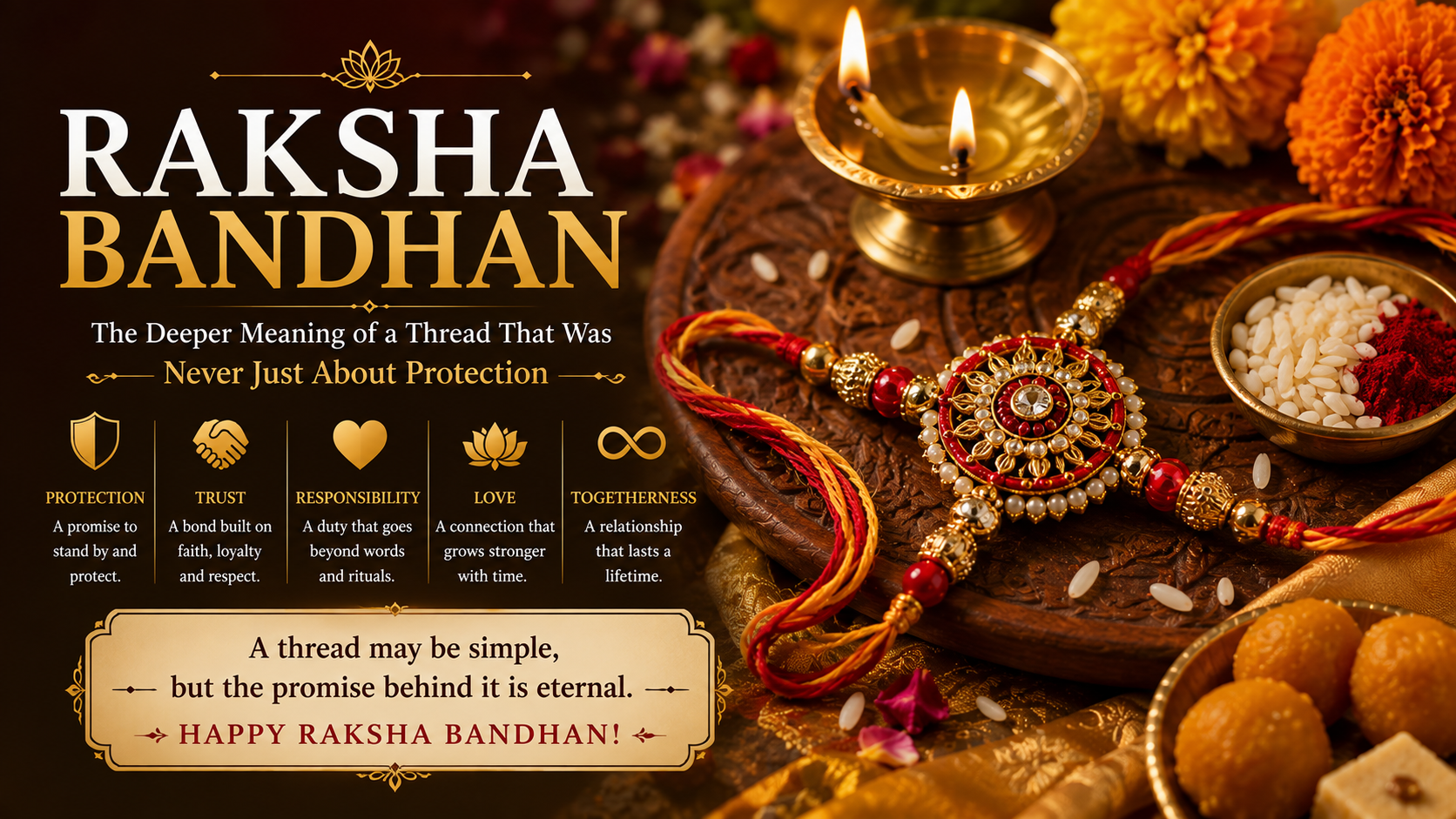
Raksha Bandhan: The Deeper Meaning of a Thread That Was Never Just About Protection
Tomorrow, Friday, August 28, 2026, is Raksha Bandhan.
The festival falls on Shravana Purnima and is one of the most recognisable celebrations of the bond between siblings.
A sister ties a Rakhi around her brother's wrist.
A brother gives a gift.
The family gathers.
Sweets are exchanged.
Photographs are taken.
And the ritual is complete.
But the Rakhi itself is a remarkably simple object.
It is only a thread.
Why, then, has a thread become one of the most enduring symbols of family, protection and affection in Indian culture?
Because the thread is not really the point.
The promise is.
The Rakhi represents a relationship in which two people acknowledge that they are connected—and that this connection creates responsibility.
Traditionally, the brother promises protection.
But if we look at the deeper idea of Raksha, protection is not merely physical.
It can mean standing beside someone.
Supporting them.
Defending their dignity.
Offering help.
Keeping their confidence.
Showing up when life becomes difficult.
And perhaps most importantly, recognising that relationships create duties, not merely emotions.
That is where Raksha Bandhan moves from a family festival into a deeper reflection on Dharma.
When Is Raksha Bandhan in 2026?
Raksha Bandhan will be observed on Friday, August 28, 2026, in India.
The Shravana Purnima Tithi begins at approximately 9:08 AM on August 27 and ends at approximately 9:48 AM on August 28 in the India-based Panchang calculations. The Raksha Bandhan observance is therefore on August 28. The UIDAI 2026 calendar also lists Raksha Bandhan on August 28. :contentReference[oaicite:0]{index=0}
This year's date also creates an interesting calendrical detail.
The Purnima Tithi begins on August 27, but the festival is observed on August 28 because the relevant Raksha Bandhan observance is determined according to the traditional rules governing Purnima and the associated period.
This is a useful reminder that Hindu festivals cannot always be determined simply by asking:
"When does the Tithi begin?"
The relationship between Tithi, sunrise, festival rules and local Panchang matters.
Why Is Raksha Bandhan Celebrated on Purnima?
Raksha Bandhan is traditionally observed on the full Moon day of Shravana.
Purnima has an important place in the Hindu calendar.
The Moon is at its fullest.
The lunar cycle reaches completion.
And the symbolism of fullness naturally lends itself to celebration.
A relationship is also something that becomes meaningful through completeness.
A sibling relationship is not simply a biological fact.
It becomes a relationship through shared experiences.
Childhood.
Arguments.
Secrets.
Competition.
Protection.
Distance.
Reconciliation.
Memory.
And eventually, adulthood.
The Rakhi ritual gives this relationship a formal moment of recognition.
What Does "Raksha Bandhan" Actually Mean?
The name itself tells us much of the story.
Raksha means protection.
Bandhan means bond or binding.
Together, Raksha Bandhan can be understood as a bond of protection.
But there is an important philosophical question hidden here.
Who is protecting whom?
The traditional ritual places particular emphasis on the brother protecting the sister.
That reflects the social structure of the tradition in which the festival developed.
But the deeper idea can be expanded.
A sibling may protect another sibling.
A sister may protect her brother.
An older sibling may protect a younger one.
A younger sibling may stand beside an older one during difficult circumstances.
Protection can be emotional.
Financial.
Practical.
Social.
Psychological.
And sometimes simply the knowledge that someone will answer your call.
The thread therefore represents reciprocity even when the ritual language has traditionally emphasised one direction of protection.
The Rakhi Is a Promise
The physical thread is temporary.
It can break.
It can fade.
It can eventually be removed.
The relationship it represents is supposed to be more durable.
That is what makes the ritual powerful.
The Rakhi is almost like a physical reminder of an invisible commitment.
We use symbols because human beings forget.
We forget promises.
We forget relationships.
We get busy.
We move cities.
We build careers.
We start families of our own.
Life becomes complicated.
A yearly ritual creates a pause.
For one day, siblings consciously acknowledge:
We are still connected.
Protection Is Not Control
There is an important distinction here.
Protection should not become control.
To protect someone does not mean to decide their life for them.
It does not mean:
"I know what is best for you."
It does not mean controlling whom they marry.
Where they work.
How they live.
What decisions they make.
True protection creates safety without destroying autonomy.
This is especially important in the modern interpretation of Raksha Bandhan.
The ideal relationship between siblings is not one person becoming the authority over the other.
It is two adults recognising that they can still be there for one another without controlling one another.
Raksha Bandhan and Dharma
This brings us to Dharma.
Dharma is often translated as duty.
But Dharma is broader than simply following rules.
It concerns the responsibilities appropriate to a relationship, role and circumstance.
A sibling relationship creates its own form of Dharma.
You may not agree with everything your sibling does.
You may have completely different personalities.
You may live thousands of kilometres apart.
You may have had disagreements.
But there is still a certain responsibility to care.
That responsibility is not always expressed through dramatic acts.
Sometimes Dharma is simply:
Calling.
Listening.
Helping.
Showing up.
Keeping a confidence.
Offering support without judgement.
The Mythological Stories Behind Raksha Bandhan
Raksha Bandhan does not have one universally accepted origin story.
Several stories are associated with the tradition.
One of the most commonly cited involves Indra and Shachi.
According to a traditional account, Shachi tied a protective thread to Indra before battle.
The thread became associated with protection and divine blessing.
Another well-known story involves Krishna and Draupadi, although versions of this story vary across textual and regional traditions.
There are also historical and cultural stories that have become associated with Rakhi over time.
These different narratives share a common theme:
A thread becomes a symbol of a sacred relationship and a protective intention.
Krishna and Draupadi
The story of Krishna and Draupadi is particularly popular in contemporary discussions of Raksha Bandhan.
In the familiar version, Draupadi tears a piece of cloth from her garment and uses it to tend to Krishna's injured finger.
Krishna is said to remember this act of affection and later protect Draupadi.
Whether one approaches the story devotionally or symbolically, the underlying idea is powerful.
Protection does not begin with a formal ceremony.
It begins with an act of care.
Draupadi gives first.
Krishna later protects.
The relationship therefore becomes reciprocal.
One act of kindness creates another.
The Difference Between Ritual and Relationship
This is perhaps the most important lesson of Raksha Bandhan.
A Rakhi can be tied perfectly.
The ceremony can be elaborate.
The sweets can be expensive.
The gifts can be impressive.
And yet the relationship can remain weak.
The opposite is also possible.
Two siblings may live far apart.
They may not perform the ritual every year.
But they may still genuinely care for one another.
This tells us something important:
Ritual is a container for meaning. It is not a substitute for meaning.
The thread matters because of what it represents.
Why We Need Rituals
Modern life is increasingly digital.
Messages arrive instantly.
Photographs are stored in the cloud.
Video calls connect people across continents.
And yet physical rituals remain powerful.
Why?
Because rituals slow us down.
They make us physically participate.
You do not merely send a message saying:
"I care about you."
You tie something around another person's wrist.
You look at them.
You perform an action.
You create a memory.
The physical act gives emotional meaning a form.
The Thread as a Symbol
A thread is fascinating as a symbol.
A single strand is weak.
Several strands woven together are stronger.
That itself can become a metaphor for family.
One person alone may struggle.
But relationships create resilience.
The thread also connects two points.
It creates continuity.
It can be tied.
Untied.
Retied.
The physical simplicity of the Rakhi therefore carries surprisingly rich symbolism.
What Does Protection Really Mean Today?
The meaning of protection has changed.
In earlier social contexts, physical safety and financial security were major concerns.
Today, protection may include entirely different things.
Protecting someone's mental peace.
Protecting their reputation.
Protecting their privacy.
Helping them navigate a difficult workplace.
Supporting them through a divorce or separation.
Helping them financially when they are struggling.
Being present during illness.
Or simply making sure they know:
You are not alone.
This is the modern expression of Raksha.
The Role of Distance
Many siblings no longer live in the same city.
Some live in different countries.
Some meet only once or twice a year.
This makes Raksha Bandhan particularly meaningful.
The festival becomes a ritual of reconnection.
For one day, physical distance becomes less important.
The Rakhi travels.
The gift travels.
The phone call happens.
The video call happens.
The relationship is consciously renewed.
The thread becomes a bridge across distance.
Raksha Bandhan and the Changing Family
Families have changed significantly.
Siblings may have different parents.
Blended families exist.
Adopted siblings exist.
Step-siblings may become emotionally closer than biological siblings.
Some people have friends who function like siblings.
Some have lost contact with their biological family but have created strong chosen families.
This raises an important question:
Is Raksha Bandhan really about biology?
Or is it about belonging?
The deeper meaning suggests the latter.
The ritual is about acknowledging a bond of care.
Biology may create the relationship.
But behaviour creates the bond.
The Importance of Reciprocity
There is another lesson hidden in the festival.
Healthy relationships are reciprocal.
Protection should not be permanently one-sided.
Care should not be permanently one-sided.
One person should not always sacrifice while the other simply receives.
The Rakhi can therefore be interpreted as a reminder that both people have responsibilities.
The brother may promise protection.
The sister offers the Rakhi.
But both are participating in the creation of the relationship.
That is what makes the ritual meaningful.
Raksha Bandhan and the 3rd House in Jyotish
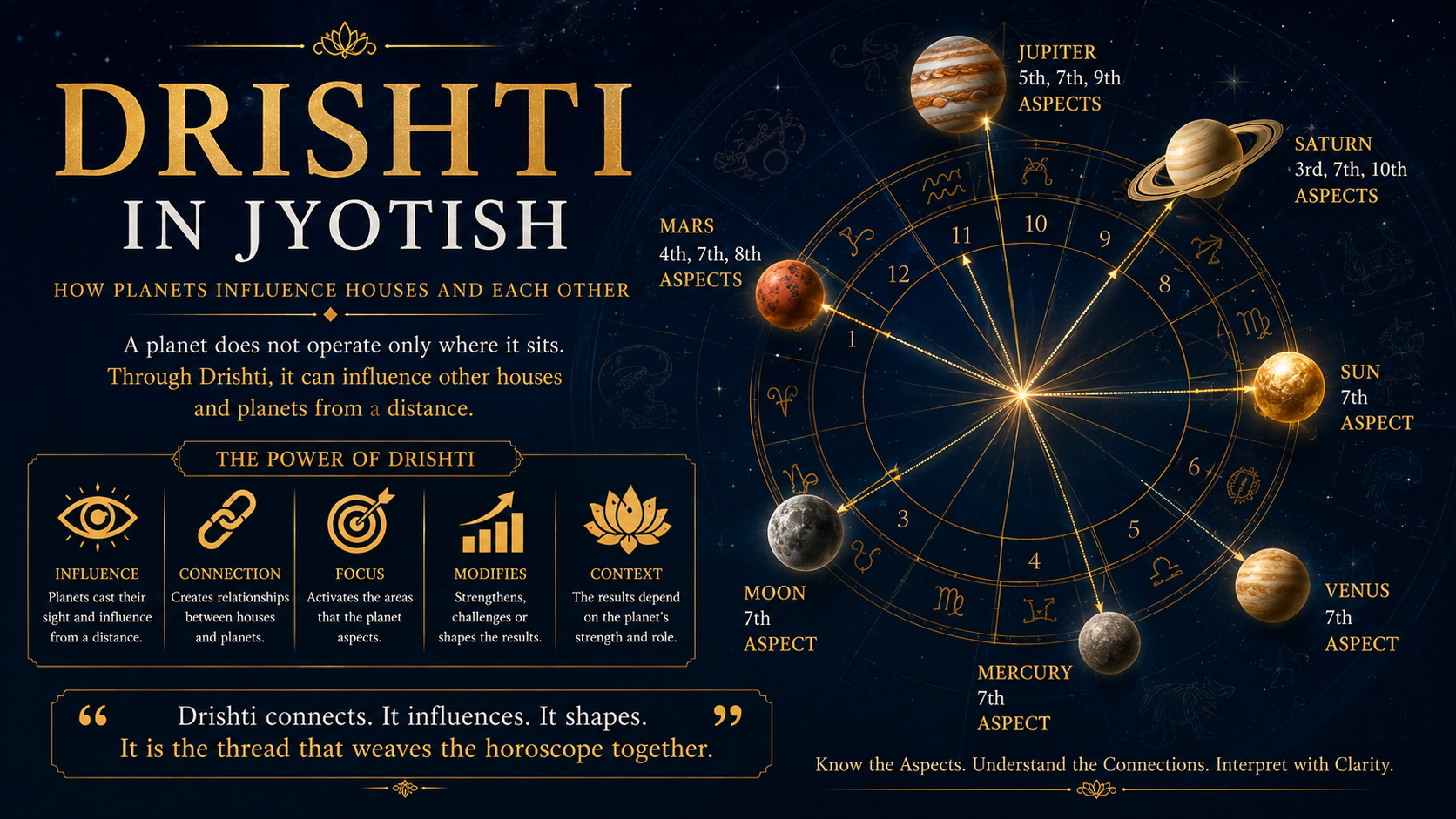
For students of Jyotish, Raksha Bandhan provides an interesting connection with the 3rd house.
The 3rd house is traditionally associated with younger siblings, courage, communication, initiative and one's immediate environment.
It is therefore one of the houses worth examining when studying sibling relationships.
But once again, the 3rd house should not be interpreted in isolation.
The 3rd lord matters.
Planets occupying the 3rd house matter.
Aspects matter.
The condition of relevant significators matters.
The 11th house may also become relevant in certain sibling analyses, particularly when considering elder siblings.
The exact approach depends upon the astrological school and the question being asked.
This is an important distinction between serious Jyotish and keyword astrology.
Why Courage Belongs to the 3rd House
The connection between siblings and courage may initially appear strange.
But there is a symbolic logic.
The 3rd house represents the capacity to take initiative.
To make an effort.
To face obstacles.
To act.
And siblings often become some of our earliest social relationships.
We learn competition.
Negotiation.
Communication.
Defence.
Compromise.
Standing up for ourselves.
In that sense, sibling relationships can become part of our earliest training in courage.
Rakhi and the Idea of Boundaries
A healthy relationship requires boundaries.
This is another modern interpretation of protection.
If I care about you, I may support you.
But I do not own you.
If I love you, I may protect you.
But I cannot make every decision for you.
If I disagree with you, I can still respect you.
This is particularly relevant among adult siblings.
Childhood relationships can carry old patterns into adulthood.
One sibling may remain "the responsible one."
Another may remain "the younger one."
But adulthood changes those roles.
Raksha Bandhan can become a reminder that the bond can remain strong even as the individuals become independent.
The Sacredness of Trust
There is another invisible thread between siblings:
trust.
A sibling may know things about you that very few other people know.
Childhood memories.
Family history.
Embarrassing moments.
Personal struggles.
Old stories.
That creates a unique form of intimacy.
Trust therefore becomes another form of Raksha.
Sometimes protecting someone simply means not exposing what they trusted you with.
A secret kept can be an act of love.
Raksha Bandhan Is Not About Perfect Siblings
Real siblings fight.
They compete.
They misunderstand each other.
They sometimes stop speaking.
They may have completely different values.
A festival should not require pretending otherwise.
In fact, the existence of conflict makes the ritual more meaningful.
A relationship does not become sacred because it is perfect.
It becomes meaningful because people continue to choose it despite imperfection.
The Rakhi does not say:
"We never disagree."
It can simply say:
"Despite everything, you matter to me."
The Gift Is Not the Point
Modern Raksha Bandhan has also become associated with gifts.
Clothes.
Money.
Jewellery.
Electronics.
Chocolates.
These can certainly be expressions of affection.
But they should not become the measure of the relationship.
The most valuable gift may be something that cannot be purchased:
Time.
Attention.
Forgiveness.
Support.
Presence.
A difficult conversation.
A willingness to help.
The festival becomes deeper when the material gift points toward something larger.
What If the Relationship Is Difficult?
Not every sibling relationship is healthy.
Some are distant.
Some are strained.
Some are deeply conflicted.
Some involve genuine harm.
In such situations, the symbolism of protection should not be used to pressure someone into tolerating unhealthy behaviour.
Family does not automatically justify the violation of boundaries.
Sometimes protecting yourself is also an act of Dharma.
This is an important modern interpretation.
Raksha should include self-raksha.
A bond is meaningful when it creates dignity, not fear.
The Spiritual Meaning of Protection
At the deepest level, protection is about reducing vulnerability.
Human beings are vulnerable.
We can lose money.
Health.
Status.
Relationships.
Security.
The knowledge that someone will stand beside us reduces that vulnerability.
This is why protection has such a strong emotional resonance.
The Rakhi becomes a physical reminder:
Someone has chosen to stand with me.
That is powerful.
The Raksha Sutra Beyond Siblings
The idea of a sacred protective thread is not limited to Raksha Bandhan.
Threads and protective cords appear in many Hindu rituals.
They can be tied during pujas, ceremonies and vows.
The thread often represents an intention.
A commitment.
A blessing.
A boundary between ordinary and sacred activity.
This broader tradition helps explain why the Rakhi itself became such an effective symbol.
The thread already carried ritual meaning.
Raksha Bandhan gave that symbolism a deeply personal form.
Purnima and Completion
The festival's connection with Purnima adds another layer.
The full Moon represents completion of the lunar cycle's waxing phase.
In many traditions, Purnima is associated with fullness, illumination and completion.
Raksha Bandhan is therefore celebrated at a point of lunar fullness.
The symbolism is fitting.
A relationship is brought into conscious awareness.
A promise is renewed.
The bond is acknowledged.
Something that exists throughout the year becomes visible through ritual.
What Raksha Bandhan Can Teach Us About Dharma
Perhaps the most useful lesson is this:
Relationships create responsibilities.
We often think of relationships only in terms of what they give us.
My family gives me support.
My friends give me companionship.
My partner gives me love.
But Dharma asks the reverse question:
What do I owe the people who matter to me?
That is a much harder question.
And a much more mature one.
The Brother's Promise Is Bigger Than Protection
Traditionally, the brother promises to protect his sister.
But protection should not be interpreted narrowly.
It can mean:
"I will stand beside you."
"I will not abandon you when things become difficult."
"I will respect your choices."
"I will help when I can."
"I will defend you when you are treated unfairly."
"I will tell you the truth when you need to hear it."
That last one is important.
Protection is not always telling someone what they want to hear.
Sometimes it is telling them what they need to hear—with compassion.
The Sister's Rakhi Is Also a Statement
The sister tying the Rakhi is not merely asking for protection.
She is also acknowledging the relationship.
The gesture says:
"You are part of my life."
"You matter to me."
"I recognise our bond."
The ritual therefore works in both directions.
The visible action is the tying of the thread.
The invisible action is the reaffirmation of the relationship.
What About Sisters Protecting Brothers?
Modern life makes this question almost unnecessary.
Of course sisters protect brothers too.
They provide emotional support.
They help during crises.
They may become financial or practical pillars of the family.
They may defend their brothers.
They may guide them.
They may simply be there.
The deeper meaning of Raksha Bandhan therefore allows the relationship to become reciprocal.
Protection is a human responsibility, not a male monopoly.
Raksha Bandhan and the Meaning of Family
Perhaps family is not simply the group of people who share our blood.
Family is the group of people with whom we accept responsibility.
That is why some friendships become like family.
And why biological relationships can sometimes feel distant.
The Rakhi therefore becomes a symbol of chosen responsibility.
It says:
"I acknowledge this bond."
And acknowledgement itself has power.
A Rakhi Can Be a Reminder
Once the festival is over, the Rakhi may remain on the wrist for days or weeks.
Every time the person sees it, the symbol remains.
That creates a small psychological effect.
The promise becomes visible.
The relationship becomes visible.
The ritual continues beyond the ritual itself.
Eventually the thread may be removed.
But ideally, the meaning remains.
That is what makes a good ritual.
It leaves something behind after the ritual ends.
What Should We Protect?
This may be the most interesting question to ask tomorrow.
What should we protect?
Not merely our siblings.
But perhaps:
Trust.
Dignity.
Family bonds.
Truth.
Vulnerability.
Promises.
The people who depend on us.
And sometimes, our own peace.
Protection is valuable only when we understand what is worth protecting.
Final Thoughts
Raksha Bandhan will be celebrated on Friday, August 28, 2026 in India. The Purnima Tithi begins on August 27 and ends on August 28, and traditional Panchang rules place the Raksha Bandhan observance on August 28. The Raksha Bandhan ritual should be performed after Bhadra has ended; exact timings vary by location. :contentReference[oaicite:1]{index=1}
But the real significance of Raksha Bandhan is not contained in the thread.
It is contained in the promise behind it.
A Rakhi says:
You matter.
I remember our bond.
I recognise my responsibility toward you.
And when life becomes difficult, I will try to be there.
That is why the festival has survived changing generations.
Because every generation understands vulnerability.
Every generation needs belonging.
Every generation needs people who will stand beside them.
The form may change.
The gifts may change.
The distance between siblings may change.
But the underlying human need does not.
To know that someone has your back.
Perhaps that is the deeper meaning of Raksha Bandhan.
Not merely:
"I will protect you."
But:
"You do not have to face everything alone."
And perhaps the most beautiful version of the Raksha Sutra is one that works both ways.
I protect you.
You protect me.
We protect the relationship.
And together, we protect what is worth preserving.
Learn Jyotish Beyond Simple Planetary Keywords
Raksha Bandhan also opens an interesting doorway into Jyotish through the 3rd house, siblings, courage, communication and the dynamics of family relationships.
At Futureye, we focus on learning astrology as an interpretive discipline—not merely memorising planetary keywords or making isolated predictions.
Explore Futureye's astrology programs and learn how to interpret Jyotish with structure, context and judgement.
About Futureye
Futureye is a practitioner-focused learning platform for serious students of astrology and occult sciences.
Our programs cover:
- Vedic Astrology
- KP Astrology
- Prashna Shastra
- Palmistry
- Tarot
- Numerology
- AI + Occult
Don't just learn astrology. Learn how to interpret it.
Sources
Drik Panchang — Raksha Bandhan 2026: https://www.drikpanchang.com/festivals/raksha-bandhan/raksha-bandhan-date-time.html
UIDAI Government Calendar 2026: https://uidai.gov.in/images/WallCalender2026.pdf
Times of India — Raksha Bandhan 2026 date and Bhadra: https://timesofindia.indiatimes.com/religion/festivals/raksha-bandhan-2026-is-raksha-bandhan-on-august-27-or-28-check-correct-date-bhadra-kaal-and-rakhi-muhurat/articleshow/133421773.cms
Suggested Internal Links
- Onam and Mahabali: The Deeper Meaning of a King Who Was Asked to Give Everything Away
- The Fourth Shravan Somwar: Why Monday Holds a Special Place in Shiva Worship
- Mangala Gauri Vrat: Why Tuesdays of Shravan Are Dedicated to Gauri
- The 5th House in Vedic Astrology
- The 3rd House in Vedic Astrology: Courage, Communication and Siblings
- Karma and Free Will in Vedic Astrology
- Panchang Is More Than a Calendar
Want to understand how Jyotish evaluates siblings, family relationships, courage and communication through the horoscope?
Explore Futureye's astrology programs and learn how to interpret these combinations systematically—not through isolated planetary keywords.
Ready to Learn the Secret Vidya?
Live cohort-based occult mastery — Vedic Astrology, Prashna Shastra, KP, Palmistry, Numerology, Tarot. Taught by Kushal Agarwal, ICAS faculty, with an AI practice agent that drills you on weak topics until they become second nature.
Or reach us at: info@thefutureye.com · +91 6290 273 797