Panchang Is More Than a Calendar: Understanding the Five Limbs of Time
Most people use a calendar to answer a simple question:
What date is it?
A Panchang asks a much more sophisticated question:
What kind of time is it?
This distinction is at the heart of traditional Indian timekeeping.
A modern calendar tells us that today is Thursday, August 20.
A Panchang goes further.
It examines the relationship between the Sun and Moon, the position of the Moon among the Nakshatras, the weekday, and several other astronomical factors to describe the quality and structure of that particular moment.
This is why Panchang has historically been important not only for religious festivals but also for Muhurta, rituals, travel, ceremonies and Jyotish practice.
The word itself explains the basic idea.
Pancha means five.
Anga means limb or component.
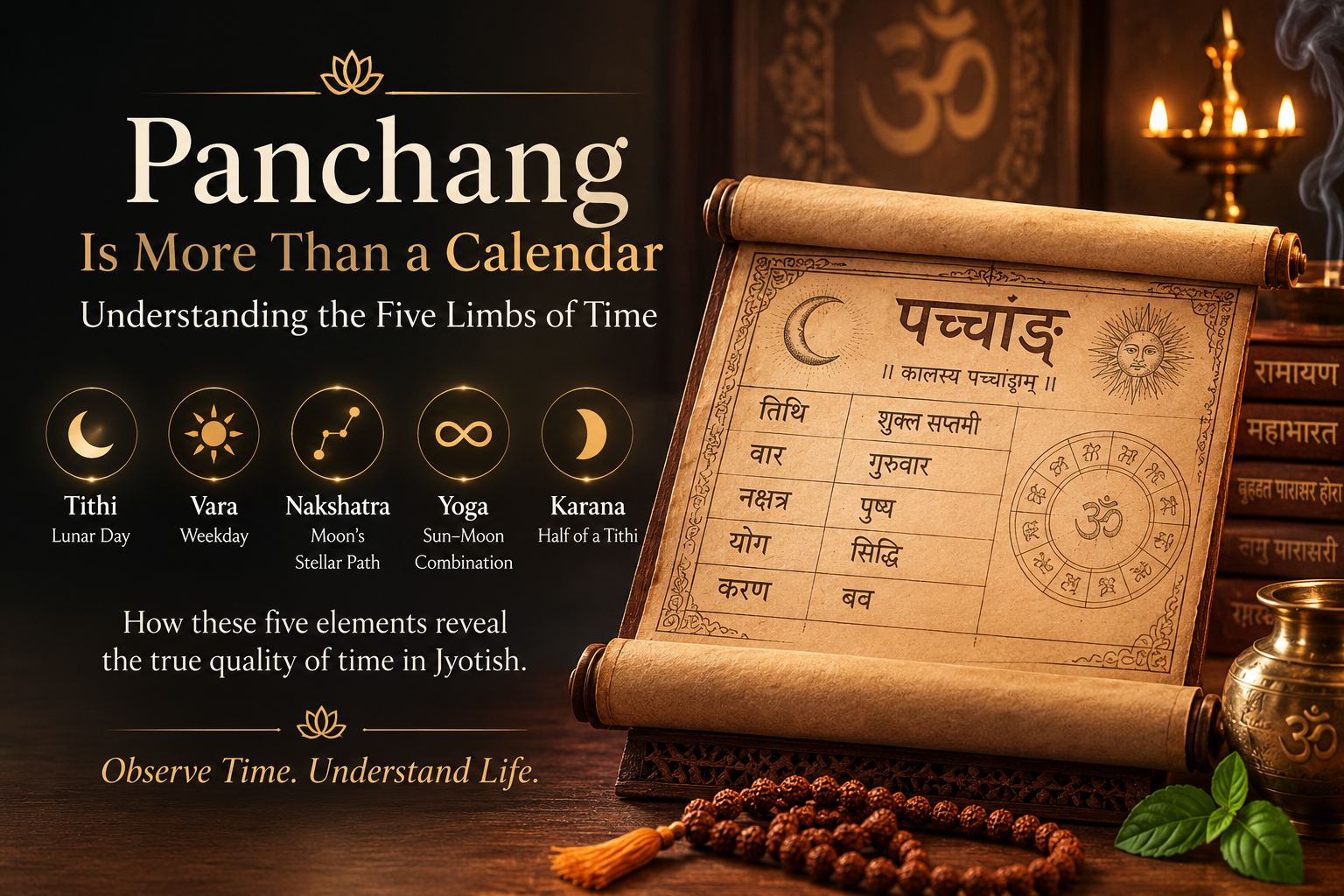
A Panchang is therefore a system built around five limbs of time:
Tithi Vara Nakshatra Yoga Karana
Understanding these five components is one of the simplest ways to begin seeing how Jyotish approaches time.
1. Tithi: The Lunar Day
The first limb of Panchang is Tithi.
Tithi is fundamentally based on the angular relationship between the Sun and the Moon.
As the Moon moves around the zodiac, its relationship with the Sun continuously changes.
Traditional Indian timekeeping divides the approximately 30 lunar days of a synodic month into 30 Tithis.
These are divided into two halves:
Shukla Paksha — the waxing half of the Moon.
Krishna Paksha — the waning half of the Moon.
Each Paksha contains 15 Tithis.
The names begin with Pratipada and progress through Dwitiya, Tritiya, Chaturthi, Panchami and so on, culminating in Purnima or Amavasya depending on the lunar phase.
But Tithi is more than simply a way of counting days.
It represents a particular stage in the relationship between the Sun and Moon.
And because the Moon is central to the traditional understanding of mind, emotion and perception, Tithi becomes particularly important in selecting appropriate times for different activities.
This is one reason a festival does not simply occur on "the 15th day of a month."
It occurs when a particular Tithi prevails under particular astronomical circumstances.
2. Vara: The Weekday
The second limb is Vara, or weekday.
This is perhaps the easiest component to understand because modern calendars also use the seven-day week.
The traditional weekdays are associated with the seven visible planetary bodies used in classical Jyotish:
Sunday — Sun Monday — Moon Tuesday — Mars Wednesday — Mercury Thursday — Jupiter Friday — Venus Saturday — Saturn
This gives each weekday a planetary association.
Monday becomes associated with Chandra.
Tuesday with Mangala.
Wednesday with Budha.
Thursday with Guru.
Friday with Shukra.
Saturday with Shani.
Sunday with Surya.
This is one reason weekdays play a role in Muhurta.
A practitioner may consider the nature of the weekday alongside Tithi, Nakshatra and other factors before selecting a time for a particular activity.
However, this does not mean that every Monday is automatically good for everything connected with the Moon.
The entire Panchang has to be considered.
That is an important principle.
One factor rarely tells the whole story.
3. Nakshatra: Where the Moon Is
The third limb is Nakshatra.
This is one of the most distinctive features of Indian astrology.
The zodiac is divided into 27 Nakshatras, each spanning 13 degrees and 20 minutes.
The Moon moves relatively quickly through these divisions, spending roughly a day in each Nakshatra.
This makes Nakshatra particularly important in understanding the daily movement of the Moon.
Some of the familiar Nakshatras include:
Ashwini.
Bharani.
Krittika.
Rohini.
Mrigashira.
Ardra.
Pushya.
Magha.
Hasta.
Chitra.
Swati.
Anuradha.
Jyeshtha.
Mula.
Shravana.
Dhanishtha.
Shatabhisha.
Revati.
Each Nakshatra has its own symbolism, deity, planetary ruler and traditional characteristics.
This is where Panchang begins to become much more nuanced.
Suppose two days have the same weekday.
They can still have very different Nakshatras.
And therefore, from a traditional Muhurta perspective, they may not be treated identically.
Nakshatra introduces another layer into the description of time.
4. Yoga: A Relationship Between Sun and Moon
The fourth limb is Yoga.
This should not be confused with yoga in the modern physical-exercise sense.
Panchang Yoga is calculated using the combined longitudes of the Sun and Moon.
The total is divided into 27 sections, producing 27 Yogas.
These include names such as:
Vishkambha.
Priti.
Ayushman.
Saubhagya.
Shobhana.
Atiganda.
Sukarma.
Dhriti.
Shula.
Ganda.
Vriddhi.
Dhruva.
Vyaghata.
Harshana.
Vajra.
Siddhi.
Vyatipata.
Variyana.
Parigha.
Shiva.
Siddha.
Sadhya.
Shubha.
Shukla.
Brahma.
Indra.
Vaidhriti.
The names themselves are reminders that traditional Panchang was not merely concerned with measuring time quantitatively.
It also classified particular combinations of astronomical positions.
This is one of the fundamental differences between a conventional calendar and Panchang.
A conventional calendar tells you when.
Panchang attempts to tell you what the configuration of time is.
5. Karana: Half of a Tithi
The fifth limb is Karana.
Karana is essentially half of a Tithi.
Since there are 60 Karanas in a lunar month, they provide a finer division of the lunar day.
There are seven recurring Karanas:
Bava.
Balava.
Kaulava.
Taitila.
Garaja.
Vanija.
Vishti, also known as Bhadra.
There are also four fixed Karanas:
Shakuni.
Chatushpada.
Naga.
Kimstughna.
Karana is particularly relevant in Muhurta because it adds another layer of precision.
A Tithi may appear suitable in a broad sense, but the Karana can provide additional information about the quality of that particular period.
Again, the principle is consistency:
Panchang is meant to be read as a system, not as isolated labels.
Why Are There Five Different Measures of Time?
This is perhaps the most important question.
Why not simply look at the date?
Because the traditional Indian understanding of time is not purely linear.
A day is not considered identical to every other day simply because both contain 24 hours.
The astronomical relationships within that day change.
The Moon changes Tithi.
The Moon moves from one Nakshatra to another.
The weekday changes.
The Sun-Moon relationship produces different Yogas.
Karanas change within Tithis.
Therefore, two moments separated by even a few hours may have different Panchang characteristics.
This becomes especially important in Muhurta, where the objective is not merely to find a convenient time but to identify a traditionally supportive configuration for a particular undertaking.
Panchang and Muhurta
Muhurta is the branch of traditional Jyotish concerned with selecting an appropriate time for an activity.
This could involve:
Marriage.
Housewarming.
Starting a business.
Beginning education.
Travel.
Religious ceremonies.
Important purchases.
Initiating a particular undertaking.
The Panchang provides several of the fundamental building blocks required for this analysis.
But an important misconception needs to be corrected.
Muhurta is not simply about finding an "auspicious day."
A serious Muhurta analysis can involve:
Tithi.
Vara.
Nakshatra.
Yoga.
Karana.
Lagna.
Planetary positions.
Tarabala.
Chandrabala.
Dasha considerations in some traditions.
And the specific nature of the activity.
Therefore, saying "Thursday is auspicious, so start your business on Thursday" is an oversimplification.
Thursday may be associated with Jupiter.
But the actual Panchang and horoscope of the moment may tell a much more complicated story.
Panchang and the Moon
There is a reason the Moon appears repeatedly throughout Panchang.
The Hindu calendar is fundamentally lunar-solar.
The Moon is fast-moving compared with the Sun and therefore provides a constantly changing clock within the zodiac.
Tithi depends on the Sun-Moon relationship.
Nakshatra depends on the Moon's position.
The lunar Paksha determines whether the Moon is waxing or waning.
Many festivals are determined by specific lunar Tithis.
This makes Chandra central to understanding traditional timekeeping.
It also explains why someone studying Jyotish cannot afford to treat the Moon as merely "one more planet."
The Sun may represent the fundamental source of vitality and identity.
But the Moon provides the constantly changing rhythm through which traditional Indian time is experienced.
Why Panchang Is Important for Festivals
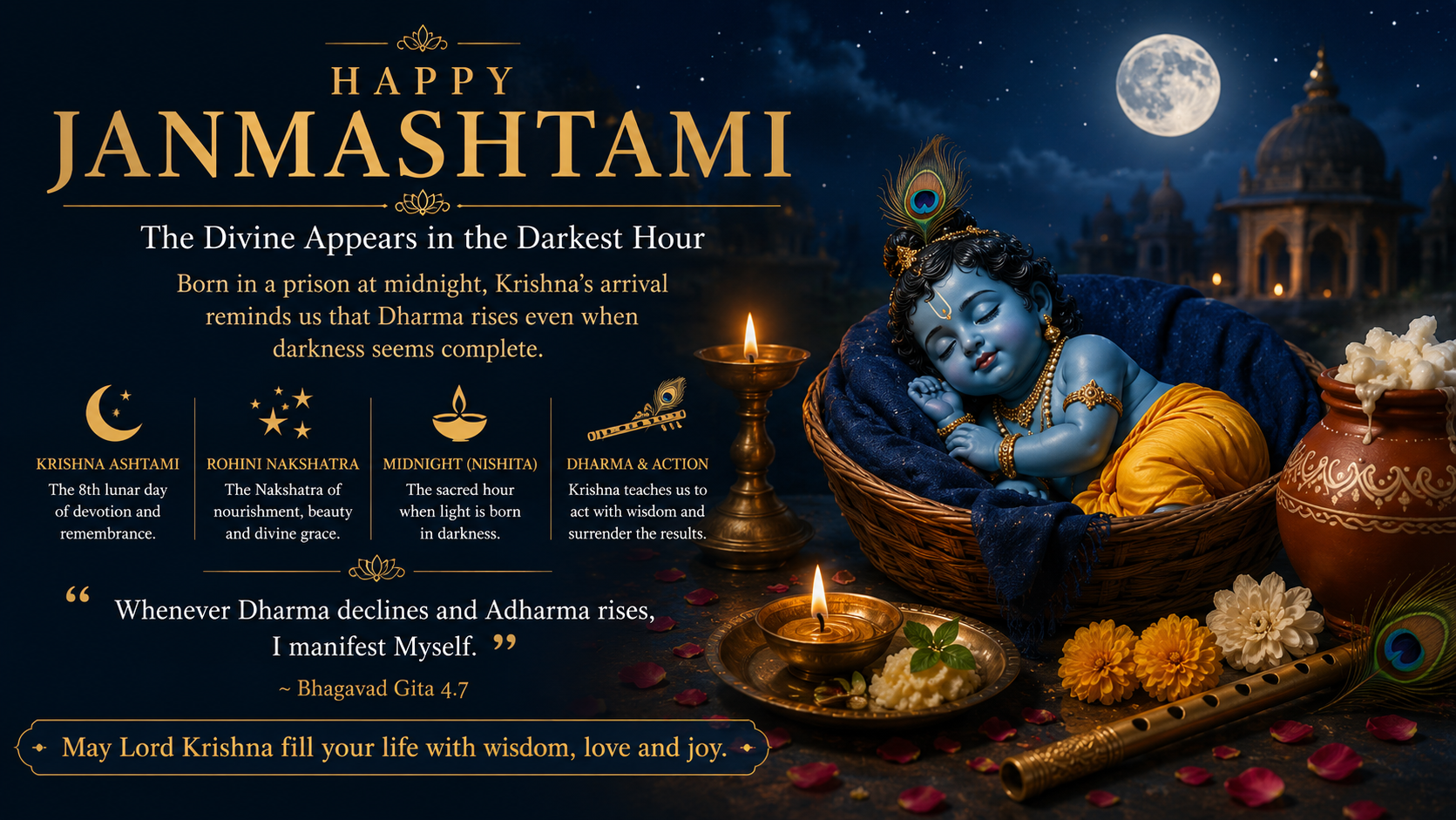
Think about a festival such as Janmashtami.
It is not defined simply as:
"August 20 every year."
Its date changes because it is determined through the lunar calendar.
The same principle applies to numerous Hindu observances.
A festival may depend upon:
A specific Tithi.
A particular Paksha.
A particular lunar month.
A Nakshatra.
A sunrise or midnight condition.
Or a combination of these factors.
This is why festival dates can sometimes differ between regions or traditions.
The Gregorian calendar is fixed.
The Panchang is astronomical.
That distinction is essential.
Panchang Is Not the Same as a Horoscope
Another common confusion is between Panchang and Kundali.
They are related, but they are not the same.
A Kundali describes the planetary configuration at a particular birth moment and location.
A Panchang describes the astronomical components of a particular time.
One is primarily natal.
The other is primarily temporal.
A horoscope asks:
What was the sky like when this person was born?
Panchang asks:
What is the configuration of time right now?
When these two are combined, astrology becomes more sophisticated.
The natal chart describes the individual.
The current sky describes the timing.
Panchang helps describe the nature of that time.
The Difference Between Panchang and Western Calendar Thinking
Modern calendars are extremely useful.
There is nothing inherently superior about one system or another.
The difference is philosophical.
The Gregorian calendar is primarily a civil timekeeping system.
Panchang developed within a tradition where astronomical cycles, ritual timing and human activity were closely connected.
The calendar therefore carries more information about celestial relationships.
This does not mean that every Panchang indication should be treated as scientifically proven to produce a particular outcome.
That distinction matters.
Panchang is a traditional astrological and calendrical framework.
Its value should be understood within that framework.
Can Panchang Predict the Future?
Not by itself.
This is another important distinction.
Panchang describes the configuration of time.
It is not a complete predictive system.
For prediction, Jyotish uses much more:
The natal chart.
Dashas.
Transits.
Divisional charts.
Aspects.
Planetary strengths.
Yogas.
And other techniques.
Panchang becomes especially relevant when the question involves timing.
In other words:
The horoscope can tell us what themes may manifest.
The planetary periods can tell us when those themes may become active.
Panchang can help us understand the quality of particular moments.
These are complementary functions.
Why Every Serious Jyotish Student Should Learn Panchang
A student can learn hundreds of planetary combinations without understanding how the traditional calendar works.
But that creates a strange gap.
They can interpret a horoscope while remaining unfamiliar with the very time system from which much of Jyotish's traditional practice emerged.
Learning Panchang provides a different kind of understanding.
It teaches the student to observe time.
Not simply count it.
That distinction is profound.
We often think of time as something that passes.
Traditional Jyotish asks us to consider whether different moments have different characteristics.
That is the foundation of Muhurta.
Panchang Teaches a Different Relationship With Time
Modern life often treats time as a resource.
"Save time."
"Spend time."
"Don't waste time."
"Time is money."
Panchang introduces another perspective.
Time can also be observed.
The Moon changes.
The Sun moves.
Tithis unfold.
Nakshatras change.
The lunar month progresses.
The seasons shift.
The sky becomes a continuously changing clock.
This creates a more cyclical understanding of life.
Instead of seeing time merely as a straight line from yesterday to tomorrow, traditional Indian thought repeatedly returns to cycles.
Lunar cycles.
Solar cycles.
Planetary cycles.
Dashas.
Transits.
A person's life itself becomes part of a larger rhythm.
The Five Limbs Work Together
The real beauty of Panchang is not in memorising five definitions.
It is in understanding how the five components interact.
Imagine a particular moment.
The Tithi describes the Sun-Moon angular relationship.
The Vara gives the weekday and its planetary association.
The Nakshatra describes the Moon's stellar division.
The Yoga describes a combined Sun-Moon relationship.
The Karana provides a finer division of the Tithi.
None of these alone tells the complete story.
Together, they create a multidimensional description of time.
This is why a good Panchang is far more informative than a list of festival dates.
It is effectively a map of the celestial clock.
The Real Lesson of Panchang
Perhaps the deepest lesson is surprisingly simple:
Time is not merely something that happens to us.
Traditional Jyotish teaches us to observe it.
A student of astrology who learns to read a Panchang begins to see the sky differently.
Monday is no longer simply Monday.
It is a lunar weekday.
A date is no longer merely a number.
It carries a Tithi.
The Moon is not merely in a zodiac sign.
It is moving through a Nakshatra.
A particular moment is not simply 10:30 AM.
It has a particular Panchang configuration.
Whether one accepts every traditional interpretation or approaches it primarily as a cultural and astrological framework, the discipline of observing these cycles changes the way one thinks about time.
And that is perhaps the greatest value of Panchang.
It teaches us to stop treating time as empty space between events.
Time itself becomes something worth studying.
Final Thoughts
Panchang is one of the foundations upon which many traditional Indian practices of timing are built.
Its five limbs—Tithi, Vara, Nakshatra, Yoga and Karana—provide different perspectives on the astronomical configuration of a moment.
Tithi follows the relationship between Sun and Moon.
Vara connects the day with the seven classical planetary rulers.
Nakshatra tracks the Moon through the 27 lunar mansions.
Yoga derives from the combined positions of Sun and Moon.
Karana divides the Tithi into smaller units.
Together, they form a sophisticated traditional framework for understanding time.
But learning Panchang is not about memorising terminology.
It is about developing a habit of observation.
The sky changes constantly.
The Moon changes constantly.
Time changes constantly.
And Jyotish begins, in many ways, with learning how to notice those changes.
A calendar tells you the date.
A Panchang asks you to look at the sky.
Learn Jyotish Beyond the Basics
Understanding Panchang is only one part of learning Jyotish.
To interpret astrology meaningfully, you need to understand how the natal chart, planets, houses, signs, Nakshatras, Dashas, transits and timing systems work together.
At Futureye, we focus on practitioner-oriented astrology—not just memorising planetary keywords.
Explore Futureye's astrology programs and learn how to read the language of time, charts and planetary patterns.
About Futureye
Futureye is a practitioner-focused learning platform for serious students of astrology and occult sciences.
Our programs cover:
- Vedic Astrology
- KP Astrology
- Prashna Shastra
- Palmistry
- Tarot
- Numerology
- AI + Occult
Don't just learn astrology. Learn how to interpret it.
Ready to Learn the Secret Vidya?
Live cohort-based occult mastery — Vedic Astrology, Prashna Shastra, KP, Palmistry, Numerology, Tarot. Taught by Kushal Agarwal, ICAS faculty, with an AI practice agent that drills you on weak topics until they become second nature.
Or reach us at: info@thefutureye.com · +91 6290 273 797