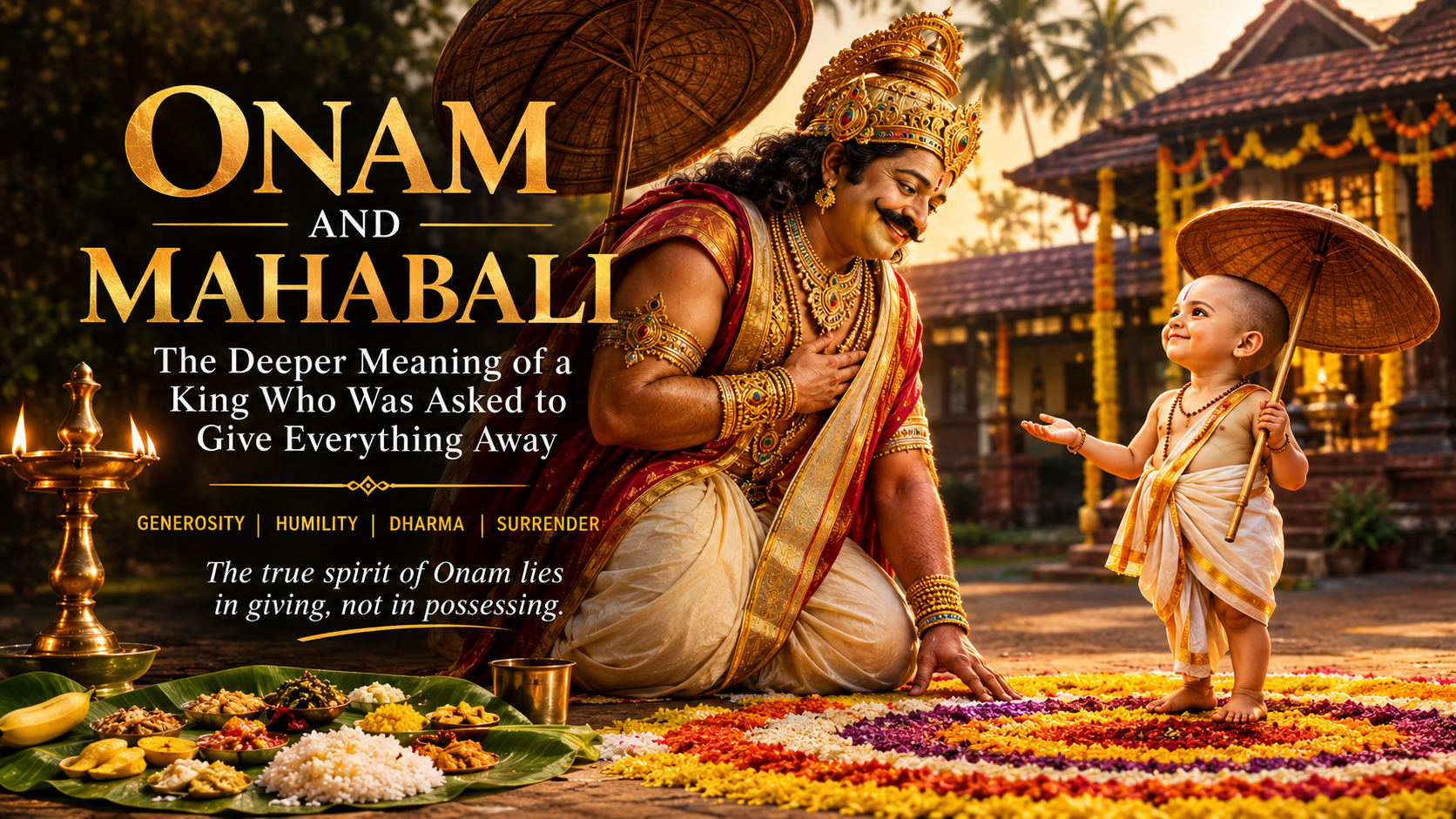
Onam and Mahabali: The Deeper Meaning of a King Who Was Asked to Give Everything Away
Tomorrow, Wednesday, August 26, 2026, is Thiruvonam, the principal day of Onam.
In Kerala, Onam is one of the most important celebrations of the year.
Homes are decorated.
Pookalams are created.
Families gather.
The Onam Sadya is prepared.
Traditional games and cultural celebrations take place.
And beneath all of it is an extraordinary story involving a powerful king, a small Brahmin boy and three steps that changed the meaning of generosity forever.
The story of Mahabali and Vamana is familiar to millions.
But it becomes much more interesting when we stop treating it merely as a story about a king being sent to the underworld.
Because Mahabali is not portrayed as an ordinary villain.
He is remembered as a generous and powerful ruler.
And Vamana is not merely a small child asking for land.
He is Vishnu himself.
The encounter therefore raises a much deeper question:
What happens when generosity, power, ego, Dharma and surrender meet?
That is where the deeper meaning of Onam begins.
When Is Onam in 2026?
In 2026, Thiruvonam falls on Wednesday, August 26.
The Thiruvonam Nakshatra begins at approximately 10:51 PM on August 25 and ends around 12:48 AM on August 27 in Kerala calculations. Onam is determined through the Malayalam solar calendar, with Thiruvonam Nakshatra prevailing during the month of Chingam. :contentReference[oaicite:0]{index=0}
The Kerala Government's 2026 holiday calendar also lists August 26 as Thiruvonam, with August 25 observed as First Onam. :contentReference[oaicite:1]{index=1}
This is important because Onam is not determined in the same way as many lunar festivals.
It belongs to the Malayalam solar calendar.
The principal day is linked to the Nakshatra known as Thiruvonam in Malayalam tradition and Shravana in other Indian calendrical systems.
And that creates an interesting bridge between Onam and Jyotish.
What Is Onam Really Celebrating?
Onam is commonly associated with the annual return of King Mahabali to visit his people.
The traditional story describes Mahabali as a powerful Asura king whose rule was marked by prosperity and generosity.
His subjects were happy.
There was abundance.
There was little poverty.
And Mahabali was known for giving generously.
But his growing power eventually attracted the attention of the Devas.
Vishnu appeared as Vamana, a dwarf Brahmin.
Vamana approached Mahabali during a sacrificial ritual and asked for a seemingly insignificant gift:
Three paces of land.
Mahabali agreed.
What happened next transformed the entire story.
The Three Steps of Vamana
After Mahabali granted the request, Vamana expanded into a cosmic form known as Trivikrama.
With one step, he covered the Earth.
With the second, he covered the heavens.
There was nowhere left for the third step.
Mahabali had promised three steps.
And now the promise had become impossible to fulfil in the ordinary sense.
So Mahabali offered his own head.
The third step was placed upon him.
And Mahabali was sent to Patala, the underworld.
At first glance, this appears to be a story about defeat.
The king loses everything.
His kingdom.
His power.
His position.
His physical freedom.
But the tradition does not remember Mahabali simply as a defeated king.
He is remembered with affection.
And that is where the story becomes much more profound.
Why Is Mahabali Loved If He Lost?
This is perhaps the most interesting question in the entire Onam tradition.
If Mahabali was defeated by Vishnu, why is his return celebrated?
Because Mahabali's character matters.
He was generous.
He was devoted to his promise.
He did not withdraw his word when he realised who Vamana really was.
He could have refused.
He could have argued.
He could have attempted to protect his kingdom.
Instead, he gave what remained.
His own head.
In that moment, the story moves from charity to surrender.
Giving away possessions is one thing.
Giving away one's ego is something else entirely.
Mahabali and the Meaning of Generosity
Generosity is easy when we have excess.
Giving away something we do not need is relatively simple.
But what happens when generosity costs us something?
Mahabali's test begins precisely there.
He has already promised.
The promise has become inconvenient.
The request has turned out to be far greater than expected.
Yet he does not break his word.
This creates an important distinction:
Generosity is not simply giving what we have.
It can also mean remaining faithful to our principles when doing so becomes difficult.
That is why Mahabali remains worthy of respect within the story.
Vamana and the Test of Ego
There is another layer.
Mahabali was powerful.
He had conquered.
He possessed enormous wealth.
He was respected.
He was a successful king.
And perhaps that success itself contained the seed of a problem.
Power can quietly become identity.
We begin with:
"I have power."
Then:
"I am powerful."
Eventually:
"I deserve power."
The distinction disappears.
Vamana's appearance disrupts that certainty.
The king who thought he could give land discovers that he cannot even measure the person asking for it.
The cosmic form of Vamana places Mahabali in front of something much larger than his own conception of power.
Vamana Is Not Simply a Trickster
It is tempting to interpret the story as:
Vishnu tricked Mahabali.
But that misses the philosophical depth of the narrative.
Vamana does not merely take.
He creates a situation in which Mahabali must confront the limits of possession.
The first two steps consume the physical universe.
The third step requires something beyond physical possession.
Mahabali therefore gives himself.
The story moves from:
Land → Kingdom → Self.
That progression is crucial.
What Does the Third Step Really Mean?
The third step can be interpreted symbolically as the movement from possession to surrender.
The first step takes what we own.
The second takes what we think we control.
The third asks:
What remains when everything else is gone?
Mahabali's answer is:
"Myself."
That is why the story has endured.
It is not merely a myth about cosmic measurement.
It is a story about the limits of ownership.
We spend our lives accumulating.
Money.
Property.
Recognition.
Knowledge.
Status.
Relationships.
But eventually, everything we think we possess becomes temporary.
The third step reminds us of that.
The Meaning of Mahabali's Name and Legacy
Mahabali means something like great Bali.
He is remembered as Bali Chakravarti, the great king.
His greatness in the Onam tradition is not simply measured through conquest.
It is measured through character.
He keeps his word.
He gives.
He accepts.
He surrenders.
And perhaps this is why Kerala's Onam tradition celebrates his return rather than his defeat.
The story transforms political power into moral memory.
Why Does Mahabali Return Every Year?
According to the traditional belief, Vishnu granted Mahabali permission to return and visit his people once each year.
That annual return is central to Onam.
The people welcome their beloved king.
The homes are decorated.
Food is prepared.
Pookalams are created.
Families gather.
The festival becomes a celebration of abundance and remembrance.
But there is a beautiful emotional dimension here.
Mahabali's people remember him.
Even after losing his kingdom, his relationship with his people survives.
This suggests another definition of leadership.
A ruler's legacy is not the territory he controls.
It is the relationship he creates with those he serves.
Onam and the Idea of an Ideal Kingdom
Mahabali's kingdom is often remembered as a time of prosperity and equality.
The popular imagination describes a society where people lived without significant hardship and where the king was deeply loved.
This makes Onam more than a religious festival.
It also carries a social ideal.
A good ruler should create prosperity.
A good society should care for its people.
Power should serve rather than merely dominate.
The story therefore contains an implicit question for every generation:
What does a good society look like?
Why Onam Is Called a Harvest Festival
Onam also has a strong agricultural dimension.
It arrives during the period associated with the harvest cycle in Kerala.
The festival celebrates abundance.
Rice.
Flowers.
Vegetables.
Food.
Community.
The famous Onam Sadya itself reflects this abundance.
A large traditional meal is served, often on banana leaves, with numerous vegetarian preparations.
This makes the festival a celebration of nourishment as well as mythology.
The myth of Mahabali and the agricultural rhythm of Kerala therefore come together.
The king returns.
The land gives.
The community gathers.
The harvest becomes a symbol of prosperity.
The Pookalam and the Language of Flowers
One of the most recognisable traditions of Onam is the Pookalam, a floral arrangement created at the entrance of homes.
Flowers are arranged in increasingly elaborate patterns during the days leading up to Thiruvonam.
The Pookalam is more than decoration.
It transforms an ordinary entrance into a welcoming space.
And that is perfectly aligned with the central idea of Onam:
Someone is coming home.
Mahabali is returning.
The house is prepared.
The community is ready.
The flowers become an invitation.
Onam Sadya and the Idea of Abundance
The Onam Sadya is another expression of the festival's central theme.
It is not simply a meal.
It is a shared experience.
Many dishes are prepared.
Food is served together.
People sit together.
The meal follows a traditional structure.
There is an important social principle here.
Abundance becomes meaningful when it is shared.
If prosperity exists only for one individual, it creates isolation.
When prosperity becomes something the community can experience together, it becomes celebration.
This is very close to the ideal represented by Mahabali's kingdom.
Onam and Vishnu
At the centre of the Mahabali story is Vishnu.
Vishnu appears as Vamana to restore cosmic balance.
This is consistent with a recurring theme in Vaishnava traditions:
When Dharma becomes disturbed, divine intervention restores balance.
But the story is not simply:
"Vishnu is good and Mahabali is evil."
That reading is too simplistic.
Mahabali himself possesses admirable qualities.
The tension is more nuanced.
A powerful and generous king becomes extraordinarily dominant.
Vishnu intervenes.
Mahabali loses his worldly position.
But he gains something more subtle.
He becomes immortal in cultural memory.
The Interesting Role of Dharma
Dharma is often reduced to "good behaviour."
But the Mahabali story raises a more difficult question.
What happens when two forms of Dharma appear to conflict?
Mahabali has a duty to rule.
He also has a commitment to generosity.
He has given his word.
Vishnu, meanwhile, acts to restore a larger cosmic balance.
The story therefore creates a tension between:
Personal duty and cosmic order.
That tension appears repeatedly in Indian philosophical literature.
Doing what feels morally right in one context may still have consequences in a larger system.
This is why Dharma is rarely a simple checklist.
Mahabali's Surrender
Perhaps the most important moment in the story is not the first step.
It is not the second.
It is the third.
Mahabali knows that he has nothing left.
And instead of resisting, he offers himself.
This is Atma-samarpana in spirit—the surrender of the self.
Whether one interprets the story literally, devotionally or philosophically, the symbolism is powerful.
The ultimate offering is not money.
Not property.
Not status.
Not ritual objects.
It is the ego itself.
Onam and the Psychology of Possession
Modern life is deeply organised around possession.
My house.
My company.
My money.
My career.
My achievements.
My followers.
My reputation.
My identity.
Possession creates a sense of security.
But it can also create fear.
If something belongs to me, I fear losing it.
The more I possess, the more I have to protect.
Mahabali's story turns this logic upside down.
He becomes most admirable at the exact moment when he possesses the least.
That is a profound idea.
Perhaps our greatness is not measured only by what we can acquire, but by what we can release without losing ourselves.
Onam and the Meaning of Home
There is also something deeply emotional about Mahabali returning home every year.
Home is not simply a physical location.
It is memory.
Belonging.
Recognition.
Relationship.
For the people of Kerala, Onam creates a cultural homecoming even for those living far away.
Families gather.
People travel.
Traditional food is prepared.
Old customs are repeated.
The festival reconnects people with ancestry and place.
That is one reason Onam remains meaningful even for people who engage with it primarily as a cultural celebration.
Onam and Jyotish
For students of Jyotish, Onam offers an interesting point of reflection because its date is linked to Thiruvonam Nakshatra, known as Shravana in the broader Nakshatra system. :contentReference[oaicite:2]{index=2}
Shravana is traditionally associated with the act of hearing.
Its name is connected with listening.
This makes the Nakshatra particularly interesting when placed beside the story of Mahabali.
A king is approached.
A request is made.
A promise is given.
The consequences unfold.
The story itself is transmitted through listening.
The oral tradition matters.
And perhaps that is fitting.
Before we can understand Dharma, we must first learn to listen.
Shravana and Learning
Shravana is traditionally associated with learning through hearing.
In classical Indian educational traditions, knowledge was often transmitted orally.
The student listened.
Remembered.
Repeated.
Contemplated.
The association of Onam with Shravana therefore adds an interesting philosophical layer.
The festival is not only about what happened to Mahabali.
It is also about what we choose to hear from the story.
One person may hear a story about Vishnu.
Another may hear a story about generosity.
Another may hear a story about humility.
Another may hear a story about power.
Another may hear a story about surrender.
The same story can teach different people different things.
Onam and the Balance Between Power and Humility
Mahabali represents power.
Vamana initially appears powerless.
One is a great king.
The other is a small Brahmin boy.
The visual contrast is deliberate.
It reminds us that appearances can be deceptive.
Power is not always visible.
Wisdom is not always loud.
Strength is not always physical.
And humility can coexist with enormous spiritual power.
Vamana's small form becomes cosmic.
Mahabali's enormous kingdom becomes insignificant.
The story therefore dismantles the assumption that size equals power.
Why the Story Still Matters
It is easy to think that ancient stories have little relevance to modern life.
But consider the questions raised by Mahabali:
How much power is enough?
When does success become ego?
Can we keep our word when it becomes inconvenient?
What do we owe the people we lead?
What happens when we lose what we built?
Can surrender be a form of strength?
What does a meaningful legacy look like?
These questions are not ancient.
They are intensely modern.
They apply to business leaders.
Parents.
Politicians.
Entrepreneurs.
Professionals.
And anyone who has ever achieved something significant.
Mahabali and Leadership
Perhaps one of the most contemporary readings of Onam is its idea of leadership.
Mahabali's people loved him.
That is what survives.
Not his military power.
Not his wealth.
Not his kingdom.
His relationship with his people.
This suggests a powerful leadership principle:
People remember how power made them feel.
A leader can control people through fear.
Or create loyalty through trust.
The latter lasts longer.
Onam celebrates a king whose greatest legacy was not domination but belonging.
The Story of Onam Is Not About Losing
The surface story is one of loss.
Mahabali loses his kingdom.
He loses his freedom.
He is sent away.
Yet Onam transforms that loss into a homecoming.
This is a remarkable reversal.
What appears to be defeat becomes remembrance.
What appears to be exile becomes annual return.
What appears to be surrender becomes immortality in cultural memory.
This is perhaps one of the deepest lessons of the festival:
The meaning of an event is not always determined by how it looks at the moment it happens.
What Can We Learn From Mahabali?
Perhaps five lessons stand out.
Generosity: Give without constantly calculating what you will receive.
Humility: Power does not make us larger than Dharma.
Integrity: A promise matters most when keeping it becomes difficult.
Surrender: There are moments when resistance must give way to acceptance.
Legacy: What survives us is often the relationship we created with others.
These are not merely religious values.
They are human values.
What Can We Learn From Vamana?
Vamana offers a different set of lessons.
Do not underestimate appearances.
The small can contain the cosmic.
Power can take many forms.
The ability to transform is itself power.
Dharma may require intervention.
Preserving balance sometimes requires disrupting an existing order.
And perhaps most importantly:
Divine action does not always appear in the form we expect.
Onam Is a Celebration of Return
At its emotional core, Onam is about return.
Mahabali returns.
Families return to one another.
People return to tradition.
The community returns to shared food.
The home is prepared.
The flowers are arranged.
The lamps are lit.
The meal is served.
This is why Onam carries such warmth.
It is not only a festival of mythology.
It is a festival of belonging.
The Deeper Question: What Will We Leave Behind?
Mahabali eventually had to leave his kingdom.
So will every human being eventually leave behind whatever they build.
The question is not whether we will lose our possessions.
We will.
The more important question is:
What will remain after we leave?
Will people remember our wealth?
Our title?
Our possessions?
Or will they remember our generosity?
Our integrity?
Our kindness?
The way we treated people?
That is the question Mahabali's story quietly places before us.
Final Thoughts
Onam will be celebrated on Wednesday, August 26, 2026, with Thiruvonam Nakshatra marking the principal day of the festival. The Kerala Government calendar also lists August 26 as Thiruvonam. :contentReference[oaicite:3]{index=3}
But Onam is much more than a date on the calendar.
It is the story of a king who possessed enormous power but became remembered for his willingness to give.
It is the story of Vamana, whose apparently small form contained something immeasurable.
It is the story of three steps.
Earth.
Heaven.
And finally, the self.
Perhaps that is why Mahabali's story has survived so powerfully.
We spend much of our lives trying to acquire.
More wealth.
More recognition.
More influence.
More security.
Mahabali reminds us of another kind of greatness.
The ability to give.
The ability to keep one's word.
The ability to accept loss.
And ultimately, the ability to surrender.
Tomorrow, when the pookalam is created, the Sadya is served and families gather to celebrate Onam, the story of Mahabali can be remembered in a simple way:
A kingdom can be lost.
Possessions can disappear.
Power can change hands.
But character can become legacy.
And perhaps the greatest measure of a life is not what we managed to keep.
It is what remained of us in the hearts of those we touched.
Learn Jyotish Beyond Simple Planetary Keywords
Onam also offers a fascinating introduction to the relationship between mythology, Nakshatras, Dharma and the deeper symbolic language of Jyotish.
At Futureye, we focus on learning astrology as an interpretive discipline—not merely memorising planetary keywords or making isolated predictions.
Explore Futureye's astrology programs and learn how to interpret Jyotish with structure, context and judgement.
About Futureye
Futureye is a practitioner-focused learning platform for serious students of astrology and occult sciences.
Our programs cover:
- Vedic Astrology
- KP Astrology
- Prashna Shastra
- Palmistry
- Tarot
- Numerology
- AI + Occult
Don't just learn astrology. Learn how to interpret it.
Sources
Drik Panchang — 2026 Thiruvonam / Onam: https://www.drikpanchang.com/festivals/onam/onam-thiruvonam-date.html
Kerala Government — Public Holidays 2026: https://kerala.gov.in/assets/public_uploads/public_holiday_2026.pdf
Kerala Government — 2026 Calendar: https://gad.kerala.gov.in/sites/default/files/inline-files/calender2026_0.pdf
Suggested Internal Links
- Panchang Is More Than a Calendar
- The Fourth Shravan Somwar: Why Monday Holds a Special Place in Shiva Worship
- Mangala Gauri Vrat: Why Tuesdays of Shravan Are Dedicated to Gauri
- Tulsidas Jayanti: Dharma Beyond Prediction
- Karma and Free Will in Vedic Astrology
- The 5th House in Vedic Astrology
- Understanding Nakshatras in Jyotish
Want to understand how Jyotish connects mythology, Nakshatras, Dharma and the deeper patterns of human life?
Explore Futureye's astrology programs and learn how to interpret these connections systematically—not through isolated planetary keywords.
Ready to Learn the Secret Vidya?
Live cohort-based occult mastery — Vedic Astrology, Prashna Shastra, KP, Palmistry, Numerology, Tarot. Taught by Kushal Agarwal, ICAS faculty, with an AI practice agent that drills you on weak topics until they become second nature.
Or reach us at: info@thefutureye.com · +91 6290 273 797