When Nag Panchami Meets a Monday
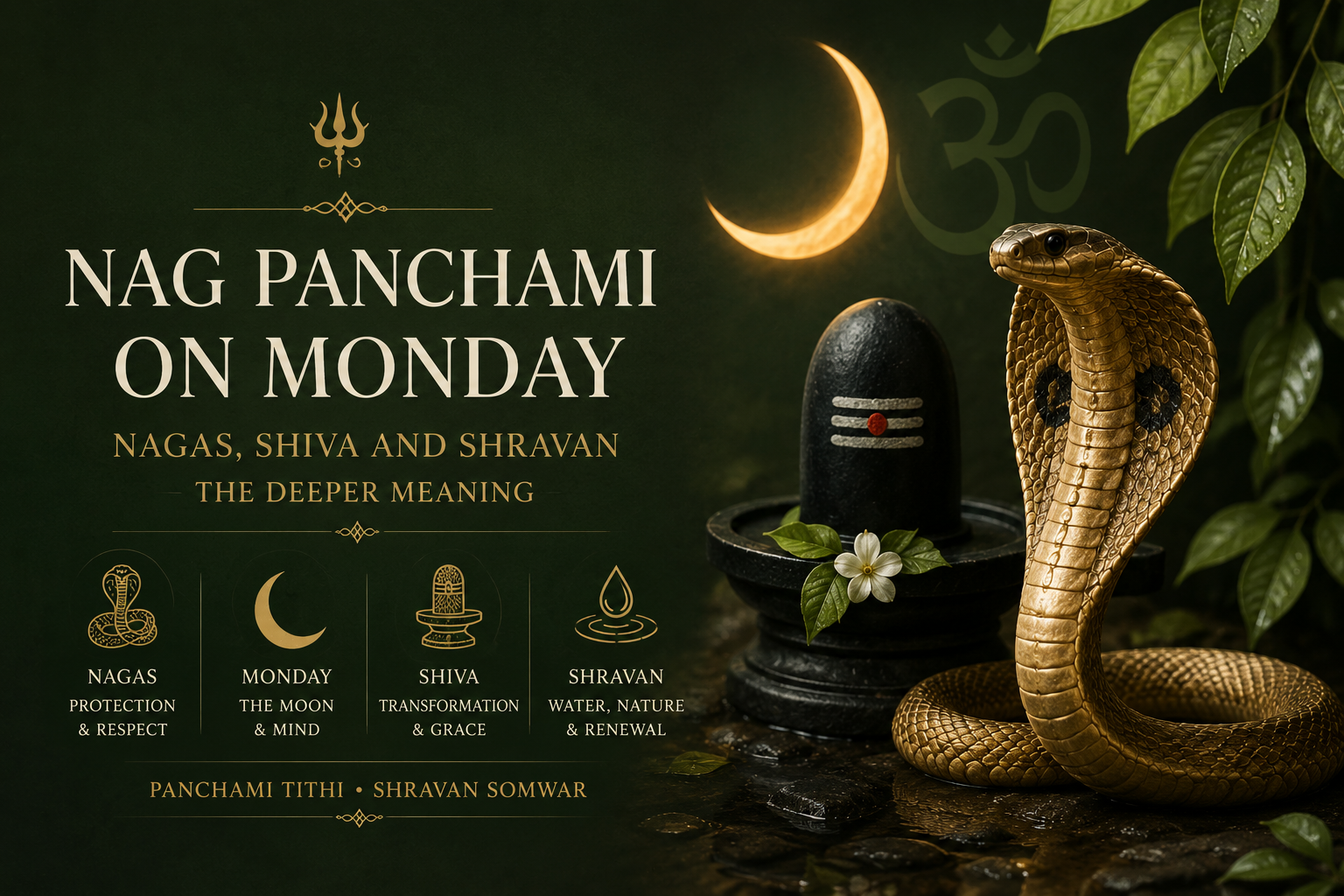
Nag Panchami will be observed on Monday, August 17, 2026.
The festival falls on Shravana Shukla Panchami, the fifth tithi of the bright fortnight of Shravan. What makes this year's observance particularly interesting is that Nag Panchami coincides with the third Shravan Somwar—the Monday traditionally dedicated to Lord Shiva during the month of Shravan.
That creates an interesting meeting of symbolism.
Panchami is associated with the Nagas.
Monday is associated with the Moon.
Shravan is strongly associated with Shiva.
And the serpent is one of the most recognisable symbols associated with Shiva himself.
So is Nag Panchami simply a festival for worshipping snakes?
Or is there a deeper symbolic framework behind the tradition?
For anyone interested in Jyotish, the second question is considerably more interesting.
First, What Is Nag Panchami?
Nag Panchami is observed on Shukla Paksha Panchami in the month of Shravan.
The word "Naga" refers to the serpent, but the traditional idea of the Naga is considerably broader than the ordinary image of a snake.
Across Indian traditions, Nagas appear as powerful supernatural beings associated with water, fertility, subterranean realms, protection and hidden forces.
They are neither simply "good" nor simply "evil."
They are beings to be respected.
This is important because modern interpretations sometimes reduce Nag Panchami to one simple instruction:
"Worship snakes."
The traditional symbolism is richer.
The Naga represents a force that can protect, nourish and sustain—but which must also be approached with respect.
That is particularly appropriate during Shravan, a month strongly connected with water, fertility, vegetation and Shiva worship.
Why Is Panchami Associated With Nagas?
The festival is defined by Panchami Tithi.
In traditional Jyotish, each tithi carries its own character and associations.
Nag Panchami therefore isn't simply a festival that happens to occur during Shravan.
The Panchami itself is part of the identity of the observance.
This is one of the reasons understanding the Hindu calendar requires more than converting a festival into a Gregorian date.
August 17 is useful as a calendar date.
But astrologically, the more meaningful description is:
Shravana Shukla Panchami.
The tithi tells us where we are within the lunar cycle.
The month tells us the broader seasonal and religious context.
The weekday adds another layer.
And in this case, all three come together unusually neatly.
Why Does Monday Matter?
Monday is Somvar.
The Sanskrit name itself is connected with Soma, traditionally associated with the Moon.
In Jyotish, the Moon represents the mind, emotional receptivity, nourishment, memory and subjective experience.
Monday therefore has a distinctly lunar character.
At the same time, Monday is traditionally associated with Shiva worship.
This is why Shravan Mondays—Shravan Somwar—are particularly important in many Shaiva traditions.
Now consider what happens on August 17, 2026.
Nag Panchami falls on a Monday.
So the festival's Naga symbolism meets the lunar and Shiva symbolism of Somvar.
That gives the day an additional layer of meaning.
It is not necessary to claim that every Monday Nag Panchami is automatically "more powerful" in a measurable sense.
A more responsible interpretation is that the traditional symbols reinforce one another.
The Serpent and Shiva
Perhaps the most familiar Naga symbolism comes from Lord Shiva himself.
The serpent around Shiva's neck is one of the defining images of Shaiva iconography.
That image is not merely decorative.
The serpent is traditionally understood through several layers of symbolism.
It can represent fear and danger.
It can represent hidden power.
It can represent transformation.
It can represent forces that cannot simply be controlled through ordinary means.
And in the imagery of Shiva, the serpent exists in a relationship with a deity who represents mastery over fear, attachment and destructive forces.
This gives Nag Panchami an important philosophical dimension.
The festival is not necessarily about eliminating everything that frightens us.
It is about learning to approach powerful forces with reverence rather than arrogance.
Why Are Nagas Connected With Water?
The monsoon setting of Nag Panchami is important.
Shravan falls during the Indian monsoon season.
Water is central to the agricultural cycle, and traditional Indian culture developed a deep relationship with rivers, wells, lakes, underground water systems and rainfall.
Nagas are frequently associated with water bodies and subterranean realms in traditional stories.
This makes the festival particularly appropriate for the season.
The Naga becomes a symbolic guardian of forces that remain largely invisible but are essential to life.
We see the rainfall.
We do not see the underground water systems that sustain communities.
We see the river.
We do not necessarily see everything happening beneath the surface.
The serpent becomes an appropriate symbol for such hidden dimensions.
The Hidden Is an Important Theme
This is where Nag Panchami becomes interesting from a Jyotish perspective.
Serpents naturally live close to the ground.
They move through places that humans cannot easily see.
They appear suddenly and disappear suddenly.
They shed their skin.
They inhabit spaces between what is visible and what is hidden.
Symbolically, these characteristics make the serpent an excellent representation of transformation and concealed forces.
Jyotish itself constantly asks us to look beneath the obvious.
A planet may appear strong by one criterion and weak by another.
A seemingly fortunate placement may produce complicated results.
A difficult placement may eventually produce maturity.
The visible chart is only the beginning.
Interpretation requires looking underneath.
Nagas, Rahu and Ketu
It is tempting to immediately equate Nagas with Rahu and Ketu.
There is certainly a strong symbolic relationship between serpent imagery and the lunar nodes in Indian astrological tradition.
Rahu and Ketu are represented in serpent-like forms in various traditional depictions and are intimately connected with eclipse symbolism.
But we should be careful about reducing every Naga reference to Rahu and Ketu.
Naga symbolism is older and broader than any one modern astrological interpretation.
Still, the comparison is useful.
Rahu and Ketu are not physical planets.
They are the lunar nodes—the points where the paths of the Sun and Moon intersect.
They are therefore directly connected with the eclipse mechanism.
And the serpent becomes a powerful symbolic bridge between:
- Hidden forces
- Cycles of transformation
- Eclipse symbolism
- The unseen
- Fear
- Desire
- Detachment
- Renewal
This is one reason Nag Panchami can be particularly fascinating for students of Jyotish.
Should Nag Panchami Be Treated as a "Rahu-Ketu Remedy"?
This is where some caution is necessary.
You will often find claims that Nag Panchami is the most powerful day to remove every form of Rahu-Ketu affliction or something called "Kaal Sarp Dosh."
Such claims are much stronger than the tradition itself necessarily requires.
A festival should not be reduced to a commercial remedy.
If a person has a specific horoscope question involving Rahu, Ketu, the nodes, ancestral symbolism or serpent-related traditions, that horoscope should be examined on its own terms.
There is no substitute for chart analysis.
Nag Panchami can certainly be observed as a day of reverence toward the Naga tradition.
It does not need exaggerated promises of instant astrological correction.
The Importance of Respect
There is another important point that deserves attention.
Traditional serpent worship should not be interpreted as an instruction to capture wild snakes, handle them, or force-feed them milk.
Snakes are wild animals, and approaching or handling them can be dangerous for both humans and the animals.
The religious symbolism can be honoured without harming wildlife.
In many homes and temples, Nag Panchami observances involve symbolic images, idols, drawings, prayers, offerings and visits to temples.
The underlying principle is reverence.
Not spectacle.
Why Milk Is Associated With Nag Panchami
Milk is one of the most familiar offerings associated with Nag Panchami.
The practice has deep cultural visibility.
But it is worth separating ritual symbolism from zoological reality.
Snakes do not naturally consume milk as a normal part of their diet.
A live snake should therefore never be forced to drink milk.
The offering can instead be made symbolically before a Naga image, deity or shrine.
This preserves the devotional meaning without turning religious practice into something harmful to an animal.
Tradition does not become weaker when it is practiced responsibly.
Nag Panchami and the Feminine Principle
There is another layer that is sometimes overlooked.
Serpent traditions in India are frequently connected with fertility, land and the generative powers of nature.
This becomes particularly meaningful during the monsoon.
The earth receives water.
Seeds germinate.
Agricultural activity begins.
The landscape transforms.
The serpent, which lives close to the earth, becomes part of this larger symbolic ecosystem.
Nag Panchami can therefore be viewed not merely as "snake worship" but as an expression of respect for the living systems that surround human life.
Why Shravan Changes the Context
If Nag Panchami occurred in a completely different month, its interpretation would still remain rooted in the Panchami tithi and Naga tradition.
But occurring in Shravan adds another dimension.
Shravan is traditionally one of the most important months for Shiva worship.
Devotees undertake fasts, visit Shiva temples and perform Abhisheka.
The Moon and water symbolism also becomes especially prominent.
Now place Nag Panchami inside that environment.
The serpent.
The Moon.
Water.
Shiva.
The monsoon.
Panchami.
These aren't random symbols placed together.
They form a coherent traditional landscape.
What Makes August 17, 2026 Interesting?
The 2026 calendar creates a particularly elegant combination.
Nag Panchami occurs on Monday, August 17.
The day is simultaneously:
Shravana Shukla Panchami
and
Shravan Somwar.
Panchami brings the Naga association.
Somvar brings the lunar and Shiva association.
Shravan provides the larger Shaiva and monsoon context.
This is why the date is worth discussing from an astrological and cultural perspective.
Not because Monday magically transforms the festival into something else.
But because several layers of traditional symbolism converge on the same day.
A Jyotish Lesson Hidden Inside Nag Panchami
There is actually a useful lesson here for students of astrology.
Astrology is often taught through isolated meanings.
Monday means Moon.
Panchami means Naga.
Shravan means Shiva.
Rahu means serpent.
But real interpretation does not work by simply collecting keywords.
The interesting part begins when the symbols interact.
That is exactly what happens in chart interpretation.
A planet does not operate independently of its house.
A house does not operate independently of its lord.
A dasha does not operate independently of the natal promise.
Likewise, a festival should not necessarily be understood through one symbol alone.
The meaning emerges from the combination.
What Can You Do on Nag Panchami?
For devotees who observe Nag Panchami, the day can be approached simply.
You may:
- Offer prayers to Naga Devatas.
- Visit a Shiva temple.
- Perform Shiva Abhisheka according to your tradition.
- Offer milk or other prescribed offerings symbolically at a shrine rather than to live snakes.
- Recite Shiva or Naga-related prayers.
- Observe a fast if that is part of your family or spiritual practice.
- Spend some time reflecting on fear, transformation and respect for nature.
- Avoid harming snakes and other living creatures.
The precise ritual varies considerably across regions and traditions.
There is no need to assume that one regional practice represents the only authentic form of Nag Panchami.
What Should You Avoid?
The most important thing is to avoid turning the festival into superstition or spectacle.
Do not handle snakes for photographs.
Do not feed milk to wild snakes.
Do not believe that one ritual automatically erases every planetary affliction in a birth chart.
And do not allow fear-based astrologers to convince you that something terrible will happen unless you perform an expensive remedy.
Spiritual practice is most meaningful when it is rooted in reverence rather than fear.
Nag Panchami Is More Than a Festival About Snakes
Perhaps the most interesting way to understand Nag Panchami is to stop thinking of it as a festival "about snakes."
It is a festival about our relationship with forces that are powerful, hidden and beyond ordinary human control.
The serpent becomes the symbol.
The monsoon provides the setting.
Shravan provides the religious context.
Shiva provides the divine association.
Panchami provides the lunar framework.
And Monday adds the lunar-Shaiva dimension.
Seen this way, Nag Panchami becomes much more than a ritual date on a calendar.
It becomes a meditation on respect.
Respect for nature.
Respect for forces we do not fully understand.
Respect for transformation.
And perhaps most importantly, respect for the limits of human control.
The Deeper Meaning of the Serpent
A snake sheds its skin but does not cease to be a snake.
That makes it a remarkably powerful symbol of transformation.
Something old is discarded.
Something new emerges.
The essential identity remains, but the outer form changes.
Human life works similarly.
We move through identities.
Careers change.
Relationships change.
Beliefs change.
Priorities change.
Sometimes transformation feels frightening precisely because the old form is familiar.
The serpent reminds us that renewal often requires leaving something behind.
That is a message that remains meaningful even outside a specifically religious interpretation.
This Monday, Look Beyond the Ritual
Nag Panchami on Monday gives devotees an opportunity to observe a traditional festival.
But it also offers something else.
A chance to slow down.
To think about the relationship between fear and reverence.
Between nature and civilisation.
Between visible and invisible forces.
Between what we try to control and what we must learn to respect.
For students of Jyotish, it is also a reminder that symbols become meaningful through context.
A serpent is not merely a serpent.
A Monday is not merely a Monday.
A tithi is not merely a date.
And a festival is not merely a ritual.
The deeper meaning emerges when the pieces are understood together.
Final Thoughts
Nag Panchami on Monday, August 17, 2026, brings together several important strands of Indian tradition.
It is Shukla Panchami in Shravan.
It is also Shravan Somwar.
Panchami connects the observance with the Naga tradition.
Monday brings the symbolism of Soma and the Moon, while Shravan brings the strong Shaiva context.
The serpent around Shiva's neck provides perhaps the most visible connection between these themes.
But the festival need not be reduced to a list of astrological remedies.
Its deeper message can be much simpler.
Respect what is powerful.
Respect what is hidden.
Respect nature.
And understand that transformation is not always something to fear.
For the student of Jyotish, Nag Panchami offers another valuable lesson:
Never stop at the symbol. Look for the relationship between the symbols.
That is where interpretation begins.
Ready to Learn Astrology Beyond Simple Symbolism?
If you want to understand how Jyotish moves beyond memorising planetary meanings and into actual interpretation, explore the astrology programs at Futureye.
Learn how planets, houses, signs, nakshatras, dashas and transits work together to create a structured framework for astrological analysis.
Don't just learn what a planet means. Learn how to interpret what it means in context.
About Futureye
Futureye is a practitioner-focused learning platform for serious students of astrology and occult sciences.
Our programs cover:
- Vedic Astrology
- KP Astrology
- Prashna Shastra
- Palmistry
- Tarot
- Numerology
- AI + Occult
Our philosophy is simple:
Don't just learn astrology. Learn how to interpret it.
Sources
Drik Panchang — Nag Panchami 2026: https://www.drikpanchang.com/festivals/nag-panchami/nag-panchami-date-time.html
Drik Panchang — August 2026 Hindu Festivals: https://www.drikpanchang.com/festivals/month/festivals-august.html
Panchang Now — Kolkata Panchang for August 17, 2026: https://www.panchang.now/panchang/kolkata/2026-08-17
Want to understand the deeper logic behind Jyotish rather than simply memorising astrological meanings?
Explore Futureye's astrology programs and learn how to interpret astrology as a practitioner.
Ready to Learn the Secret Vidya?
Live cohort-based occult mastery — Vedic Astrology, Prashna Shastra, KP, Palmistry, Numerology, Tarot. Taught by Kushal Agarwal, ICAS faculty, with an AI practice agent that drills you on weak topics until they become second nature.
Or reach us at: info@thefutureye.com · +91 6290 273 797