The Fourth Shravan Somwar: Why Monday Holds a Special Place in Shiva Worship
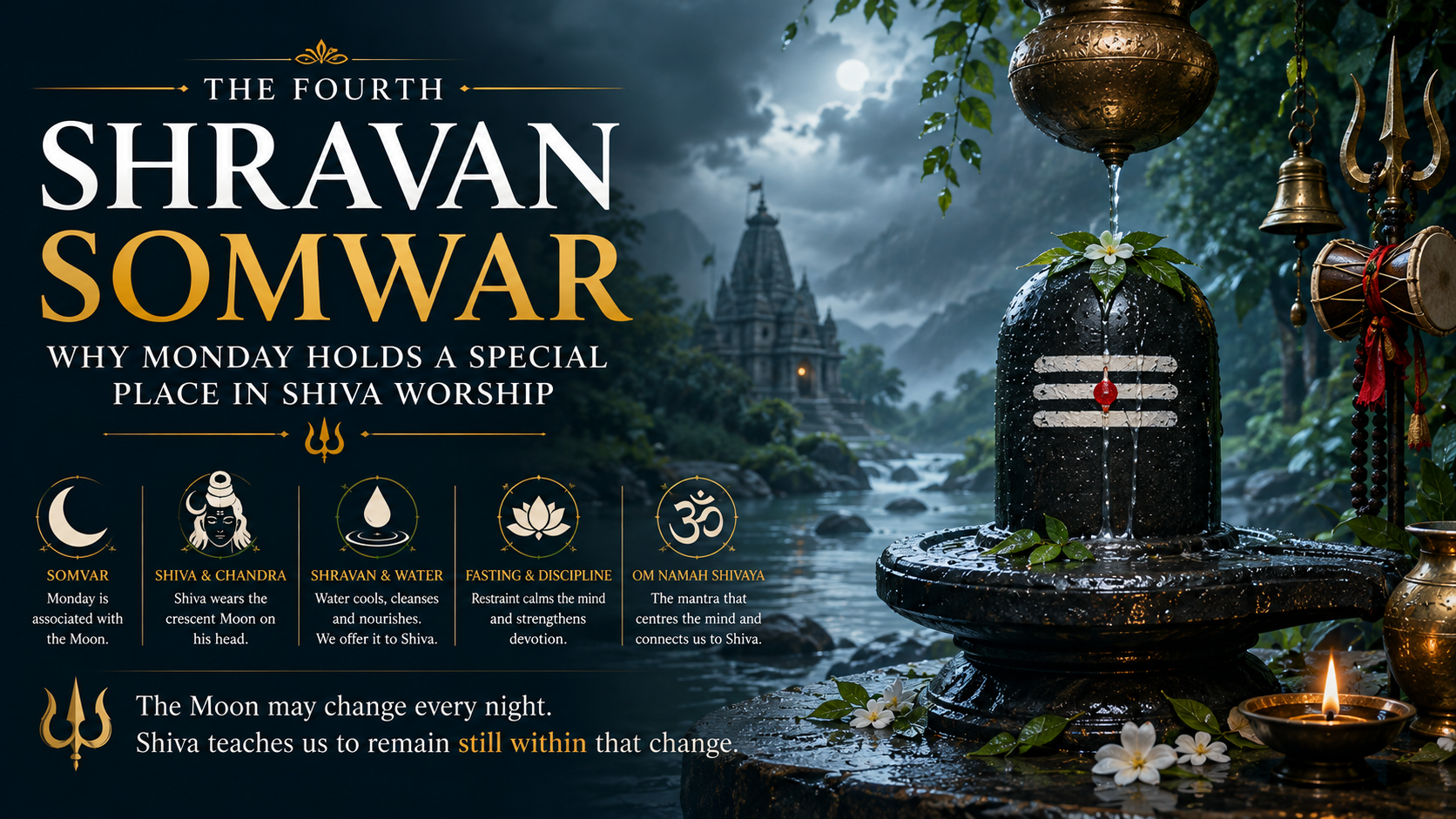
Tomorrow, Monday, August 24, 2026, marks the fourth Shravan Somwar in the North Indian Shravan calendar.
For millions of devotees, Shravan is already a month of heightened devotion to Lord Shiva.
But Mondays occupy a special position within that month.
People fast.
Shiva temples become crowded.
Water and milk are offered to the Shiva Lingam.
The mantra "Om Namah Shivaya" is recited.
Some devotees undertake elaborate rituals, while others simply visit a temple and sit quietly before Shiva.
But why Monday?
Why is Somvar associated so strongly with Shiv Ji?
And why does a Monday during Shravan carry additional significance?
The answer becomes particularly interesting when we look at the connection between Shiva, the Moon, water, the mind and the lunar calendar.
What Is Shravan Somwar?
Shravan Somwar simply means the Monday occurring during the month of Shravan.
Shravan is a lunar month, and its dates vary depending on the regional calendar tradition.
In the North Indian calendar, Shravan began on July 30, 2026.
The four Shravan Mondays fall on:
August 3
August 10
August 17
August 24
Therefore, August 24 is the fourth Shravan Somwar in this calendar system. :contentReference[oaicite:0]{index=0}
Some other regional calendars follow an Amanta system and may have different month boundaries and observance dates.
This is an important point when discussing Hindu festivals.
The Gregorian calendar gives us a fixed date.
The traditional Hindu calendar works through lunar and solar relationships.
That is why regional observances can sometimes differ.
Why Is Monday Called Somvar?
The answer is hidden in the name itself.
Monday is Somvar.
"Soma" is associated with the Moon.
In Jyotish, the Moon is Chandra.
This creates one of the most important symbolic connections behind Monday worship.
Monday is associated with the Moon.
Shiva is depicted wearing the crescent Moon on his head.
Therefore, Monday's association with Shiva is not an arbitrary assignment.
The relationship between Soma, Chandra and Shiva is deeply embedded in Indian religious and astrological symbolism.
This also explains why Monday has significance for Shiva worship throughout the year—not only during Shravan.
Shiva and the Moon
Look at almost any traditional depiction of Lord Shiva.
You will find the crescent Moon in his matted hair.
This is known as the Chandrashekhara aspect of Shiva—Shiva who bears the Moon.
The Moon is not merely an ornament in this imagery.
It carries symbolic meaning.
In Jyotish, the Moon represents the mind, emotional experience, memory, receptivity and nourishment.
It is also the primary marker through which the traditional lunar calendar is structured.
This makes the relationship between Shiva and the Moon particularly interesting.
The deity associated with stillness and transcendence carries upon his head the symbol associated with the constantly changing mind.
The symbolism is powerful.
The Moon changes every night.
Shiva remains still.
The mind fluctuates.
Consciousness can remain centred.
That contrast gives us one possible way of understanding the image.
The Mind and Shiva
The Moon is perhaps the most psychologically relevant Graha in Jyotish.
The Sun represents a more stable principle of identity and vitality.
The Moon changes constantly.
Waxing.
Waning.
Bright.
Dark.
Visible.
Hidden.
This makes Chandra a natural symbol for the changing mind.
And Shiva is traditionally associated with meditation, stillness and inner awareness.
Put these together and a philosophical idea emerges:
The mind may change constantly, but awareness does not have to be controlled by every change of the mind.
This is one reason Shiva worship can have such a strong contemplative dimension.
The objective is not necessarily to stop thoughts.
It is to develop a different relationship with them.
Why Is Shravan Special?
Monday already has a Shiva association.
Shravan adds another layer.
Shravan is traditionally regarded as a particularly sacred month for Shiva worship.
The monsoon season provides the physical background.
The landscape is transformed by water.
Rivers swell.
Vegetation becomes abundant.
The earth becomes fertile.
The atmosphere changes.
And water becomes one of the central elements of religious practice.
Devotees offer water to Shiva.
The Kanwar tradition involves carrying sacred Ganga water.
Abhisheka becomes an important form of worship.
Thus, Shravan creates an environment in which the symbolism of water and Shiva becomes especially prominent.
Why Do We Pour Water Over the Shiva Lingam?
The ritual of Abhisheka is one of the most recognisable forms of Shiva worship.
Water is poured over the Shiva Lingam while prayers or mantras are recited.
At a basic level, water is an offering.
But symbolically, it carries several meanings.
Water cools.
Water cleanses.
Water nourishes.
Water sustains life.
Water flows.
Water also adapts to whatever vessel contains it.
These qualities make water an appropriate symbol in a tradition associated with surrender and transformation.
The devotee takes something essential and offers it back to the divine.
The ritual is simple.
But its symbolism is profound.
The Story of Shiva and Halahala
The connection between water and Shiva also becomes particularly evocative through the story of the Samudra Manthan.
During the churning of the cosmic ocean, a deadly poison known as Halahala emerged.
Its destructive power was so great that it threatened the universe.
Shiva consumed the poison to protect creation.
The poison remained in his throat, giving rise to the name Neelkantha, the blue-throated one.
The image is one of Shiva containing something destructive without allowing it to spread through the world.
This is a powerful metaphor for emotional and psychological life.
We encounter anger.
Fear.
Grief.
Jealousy.
Pain.
We cannot always prevent these experiences from appearing.
But we can learn not to allow every emotion to control our actions.
The symbolism of Shiva offers precisely that possibility.
Shravan Somwar and Emotional Discipline
This is where the Moon becomes relevant again.
If Chandra represents the mind, then Shiva worship during a lunar month can be understood as an opportunity for emotional discipline.
A Monday fast is not simply about avoiding food.
It creates a deliberate interruption in routine.
Instead of automatically satisfying every appetite, the devotee practises restraint.
Instead of reacting immediately, there is an opportunity to pause.
Instead of allowing the mind to move continuously outward, attention is redirected toward prayer.
This does not mean that fasting automatically produces spiritual transformation.
The intention behind the practice matters.
But ritual can create the structure within which discipline becomes possible.
Why Do People Fast on Shravan Mondays?
Different communities follow different forms of fasting.
Some people consume only fruits or specific fasting foods.
Some avoid grains.
Some observe a stricter fast.
Some simply practise dietary restraint while maintaining their normal responsibilities.
There is no single universal Shravan Somwar practice followed identically throughout India.
The common principle is vrata.
A vrata is not simply a diet.
It is an intentional discipline.
The individual voluntarily accepts a restriction in order to direct attention toward a particular spiritual objective.
That makes fasting less about punishment and more about conscious choice.
Fasting and the Psychology of Desire
Human beings are constantly responding to impulses.
Hunger.
Comfort.
Entertainment.
Attention.
Recognition.
Pleasure.
We are accustomed to satisfying these impulses quickly.
Fasting introduces a small gap between desire and action.
"I want this."
But I do not immediately act on it.
That gap can be valuable.
It teaches restraint.
And restraint is one of the recurring themes of spiritual practice.
This is also why Shravan Somwar can be understood beyond the question of whether fasting "works" as an astrological remedy.
Its psychological value can exist independently of supernatural claims.
Is Shravan Somwar an Astrological Remedy?
This is where caution is necessary.
You will often see claims that fasting on Monday will automatically cure every Moon-related problem.
Or that it will guarantee marriage.
Or remove every emotional difficulty.
Or fulfil any wish.
Such statements are much too simplistic.
Traditional remedial astrology does contain associations between planets, deities, mantras, fasting and ritual practices.
But a responsible astrologer should never turn these into universal guarantees.
A horoscope must be examined in context.
If someone is dealing with a Moon-related issue, the Moon's sign, house, dignity, aspects, conjunctions, Nakshatra, dasha and the broader chart all matter.
A Monday fast cannot replace interpretation.
Shiva Is Not Simply "The Moon"
Another common mistake is to create rigid one-to-one equations.
"Shiva equals Moon."
Or:
"Shiva is the planet Moon."
That is not an adequate representation of the tradition.
Shiva is a deity with an enormous philosophical and theological framework.
The Moon is a Graha with its own astrological significations.
There are symbolic relationships between them.
Shiva wears the Moon.
Monday is associated with Soma.
The lunar calendar determines Shravan.
But symbolic association should not be confused with literal identity.
This distinction is important for serious students of Jyotish.
Why the Fourth Shravan Somwar Matters
The fourth Monday has a special quality simply because it marks the culmination of the four-Monday sequence in the North Indian Shravan calendar.
For devotees who have observed all four Mondays, August 24 becomes the final Monday of this year's Shravan observance in that calendar.
The significance is therefore not necessarily that the fourth Monday possesses a magical property unavailable on the first three.
Its meaning can instead come from completion.
Beginning.
Continuity.
Discipline.
Completion.
A person makes a commitment.
They repeat it.
And eventually they reach the end.
That itself is spiritually meaningful.
The Importance of Repetition
One of the most underestimated aspects of traditional practice is repetition.
A mantra is repeated.
A fast is repeated.
A temple visit is repeated.
An offering is repeated.
A pilgrimage may be repeated.
Why?
Because transformation rarely happens through one dramatic event.
It often happens through repeated attention.
The mind is constantly distracted.
Repetition creates an anchor.
This is one reason mantra and ritual have survived for centuries.
Their power is not necessarily in novelty.
It is in consistency.
"Om Namah Shivaya"
Few mantras are more closely associated with Shiva than:
Om Namah Shivaya
The Panchakshara mantra is traditionally understood through the five syllables Na-Ma-Shi-Va-Ya.
It is widely recited in Shaiva traditions.
The meaning is often broadly understood as an act of reverence or surrender to Shiva.
What makes the mantra particularly interesting is its simplicity.
No elaborate philosophical argument is required to repeat it.
The practitioner simply returns to the sound.
Again.
And again.
And again.
That repetition can itself become a form of meditation.
Shiva and the Idea of Stillness
Modern life rewards movement.
More work.
More information.
More communication.
More achievement.
More consumption.
Shiva represents almost the opposite image.
He sits.
He meditates.
He remains still.
He is surrounded by symbols of death, transformation and impermanence.
The message is not that action is wrong.
It is that action without stillness can become compulsive.
We need periods in which we stop.
Observe.
Reflect.
And allow the mind to settle.
Shravan provides a cultural framework for doing precisely that.
The Moon's Waxing and Waning
There is another beautiful lesson hidden in the Moon symbolism.
The Moon is never permanently full.
It grows.
It reaches fullness.
It decreases.
It disappears.
Then the cycle begins again.
Human emotional life is similar.
There are periods of confidence.
Periods of uncertainty.
Periods of expansion.
Periods of withdrawal.
Periods of clarity.
Periods of confusion.
The Moon reminds us that change is not necessarily failure.
A waning Moon is not a "bad Moon."
It is part of the cycle.
This is an important philosophical lesson for anyone interested in astrology.
The Mind Does Not Need to Be Perfect
If the Moon represents the mind, perhaps one lesson of Shiva's crescent Moon is that the mind does not have to become permanently still before spiritual practice can begin.
The Moon continues to change.
It simply rests upon Shiva.
In the same way, thoughts may continue to arise.
Emotions may continue to fluctuate.
The objective is not necessarily to eliminate them.
It is to avoid becoming completely identified with every movement of the mind.
This is a much more mature understanding of meditation than simply "stop thinking."
Shravan Somwar and the Idea of Surrender
There is a subtle difference between resignation and surrender.
Resignation says:
"I cannot do anything, so I give up."
Surrender says:
"I will do what is within my control, and I will release my attachment to the outcome."
These are very different.
The devotee fasts.
Prays.
Offers water.
Visits the temple.
Recites mantra.
These are acts of effort.
But after the effort comes surrender.
The outcome is placed beyond personal control.
This relationship between effort and surrender appears repeatedly in Indian spiritual philosophy.
What Can We Learn From Shiva?
Perhaps the most useful lesson is not about receiving blessings.
It is about becoming capable of carrying difficulty.
Shiva carries poison.
He carries the Ganga.
He carries the Moon.
He carries the serpent.
He carries the responsibility of protecting creation.
The symbolism repeatedly presents a figure capable of holding powerful and potentially dangerous forces without being destroyed by them.
For a human being, that can become a powerful metaphor.
Can we hold anger without becoming violent?
Can we hold grief without becoming consumed by it?
Can we hold success without becoming arrogant?
Can we hold desire without becoming its servant?
That is a far deeper question than simply asking for good fortune.
The Fourth Monday as a Moment of Reflection
If you observe the fourth Shravan Somwar tomorrow, perhaps the day can be used for more than ritual.
Ask yourself:
What has been occupying my mind?
What am I unnecessarily attached to?
Where do I react too quickly?
Where do I need greater discipline?
What should I release?
What should I preserve?
Where do I need more stillness?
These questions connect the symbolism of Shiva and the Moon with everyday life.
And they require no elaborate ritual.
What About Those Who Do Not Fast?
Nothing prevents someone from observing Shravan Somwar without fasting.
Devotional practice varies.
A person may visit a temple.
Recite a mantra.
Offer water.
Meditate.
Read Shiva-related scriptures.
Perform charity.
Or simply spend a few quiet minutes reflecting on the qualities represented by Shiva.
The essence of a spiritual observance should not become a competition in austerity.
The practice should ideally produce greater awareness, not greater ego.
The Deeper Meaning of Somvar
Perhaps the deepest meaning of Somvar can be expressed in one sentence:
Learn to relate differently to the mind.
The Moon changes.
The mind changes.
But Shiva remains the symbol of stillness beneath that change.
That is why the Monday-Shiva connection is so beautiful.
The day associated with the changing Moon becomes a day dedicated to the deity who carries the Moon upon his head.
It is almost as if the symbolism is saying:
You do not have to stop the mind from changing. You have to learn how to hold it.
Final Thoughts
The fourth Shravan Somwar falls on Monday, August 24, 2026, in the North Indian Shravan calendar. It is also observed as the fourth Shravan Somwar Vrat in the traditional calendar listings. :contentReference[oaicite:1]{index=1}
But the significance of the day does not need to be reduced to a list of rituals.
Monday is Somvar.
Somvar is associated with Soma and the Moon.
Shiva wears the Moon.
Shravan is a lunar month strongly associated with Shiva worship.
The monsoon brings water.
Water is offered to Shiva.
Fasting introduces restraint.
Mantra creates repetition.
And devotion creates a framework for surrender.
All these symbols point toward a larger idea.
Stillness in the presence of change.
The Moon will continue to wax and wane.
The mind will continue to fluctuate.
Circumstances will continue to change.
We cannot control all of that.
But we can learn how we respond.
Perhaps that is the deeper lesson of Shravan Somwar.
Not that Shiva will remove every difficulty from our lives.
But that through devotion, discipline and awareness, we may become better equipped to carry what life places before us.
Tomorrow, when millions of devotees offer water to Shiva, the ritual can therefore be understood in a very simple way.
Offer the water.
Offer the prayer.
Offer the desire.
And then, for a moment, become still.
Om Namah Shivaya.
Learn Jyotish Beyond Simple Remedies
The Moon, Shiva, Monday and Shravan are connected through layers of traditional symbolism—but serious Jyotish requires more than assigning one deity to one planet.
To interpret a horoscope properly, students need to understand planets, houses, signs, Nakshatras, Dashas, transits and the relationships between them.
At Futureye, we focus on learning astrology as an interpretive discipline rather than a collection of fear-based remedies.
Explore Futureye's astrology programs and learn how to interpret Jyotish with structure, context and judgement.
About Futureye
Futureye is a practitioner-focused learning platform for serious students of astrology and occult sciences.
Our programs cover:
- Vedic Astrology
- KP Astrology
- Prashna Shastra
- Palmistry
- Tarot
- Numerology
- AI + Occult
Don't just learn astrology. Learn how to interpret it.
Sources
Drik Panchang — Shravana 2026 Festivals: https://www.drikpanchang.com/festivals/lunar-month/festivals-shravana.html
Drik Panchang — August 24, 2026 Panchang: https://www.drikpanchang.com/panchang/day-panchang.html?date=24/08/2026
Times of India — Weekly Panchanga, August 24–30, 2026: https://timesofindia.indiatimes.com/astrology/horoscope/weekly-panchanga-2430-august-2026-raksha-bandhan-putrada-ekadashi-onam-lunar-eclipse-and-shubh-muhuratas/articleshow/133407654.cms
Suggested Internal Links
- Saavan and Shiv Ji: Why Shravan Is Sacred to Lord Shiva
- Panchang Is More Than a Calendar
- The Moon in Vedic Astrology: Understanding Chandra
- The 12th House Is Not Just the House of Loss
- Nag Panchami: The Deeper Meaning of Nagas, Shiva and Shravan
- Karma and Free Will in Vedic Astrology
Want to understand the deeper relationship between planets, deities, Tithis and traditional Jyotish?
Explore Futureye's astrology programs and learn how to interpret astrology beyond simple planetary keywords and remedies.
Ready to Learn the Secret Vidya?
Live cohort-based occult mastery — Vedic Astrology, Prashna Shastra, KP, Palmistry, Numerology, Tarot. Taught by Kushal Agarwal, ICAS faculty, with an AI practice agent that drills you on weak topics until they become second nature.
Or reach us at: info@thefutureye.com · +91 6290 273 797