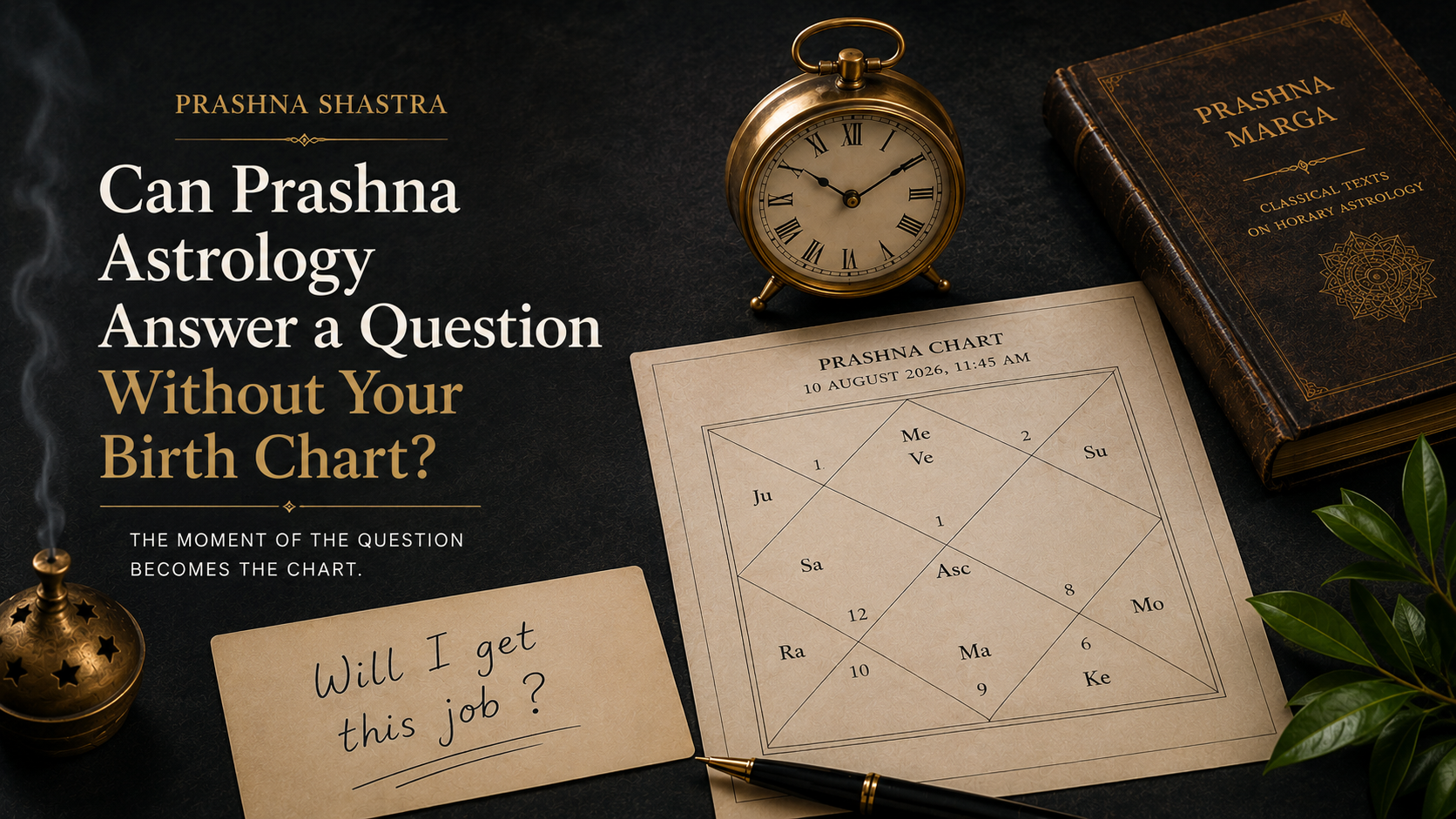
Yes. Prashna Shastra can be used to investigate a specific question without relying on the querent's birth chart.
Instead of starting from the moment of birth, Prashna begins with the moment a meaningful question is asked or received and a chart is cast for that moment. The astrologer then judges the relevant houses, their lords, the Ascendant, Moon, planetary relationships, and other Prashna techniques to assess the situation and its likely outcome. Classical horary traditions in Indian astrology include texts such as Prashna Marga and Prashna Tantra. :contentReference[oaicite:0]{index=0}
Key Takeaways
- Prashna is designed around a specific question, not a complete life reading.
- A birth chart is not essential for a Prashna reading.
- The moment of the question becomes the foundation of the chart.
- The Ascendant represents the querent and the relevant house represents the matter being asked about.
- The Moon is an important indicator of the unfolding situation.
- The astrologer must first identify the correct houses before interpreting planets.
- Prashna is particularly useful when birth details are unavailable or unreliable.
- Asking the same question repeatedly simply to obtain a preferred answer defeats the purpose of the method.
Imagine this.
You are waiting for a job offer.
The interview went well.
The recruiter said they would get back to you.
Three days have passed.
You don't know your exact birth time.
You don't even have your horoscope with you.
But you have one very specific question:
"Will I get this job?"
This is precisely the kind of situation in which Prashna becomes interesting.
Instead of asking you for your date, time, and place of birth, a Prashna astrologer works with the question itself and the moment at which it is asked or received.
That makes Prashna fundamentally different from natal astrology.
And it is also why Prashna is one of the most practical branches of Jyotish for a practicing astrologer.
What Is Prashna Shastra?
The Sanskrit word Prashna means "question."
Prashna Shastra, therefore, is essentially the astrology of a question.
The basic idea is simple:
A person has a genuine concern.
The concern reaches the point where it becomes a clearly formulated question.
That moment is treated as significant.
A chart is then constructed for the relevant time and place, and the astrologer interprets that chart to understand the situation.
Classical Indian astrology has an established literature devoted to this form of horary judgment. Prashna Marga, associated with the Kerala tradition, is one of the best-known classical works on the subject, while Prashna Tantra is another important text in the horary tradition. :contentReference[oaicite:1]{index=1}
So Prashna is not simply a modern trick for people who lost their birth certificates.
It has its own methodology and textual tradition.
How Is Prashna Different From a Birth Chart?
A natal horoscope begins with one question:
"What does this life look like?"
Prashna begins with a different question:
"What is happening with this specific matter right now?"
That distinction changes the entire approach.
A birth chart can be used to investigate broad areas such as:
- Career
- Marriage
- Wealth
- Education
- Health
- Children
- Personality
- Long-term life patterns
Prashna is much more focused.
You might ask:
"Will I receive this promotion?"
"Will this property deal happen?"
"Will I get this particular job?"
"Will this person contact me?"
"Will my lost item be recovered?"
The question defines the field of investigation.
That is one of Prashna's greatest strengths.
The Moment Becomes the Starting Point
In natal astrology, the birth moment is the foundation.
In Prashna, the relevant question moment becomes the foundation.
This is why exact timing matters.
The astrologer needs to establish the moment at which the question is genuinely understood and accepted for judgment, according to the particular Prashna tradition being followed.
The chart is then cast for that moment and location.
From there, the astrologer begins with the Ascendant.
What Does the Ascendant Represent?
The Ascendant, or Lagna, represents the person asking the question.
This makes intuitive sense.
If the question is:
"Will I get this job?"
the Lagna represents you.
The house representing the job represents the matter you are asking about.
The astrologer then studies the relationship between the two.
This is one of the first major principles a Prashna student needs to understand.
Don't start by asking:
"What does Mars mean?"
Start by asking:
"Who represents whom?"
That shift completely changes the way you read a Prashna chart.
The House of the Question
Every Prashna requires the astrologer to identify the relevant house.
For example:
| Question | Primary Area to Examine |
|---|---|
| Will I get the job? | 10th house |
| Will I get married? | 7th house |
| Will I make money from this deal? | 2nd and 11th houses |
| Will I buy this property? | 4th house |
| Will I win the competition? | Relevant competitive houses |
| Will I travel? | Relevant travel houses |
| Will this litigation succeed? | Houses connected with the dispute |
These are starting points, not complete formulas.
A serious Prashna judgment requires supporting houses, house lords, planetary strength, aspects, significators, and timing.
The important lesson is:
The question determines the architecture of the analysis.
Why the Moon Matters
The Moon is particularly important in predictive astrology because it moves quickly and reflects the unfolding of circumstances.
In Prashna, astrologers pay close attention to the Moon's:
- Sign
- House
- Nakshatra
- Lordship
- Aspects
- Previous condition
- Applying and separating relationships
The Moon can help describe what has already happened, what is developing, and where the matter is moving.
This makes it especially useful for questions involving changing situations.
For example, consider someone asking:
"Will this negotiation succeed?"
The answer isn't necessarily sitting in one static combination.
The situation is moving.
The Moon can provide information about that movement.
The Question Must Be Genuine
This is where Prashna becomes very different from randomly generating charts.
A Prashna is not meant to be a game.
You shouldn't keep asking:
"Will I get the job?"
Then:
"Are you sure?"
Then:
"Let me ask again."
Then:
"What if I ask from another city?"
That destroys the purpose of the exercise.
The astrologer needs a genuine question arising from a genuine situation.
Some traditional approaches place considerable importance on the sincerity and appropriateness of the question before proceeding with judgment. :contentReference[oaicite:2]{index=2}
This is not merely spiritual etiquette.
It is essential to methodology.
If the question itself is meaningless, the resulting interpretation becomes difficult to structure.
What If You Don't Know Your Birth Time?
This is one of Prashna's most practical applications.
Suppose someone knows:
- Date of birth
- Birthplace
but has no reliable birth time.
A natal chart may require rectification before it can be used confidently.
Prashna offers another route.
Instead of spending the first stage of the consultation trying to reconstruct the past, the astrologer can address the specific issue that brought the person to the consultation.
For example:
"Will my business survive this year?"
or
"Will I get the job I interviewed for?"
The astrologer can examine that specific question through Prashna.
That doesn't mean Prashna replaces natal astrology.
It means the two methods answer different kinds of questions.
When Prashna Is Better Than Natal Astrology
Suppose someone asks:
"Tell me everything about my career."
That's a natal-chart question.
Now suppose they ask:
"Will I receive an offer from Company X this month?"
That's far more suitable for Prashna.
Prashna works particularly well when:
- The question is specific.
- The situation is current.
- A decision is approaching.
- Birth time is unavailable.
- The person needs a focused judgment.
- The question involves a particular event.
For broad life analysis, the natal chart usually offers a much larger framework.
The mistake is not choosing one system over another.
The mistake is using the wrong tool for the question.
Can Prashna Predict the Future?
This depends on what we mean by "predict."
Prashna is designed to judge the development and likely outcome of a specific matter.
A skilled practitioner may assess whether an event is supported, obstructed, delayed, or likely to materialise, and may use appropriate timing techniques to refine the judgment.
But Prashna should not be marketed as a magical yes/no machine.
The quality of the result depends on:
- The quality of the question.
- Correct chart calculation.
- Appropriate house identification.
- The method being followed.
- The astrologer's interpretive skill.
- Timing techniques.
The chart is not a substitute for judgment.
The astrologer still has to interpret it.
The Biggest Mistake Beginners Make
The biggest mistake is treating Prashna as a collection of isolated rules.
For example:
"Moon in this house means yes."
"Saturn means delay."
"Jupiter means success."
That isn't professional prediction.
A serious Prashna practitioner builds a chain of evidence.
For a job question, the astrologer may examine:
Querent → 10th house → 10th lord → relevant significators → Moon → planetary relationships → timing
The more independent indicators support the same conclusion, the stronger the judgment becomes.
This is the mindset Futureye students should develop.
Don't hunt for one combination.
Build the case.
A Practical Prashna Workflow
If you're learning Prashna, use this sequence every time.
Step 1: Write the Question Clearly
Avoid:
"Tell me about my career."
Prefer:
"Will I receive the job offer from Company X?"
Step 2: Establish the Prashna Moment
Record the exact time and location according to the tradition and method you are following.
Step 3: Judge the Lagna
The Ascendant and its lord provide information about the querent and the overall condition of the matter.
Step 4: Identify the Relevant House
Determine which house represents the question.
Step 5: Examine the House and Its Lord
Study occupancy, dignity, aspects, and relationships.
Step 6: Examine the Moon
Look at its condition and movement in the context of the question.
Step 7: Build the Significator Chain
Identify the planets that connect the querent and the matter being asked about.
Step 8: Judge the Outcome
Don't make a prediction until multiple indicators have been considered.
Step 9: Look at Timing
If the method supports timing, identify when the promised event is likely to materialise.
Prashna Is Not Just "Astrology Without Birth Time"
This is an important distinction.
If you think Prashna is simply a shortcut for people who don't know their birth time, you have missed its deeper purpose.
Prashna has its own logic.
It is a specialised method for interrogating a specific situation.
The absence of a birth chart is therefore not the defining feature.
The question is.
That is why a person who has an accurate natal chart can still consult Prashna for a particular event.
The two charts can answer different questions.
The Futureye Approach to Prashna
At Futureye, Prashna should be learned as a predictive discipline—not as a list of lucky and unlucky placements.
A serious student should become comfortable with:
- Question formulation
- House selection
- Lagna analysis
- Moon analysis
- House lords
- Significators
- Planetary relationships
- Timing
- Classical Prashna principles
- Real-chart practice
Most importantly, students should learn to explain why they reached a conclusion.
If your prediction is:
"Yes, the job will happen."
you should be able to explain exactly why.
Which house represents the job?
Which planet represents the querent?
What connects them?
What supports the event?
What creates the timing?
That is what turns Prashna from intuition into a repeatable predictive framework.
Frequently Asked Questions
Can Prashna Astrology work without a birth time?
Yes. A Prashna chart is based on the relevant question moment rather than the person's birth time.
Is Prashna the same as a birth chart?
No. A natal chart studies the horoscope of birth, while Prashna examines a specific question through a chart associated with the moment of inquiry.
What kind of questions can be asked in Prashna?
Prashna can be applied to specific questions involving relationships, employment, business, property, travel, education, disputes, finances, and other concrete situations.
Can I ask the same Prashna question multiple times?
Repeatedly asking the same question simply to obtain a different answer is generally discouraged in traditional practice. The question should arise from a genuine concern.
Is Prashna better than a natal chart?
Neither is universally better. They serve different purposes. A natal chart is better suited to broad life analysis, while Prashna is particularly useful for focused questions about specific situations.
Does Prashna always give a yes or no answer?
No. A serious Prashna judgment may indicate yes, no, delay, uncertainty, conditions, or a changing outcome. Forcing every chart into a binary answer can oversimplify the method.
Final Thoughts
Prashna is one of the most useful tools an astrologer can learn because it teaches a fundamental lesson:
Good astrology starts with a good question.
The birth chart tells the story of a life.
Prashna interrogates a moment.
And when the question is specific, sincere, and important, that distinction becomes incredibly powerful.
If you're serious about becoming a practicing astrologer, don't treat Prashna as a shortcut.
Learn the framework.
Learn the classical principles.
Read hundreds of charts.
Make predictions.
Record the outcomes.
Then refine your judgment.
That is how Prashna becomes a skill.
Ready to Learn Prashna Shastra?
If you want to learn how professional astrologers approach specific questions using Prashna Shastra, explore the Futureye Prashna Astrology program.
You'll learn structured Prashna analysis, relevant houses, planetary relationships, timing techniques, and practical chart interpretation through live, practitioner-focused training.
Download the Prashna Prospectus and see how the complete program is structured.
About Futureye
Futureye is a practitioner-focused learning platform for serious students of astrology and occult sciences.
Our programs cover:
- Vedic Astrology
- Prashna Shastra
- KP Astrology
- Tarot
- Numerology
- Palmistry
- AI + Occult
The philosophy is simple:
Don't just learn astrology. Build your prediction system.
Sources
- Prashna Marga — classical Kerala text on Prashna/Horary Astrology. :contentReference[oaicite:3]{index=3}
- Prashna Tantra — classical Indian horary astrology text. :contentReference[oaicite:4]{index=4}
- Paramarsh, "Prashna (Horary) Astrology: Reading the Question." :contentReference[oaicite:5]{index=5}
Suggested Internal Links
Link this article to:
- Futureye Prashna Shastra category page
- "What Is Prashna Shastra? A Complete Beginner's Guide"
- "Prashna vs Vedic Astrology: Which Should You Use?"
- "How to Frame the Perfect Prashna Question"
- "KP Horary vs Traditional Prashna: What's the Difference?"
Suggested Schema
- Article
- FAQPage
- BreadcrumbList
Social Media Summary
Prashna is one of the most practical branches of Jyotish—but most beginners misunderstand it.
You don't need a birth chart to ask a Prashna.
You need a genuine question.
In this article, we break down how Prashna works, why the moment of inquiry matters, how the relevant house is identified, and how a practitioner should actually build a prediction.
LinkedIn Post
You don't always need a birth chart to ask astrology a serious question.
That's the whole point of Prashna Shastra.
Instead of beginning with your birth details, Prashna begins with a specific question and examines the chart associated with the moment of inquiry.
But here's where beginners go wrong:
They treat Prashna like a yes/no machine.
"Jupiter is here → YES."
"Saturn is there → NO."
That's not prediction.
A serious Prashna practitioner builds a chain:
Question → Querent → Relevant House → House Lord → Moon → Significators → Timing → Judgment.
The question comes first.
The chart comes second.
And interpretation is everything.
I wrote about how Prashna actually works—and why it deserves to be learned as a serious predictive discipline.
Read the full article on Futureye.
#Prashna #Jyotish #VedicAstrology #Astrology #Futureye
X Thread
1/ You don't always need a birth chart to ask astrology a serious question.
That's the whole idea behind Prashna Shastra.
2/ Prashna begins with a specific question and a chart associated with the moment of inquiry.
Not your birth time.
The question is the starting point.
3/ But Prashna isn't a magical yes/no machine.
"Jupiter = yes."
"Saturn = no."
That's beginner astrology.
4/ A serious practitioner asks:
Who is the querent?
What house represents the question?
What does its lord do?
What does the Moon show?
Which planets connect the two?
5/ The biggest skill in Prashna isn't memorising combinations.
It's building a chain of evidence.
6/ That's why Prashna is worth learning properly.
It forces you to think like a practitioner.
7/ Full guide:
Can Prashna Astrology Answer a Question Without Your Birth Chart?
Read it on Futureye.
Newsletter Summary
Subject: You Don't Always Need a Birth Chart
Preview: What Prashna Shastra can tell you from the moment you ask a question.
Summary:
What if you have an urgent question but don't know your exact birth time?
That's where Prashna Shastra becomes fascinating.
This week's Futureye article explains how Prashna works, why the moment of inquiry matters, how astrologers identify the relevant house, and why professional Prashna is far more sophisticated than simply looking for a yes or no.
Learn the framework behind one of Jyotish's most practical predictive disciplines.
Ready to Learn the Secret Vidya?
Live cohort-based occult mastery — Vedic Astrology, Prashna Shastra, KP, Palmistry, Numerology, Tarot. Taught by Kushal Agarwal, ICAS faculty, with an AI practice agent that drills you on weak topics until they become second nature.
Or reach us at: info@thefutureye.com · +91 6290 273 797