Direct Answer
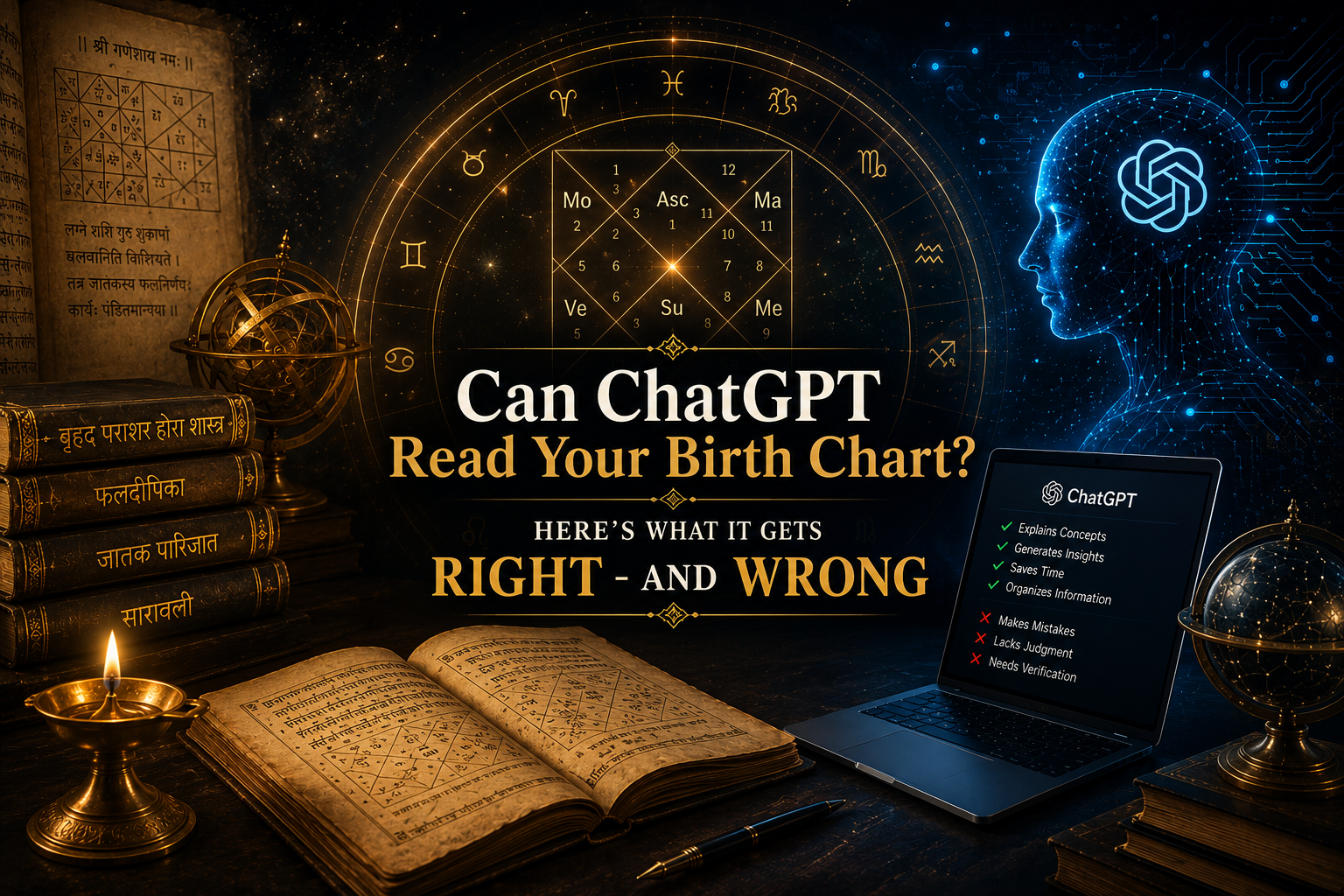
Yes, ChatGPT can help interpret a birth chart—but it cannot reliably calculate one or replace the judgment of a trained astrologer.
When given accurate birth chart data, ChatGPT excels at explaining planetary combinations, translating technical concepts into simple language, generating consultation reports, and brainstorming multiple interpretations. However, it can also confidently produce incorrect astrological calculations, mix different systems of astrology, or invent chart details if the input is incomplete.
Professional astrologers don't use AI to replace astrology. They use it to become faster, more consistent, and more productive while relying on classical principles for the final judgment.
Key Takeaways
- ChatGPT should interpret verified chart data—not calculate planetary positions.
- AI dramatically improves productivity but still makes factual mistakes.
- Classical Jyotish knowledge remains the foundation of accurate prediction.
- The best astrologers of the future will combine traditional techniques with AI-assisted workflows.
- Beginners should learn astrology first and AI second.
- AI is a powerful assistant, not an infallible astrologer.
If you're asking whether ChatGPT can accurately read your horoscope, the answer is yes—with important conditions.
Give ChatGPT a correctly generated birth chart, a clear methodology, and specific questions, and it can produce surprisingly useful interpretations.
Ask it to calculate your horoscope from scratch, identify obscure KP sub-lords without verification, or make definitive life predictions without context, and the quality drops quickly.
Think of ChatGPT as an incredibly fast research assistant that has read thousands of astrology books—but still needs supervision from someone who understands Jyotish.
Why This Question Matters More Than Ever
Search for "AI astrology" today, and you'll find hundreds of websites claiming artificial intelligence can predict your future in seconds.
Some promise instant birth chart readings.
Others claim AI is more accurate than human astrologers.
At the opposite extreme, many astrologers dismiss AI entirely, arguing that no machine can understand karma, free will, or planetary consciousness.
The truth lies somewhere in between.
Artificial intelligence is changing how astrology is practiced—not because it has mastered Jyotish, but because it can dramatically reduce the time spent on repetitive work.
The astrologers who understand this distinction will have a significant advantage over those who either fear AI or trust it blindly.
What ChatGPT Actually Does
One of the biggest misconceptions is that ChatGPT is an astrology software.
It isn't.
ChatGPT is a large language model (LLM) trained to recognize patterns in language.
It doesn't observe the sky.
It doesn't calculate planetary positions.
It doesn't generate horoscopes from astronomical data.
Instead, it predicts the next most likely word based on the information you provide.
That distinction is crucial.
When you paste accurate chart data into ChatGPT, it can explain the chart because it has learned from vast amounts of text discussing astrology.
When you ask it to calculate the chart itself, it is no longer working within its strength.
What ChatGPT Gets Right
Used correctly, ChatGPT can save astrologers hours every week.
It is particularly effective at:
- Explaining complex yogas in plain English
- Translating Sanskrit terminology for beginners
- Drafting detailed consultation reports
- Comparing multiple astrological combinations
- Creating educational material
- Suggesting questions to ask during consultations
- Producing structured lesson notes
- Summarizing classical astrology texts
- Generating social media content and newsletters
- Brainstorming alternative interpretations without replacing the astrologer's judgment
For astrology teachers, content creators, and consultants, these tasks consume a surprising amount of time.
AI reduces that workload dramatically.
Instead of spending two hours formatting a client report, you can spend those two hours studying charts or consulting clients.
That is where AI creates real value.
What ChatGPT Gets Wrong
Now comes the part most AI enthusiasts don't like discussing.
ChatGPT can be incredibly persuasive even when it is completely wrong.
This phenomenon—known as hallucination—occurs when an AI model generates information that sounds convincing but has no factual basis.
In astrology, hallucinations can be especially dangerous because many beginners lack the experience to recognize subtle errors.
Some common mistakes include:
- Inventing planetary positions that don't exist.
- Mixing Western tropical astrology with Vedic sidereal astrology.
- Ignoring ayanamsa differences.
- Confusing houses, signs, and nakshatras.
- Misidentifying yogas.
- Applying textbook meanings without considering context.
- Producing contradictory interpretations within the same reading.
The language remains fluent.
The confidence remains high.
But the interpretation may still be wrong.
That is why professional astrologers never treat AI as the final authority.
They treat it as an assistant whose work must be reviewed.
Why AI Struggles with KP Astrology
If you've studied even the basics of KP Astrology (Krishnamurti Paddhati), you've probably noticed something interesting.
Two astrologers can look at the same horoscope and reach different conclusions—not because one of them is wrong, but because KP is a system of hierarchy and judgment, not just information.
ChatGPT knows what a sub-lord is.
It can explain the 249 sub-divisions.
It can describe ruling planets.
But knowing the definitions is not the same as applying KP correctly.
A professional KP astrologer asks questions like:
- Which cuspal sub-lord is actually relevant?
- Which significators deserve priority?
- Is this promise supported in the natal chart?
- Is the current dasha capable of delivering the event?
- Do the ruling planets confirm the judgment?
These are not questions with one-line answers.
They require prioritization.
AI is very good at listing possibilities.
Astrologers are paid for identifying probabilities.
That difference is enormous.
Prashna Is Even More Challenging
Prashna Shastra is often described as the astrology of the moment.
In reality, it is the astrology of the right question asked at the right time.
A Prashna chart is not interpreted in isolation.
An experienced practitioner considers:
- the intention behind the question,
- the context,
- the timing,
- the planetary promise,
- and often, subtle observational clues from the consultation itself.
None of this is naturally available to an AI model.
If you simply type:
"Will I get married?"
ChatGPT has almost no meaningful context.
If you instead provide:
- verified Prashna chart data,
- the exact question,
- the KP or classical methodology you follow,
- and the houses you want analyzed,
the quality of the response improves dramatically.
AI performs best when the astrologer frames the problem correctly.
The Futureye AI Workflow
At Futureye, we recommend a simple rule:
Let software calculate. Let AI organize. Let the astrologer decide.
This three-step workflow dramatically reduces mistakes while saving hours every week.
| Step | Tool | Responsibility |
|---|---|---|
| 1 | Astrology software | Generate the horoscope accurately. |
| 2 | AI (ChatGPT, Claude, Gemini) | Explain, organize, summarize, compare, draft reports. |
| 3 | Astrologer | Verify, prioritize, judge, and make the final prediction. |
Notice what AI is not doing.
It isn't deciding whether marriage will happen.
It isn't promising a promotion.
It isn't predicting the exact timing of an event.
Those responsibilities remain with the practitioner.
The moment you outsource judgment to AI, you also outsource accountability.
Professional astrologers can't afford that.
ChatGPT vs Claude vs Gemini for Astrology
Many students ask us:
"Which AI should I use?"
The answer depends on the task.
| Task | ChatGPT | Claude | Gemini |
|---|---|---|---|
| Explaining concepts | Excellent | Excellent | Very Good |
| Writing reports | Excellent | Excellent | Good |
| Long-form analysis | Excellent | Outstanding | Good |
| Educational content | Excellent | Excellent | Very Good |
| Brainstorming interpretations | Excellent | Excellent | Good |
| Fact-checking against sources | Good (with browsing where available) | Good | Good |
No model is a perfect astrologer.
Each is simply a different assistant.
The quality of your prompt will usually have a greater impact than the model you choose.
The Biggest Mistake Beginners Make
Most beginners ask AI questions like this:
"Read my horoscope."
That prompt is almost guaranteed to produce a generic answer.
Professional astrologers ask much better questions.
For example:
"Interpret this chart using classical Parashari principles. Prioritize Lagna, Lagnesh, Moon, Vimshottari Dasha, Yogas, and avoid psychological generalizations. Explain your reasoning before giving a conclusion."
See the difference?
The first prompt asks AI to guess.
The second tells AI exactly how to think.
Prompt engineering is rapidly becoming a professional skill for astrologers.
The better your instructions, the more useful the output becomes.
AI Doesn't Replace Experience
Imagine two astrologers.
The first has studied astrology seriously for ten years.
The second discovered ChatGPT last week.
Both use the exact same prompt.
Will they produce the same consultation?
Of course not.
The experienced astrologer immediately notices if AI overlooks an important yoga, misinterprets a dasha, or gives too much importance to a minor combination.
The beginner often cannot distinguish between a brilliant explanation and a confident mistake.
AI doesn't eliminate the need to study.
It actually rewards those who already understand the subject.
Knowledge becomes leverage.
Can You Trust AI With Client Consultations?
Yes—but only after you've verified every important conclusion yourself.
If you're consulting clients professionally, your reputation is your most valuable asset.
One incorrect prediction doesn't just affect a single consultation—it can damage trust, referrals, and long-term credibility.
A simple rule can protect you:
Never tell a client something solely because AI said it. Tell them because your astrological judgment agrees with it.
AI should strengthen your confidence, not become its source.
A Practical Workflow Every Astrologer Can Follow
Whether you're studying Vedic Astrology, KP Astrology, or Prashna Shastra, the workflow remains surprisingly similar.
Step 1: Generate an Accurate Chart
Use reliable astrology software to calculate:
- Birth chart
- Divisional charts
- Vimshottari Dasha
- KP cusps and sub-lords (if applicable)
- Planetary strengths
Never ask an AI chatbot to perform astronomical calculations.
Step 2: Define Your Methodology
Tell the AI exactly how you want the chart analyzed.
For example:
- Classical Parashari only
- KP methodology only
- Marriage analysis
- Career analysis
- Health analysis
- Prashna interpretation
Specific prompts consistently outperform vague ones.
Step 3: Ask Focused Questions
Instead of:
"Tell me everything."
Ask:
- Which planets dominate this horoscope?
- What combinations support career growth?
- Which yogas deserve the highest priority?
- What are the strengths and weaknesses of the Lagna?
- What factors delay marriage?
- Which dasha periods deserve closer attention?
Focused questions produce focused answers.
Step 4: Verify Everything
Before accepting any conclusion, verify it against:
- Classical texts
- Your own chart-reading methodology
- Multiple combinations
- Dasha and transit timing
- Practical experience
AI should become part of your workflow—not your replacement.
Common Myths About AI in Astrology
Myth 1: AI Knows Astrology Better Than Humans
Reality:
AI has access to enormous amounts of astrological information.
That doesn't mean it understands astrology better than an experienced practitioner.
Knowledge isn't the same as judgment.
Myth 2: AI Can Predict the Future
Reality:
AI predicts language.
Astrologers predict possibilities based on astrological principles.
These are completely different skills.
Myth 3: Learning Astrology Is No Longer Necessary
Reality:
AI makes good astrologers more productive.
It makes poorly trained astrologers more confidently wrong.
The better your foundation, the more useful AI becomes.
Myth 4: AI Will Replace Astrologers
Reality:
History suggests something different.
Calculators didn't replace accountants.
Spreadsheet software didn't replace financial analysts.
Medical software didn't replace doctors.
Instead, professionals who adopted better tools became more productive than those who ignored them.
Astrology is likely to follow the same path.
Frequently Asked Questions
Can ChatGPT calculate my birth chart?
No.
ChatGPT is not an astronomical calculation engine.
Always generate your horoscope using reliable astrology software before asking AI to interpret it.
Can ChatGPT identify yogas accurately?
It often can—provided you've supplied accurate chart data.
However, you should always verify important yogas yourself, especially before making predictions for clients.
Is AI useful for KP Astrology?
Yes, particularly for explaining KP concepts, organizing observations, summarizing significators, and drafting reports.
However, deciding event promise, prioritizing significators, and confirming timing should remain the astrologer's responsibility.
Is Claude better than ChatGPT for astrology?
Both are excellent language models.
The quality of the chart data and the prompt usually matter more than the choice of model.
Use whichever integrates best into your workflow.
Should beginner astrologers use AI?
Yes—but only as a learning assistant.
Use AI to clarify concepts, summarize classical texts, and practice interpretation.
Do not depend on it for final predictions until you've developed a strong understanding of astrology yourself.
Will AI replace professional astrologers?
Highly unlikely.
What is far more likely is that astrologers who learn to work effectively with AI will outperform those who refuse to adopt modern tools.
Final Thoughts
The debate isn't whether AI can read a birth chart.
It can.
The real question is whether you know enough astrology to recognize when AI is right—and when it is confidently wrong.
That's the difference between an AI user and an AI-assisted astrologer.
The future of astrology won't belong to people who reject technology.
Nor will it belong to people who blindly trust it.
It will belong to practitioners who combine timeless astrological wisdom with modern tools to serve clients better, faster, and more accurately.
Remember this simple principle:
Software calculates. AI assists. The astrologer decides.
If you build your practice around that philosophy, you'll not only become a better astrologer—you'll be ready for the future of the profession.
Ready to Learn Astrology Professionally?
Watching random YouTube videos can teach isolated concepts.
It won't teach you how to think like a practicing astrologer.
At Futureye, our live cohort-based programs are designed for students who want to become confident practitioners—not just collectors of astrological knowledge.
Whether you're interested in:
- Vedic Astrology (Parashari)
- KP Astrology (Krishnamurti Paddhati)
- Prashna Shastra
- Tarot
- Palmistry
- Numerology
- AI-assisted Astrology
our structured programs focus on practical chart reading, predictive techniques, and real consultation skills.
Download the relevant course prospectus or contact our team to discover which program best matches your goals.
About Futureye
Futureye is an education platform dedicated to helping aspiring astrologers and occult practitioners build practical prediction skills.
Our mission is simple:
Teach astrology that works in real consultations.
Through live cohort-based learning, structured curricula, and practitioner-led guidance, Futureye helps students move beyond theory into confident chart interpretation.
Whether you're beginning your journey or looking to master advanced systems like KP Astrology and Prashna Shastra, Futureye provides a structured path toward becoming a professional practitioner.
Explore more at https://thefutureye.com
Sources
- OpenAI. ChatGPT Overview and Safety Documentation. https://openai.com/chatgpt
- Google DeepMind. Gemini Documentation. https://deepmind.google/technologies/gemini/
- Anthropic. Claude Documentation. https://docs.anthropic.com/
- Government of India, Ministry of Electronics & Information Technology. IndiaAI Mission. https://indiaai.gov.in/
- B. V. Raman. How to Judge a Horoscope.
- K. S. Krishnamurti. KP Readers (Volumes 1–6).
- Mantreswara. Phaladeepika.
- Maharshi Parashara. Brihat Parashara Hora Shastra.
Ignorance becomes risk.
The Real Competitive Advantage
Many people believe AI is the competitive advantage.
It isn't.
The competitive advantage is knowing what to ask AI and what to ignore.
That's why two astrologers using the same AI model can produce consultations of vastly different quality.
One simply copies the output.
The other questions it, improves it, cross-checks it against classical principles, and delivers a refined interpretation.
The client never sees the workflow.
They only experience a faster, clearer, more professional consultation.
That is where AI creates value—not by replacing astrologers, but by amplifying the abilities of those who know their craft.
Ready to Learn the Secret Vidya?
Live cohort-based occult mastery — Vedic Astrology, Prashna Shastra, KP, Palmistry, Numerology, Tarot. Taught by Kushal Agarwal, ICAS faculty, with an AI practice agent that drills you on weak topics until they become second nature.
Or reach us at: info@thefutureye.com · +91 6290 273 797