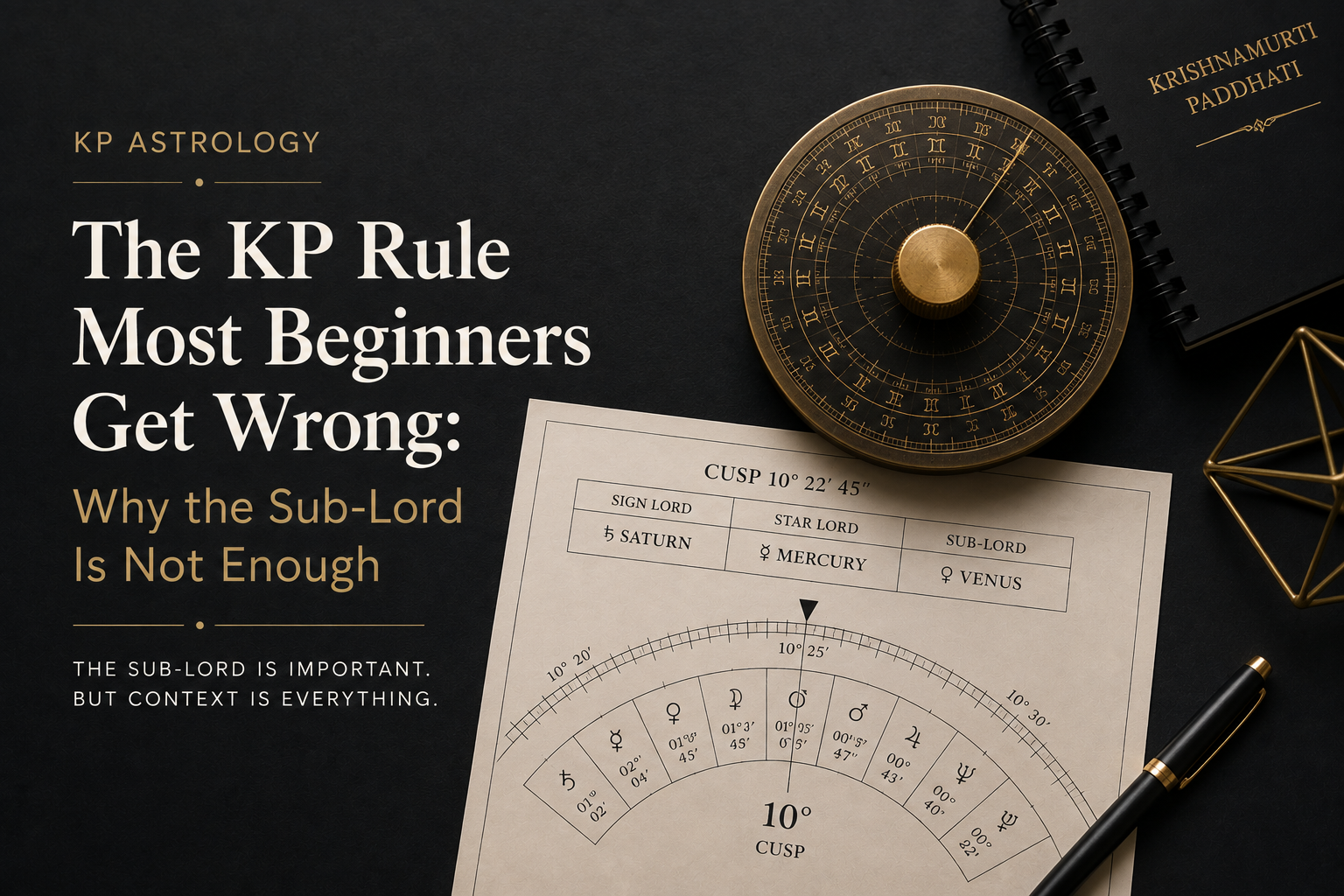
The biggest mistake beginners make in KP Astrology is treating the sub-lord as an isolated yes-or-no answer.
The sub-lord is crucial because KP takes prediction to a finer level by dividing each Nakshatra into nine unequal sub-divisions based on Vimshottari proportions, producing the familiar 249-sub framework across the zodiac. But the sub-lord has to be interpreted through the houses it signifies, its star lord, and the relevant cusp before a prediction can be made. :contentReference[oaicite:0]{index=0}
Key Takeaways
- KP does not mean "find the sub-lord and stop."
- The sub-lord must be read through its significations.
- The star lord is critical because it shows the houses connected with the planet's results.
- The relevant cusp must be identified before judging an event.
- The 249 divisions come from dividing the 27 Nakshatras using Vimshottari Dasha proportions.
- KP is particularly useful when the question is specific and event-oriented.
- Precision in KP increases the importance of accurate birth data and correct cusp calculation.
- Mixing Parashari rules into KP without understanding the KP framework can create contradictory judgments.
KP Astrology became popular because it promised something astrology students desperately wanted:
A method that could make prediction more specific.
Not just:
"Something may happen."
But:
"Will this event happen?"
And ideally:
"When?"
That is where the sub-lord enters the picture.
The problem is that once students discover the sub-lord, many stop learning.
They find a cusp.
They look at its sub-lord.
They search for the houses represented by that planet.
And then they declare:
YES.
Or:
NO.
That isn't KP.
It is a shortcut pretending to be KP.
The real strength of Krishnamurti Paddhati lies in the chain of relationships between the cusp, star lord, sub-lord and significators.
Understanding that chain is what turns the 249-sub system from a lookup table into a predictive method.
What Makes KP Different?
KP Astrology, or Krishnamurti Paddhati, was developed by Prof. K. S. Krishnamurti in the twentieth century.
One of its defining features is the subdivision of the Nakshatras into smaller unequal sections called subs or sub-lords.
Each of the 27 Nakshatras spans 13°20'.
Instead of treating that entire Nakshatra as one undivided unit, KP divides it according to the proportional lengths of the Vimshottari Dasha periods.
The result is a much finer system of planetary subdivisions.
Across the zodiac, the standard KP framework contains 249 sign-delimited sub-divisions. :contentReference[oaicite:1]{index=1}
That additional resolution is the point.
But precision is useful only if you know what to do with it.
The Three Levels You Must Not Confuse
A KP student should constantly distinguish between three different levels:
Sign Lord → Star Lord → Sub-Lord
They are not interchangeable.
The sign lord tells you the planetary ruler of the zodiac sign.
The star lord identifies the planet ruling the Nakshatra.
The sub-lord is the finest subdivision used in the KP framework.
A useful way to think about the structure is:
Sign = broad environment
Star = channel of operation
Sub = finer deciding layer
But even this analogy should not tempt you into ignoring significators.
The question remains:
Which houses are actually being connected?
That is where prediction begins.
Why the Star Lord Matters So Much
Suppose the cusp sub-lord is Venus.
A beginner may immediately look at Venus and say:
"Venus represents relationships, so marriage is promised."
That is not enough.
In KP, you need to examine the houses signified by Venus through the relevant significator structure.
If the question is marriage, you are not merely looking for the word "Venus."
You are asking whether the relevant significators connect the houses required for the event.
For example, in a marriage question, the astrologer typically studies the relevant relationship houses and examines whether the cusp and its sub-lord support the event.
The planet's natural meaning is secondary to the houses it signifies within the specific KP framework.
This is one of the biggest conceptual shifts for students coming from general Vedic astrology.
The Question Comes Before the Chart
Another mistake is trying to use KP to answer an undefined question.
A client says:
"Tell me about my career."
The astrologer begins analysing everything.
This quickly becomes vague.
KP becomes much more powerful when the question is specific.
For example:
"Will I get this job?"
"Will I buy this property?"
"Will this marriage happen?"
"Will I receive the promotion?"
"Will this business deal materialise?"
The more clearly the event is defined, the easier it becomes to identify the relevant houses and build a structured judgment.
This event-first approach is one reason KP is so attractive to practitioners who want specific answers.
How to Read a Cuspal Sub-Lord Properly
Here is a practical workflow.
Step 1: Define the Event
Do not start with planets.
Start with the question.
What exactly are you trying to predict?
Marriage?
Employment?
Promotion?
Property?
Education?
Litigation?
Travel?
Each event requires a different set of relevant houses.
Step 2: Identify the Relevant Cusp
Once the event is defined, determine which cusp is central to the question.
For marriage, the 7th cusp is central.
For career, the 10th cusp is central.
For gains, the 11th becomes important.
The exact judgment requires supporting houses as well.
The point is simple:
Do not interpret a sub-lord before knowing what event you're testing.
Step 3: Find the Cusp Sub-Lord
Now identify the sub-lord of the relevant cusp.
This is where the KP 249-sub table or appropriate astrology software becomes essential.
The exact degree matters because a small change in longitude can move a cusp or planet into a different subdivision.
The standard KP tables map zodiac degrees to sign lord, star lord and sub-lord. :contentReference[oaicite:2]{index=2}
Step 4: Study the Sub-Lord Through Its Significations
Now ask:
Which houses does this planet signify?
This is the heart of the analysis.
Do not stop at:
"Venus is the sub-lord."
Ask:
"Which houses does Venus connect?"
That is the difference between identification and prediction.
Step 5: Examine the Star Lord
Next, study the Nakshatra lord.
The sub-lord operates within the star-lord structure.
This is why simply reading the natural characteristics of the sub-lord can produce misleading results.
You need to follow the chain.
Cusp → Sub-Lord → Star Lord → Significations
The exact implementation depends on the KP school and methodology being followed, so students should learn one coherent framework rather than mixing rules from unrelated systems.
A Simple Example
Imagine a student is analysing:
"Will I get this job?"
The student finds the 10th cusp sub-lord is Mercury.
They immediately conclude:
"Yes. Mercury is good for employment."
That conclusion is premature.
Instead, the student should ask:
- What houses does Mercury signify?
- Through which star lord?
- Does Mercury connect with the houses relevant to employment?
- Are there houses that contradict the event?
- What do the relevant significators show?
- Do the operating planetary periods support the event?
- Does the timing mechanism agree?
Only after this chain is examined should the astrologer make a judgment.
The sub-lord gives you the doorway.
It does not give you the entire answer.
The 249 Sub-Lords Are Not the Point
This is an important lesson for anyone learning KP.
Students sometimes become obsessed with the number 249.
They memorise tables.
They practise degree calculations.
They learn software shortcuts.
But eventually the question becomes:
Can you actually predict?
A perfect understanding of the 249 subdivisions is useless if you don't understand significators.
The table is a tool.
The predictive framework is the skill.
Why KP Students Should Avoid Mixing Systems Carelessly
A student who has learned Parashari astrology may instinctively apply every familiar rule while reading a KP chart.
That can create confusion.
Parashari and KP share historical and conceptual roots, but they organise predictive judgment differently.
If you are using KP for a specific question, first understand the KP logic of:
- Cusps
- Star Lords
- Sub-Lords
- Significators
- Ruling Planets
- Dasha and timing
Then learn how and where other techniques can be integrated.
Do not create a hybrid system accidentally and then blame KP when the prediction fails.
The Futureye KP Framework
At Futureye, the goal should not be to produce students who can recite:
"Sub-lord is the most important."
The goal is to produce students who can actually use the framework.
A practical learning sequence is:
Question
↓
Relevant Houses
↓
Relevant Cusp
↓
Cusp Sub-Lord
↓
Star Lord
↓
Significations
↓
Supporting Significators
↓
Dasha / Timing
↓
Judgment
This is the mental workflow students should practise until it becomes automatic.
The real skill is not finding the sub-lord.
The real skill is knowing what to do after you find it.
Common KP Mistakes to Avoid
Mistake 1: Treating the Sub-Lord as a Magic Button
Finding a sub-lord is only the beginning.
Mistake 2: Ignoring the Star Lord
The star-lord relationship is central to understanding significations.
Mistake 3: Judging From Natural Significations
"Mercury means business" is not a sufficient KP judgment.
Mistake 4: Ignoring the Question
A chart cannot be interpreted properly without defining the event you are testing.
Mistake 5: Mixing Rules Without Understanding Them
Learn one complete KP framework before combining it with other predictive systems.
Mistake 6: Using Imprecise Birth Data
KP works at a fine level of subdivision, so accurate birth time and carefully calculated cusps matter greatly.
Frequently Asked Questions
What is a sub-lord in KP Astrology?
A sub-lord is the planet ruling one of the unequal subdivisions within a Nakshatra in the KP system. The subdivisions are based on Vimshottari Dasha proportions. :contentReference[oaicite:3]{index=3}
Why are there 249 sub-lords in KP Astrology?
The 27 Nakshatras are divided into unequal sub-divisions. Because of how certain subdivisions cross sign boundaries, the standard zodiacal framework contains 249 sign-delimited entries rather than simply 27 × 9 = 243. :contentReference[oaicite:4]{index=4}
Is the KP sub-lord more important than the star lord?
KP gives particular importance to the sub-lord, but it should not be interpreted in isolation. The star lord and the houses signified through the relevant planetary chain remain essential to judgment.
What is a Cuspal Sub-Lord?
The Cuspal Sub-Lord (CSL) is the planet ruling the sub-division in which a particular house cusp falls. KP practitioners use the CSL as a major part of event judgment.
Can KP Astrology predict exact events?
KP is designed for specific, event-oriented questions and uses detailed house significations and timing techniques. The quality of the prediction still depends on correct calculations, a well-defined question, and the astrologer's application of the method.
Do I need exact birth time for KP Astrology?
Accurate birth time is particularly important for KP because the system works with precise cuspal positions and sub-divisions. When the birth time is uncertain, rectification or appropriate horary techniques may be considered.
Final Thoughts
The sub-lord is one of the most powerful ideas in KP Astrology.
It is also one of the most abused.
If your entire KP method is:
Find the sub-lord → declare yes or no
you are not really using the depth of the system.
The better approach is:
Question → cusp → sub-lord → star lord → significations → supporting factors → timing → judgment.
That is where the real work begins.
And that is exactly why KP is worth learning properly.
Ready to Learn KP Astrology?
If you want to move beyond memorising the 249-sub table and actually learn how KP practitioners build predictions, explore the Futureye KP Astrology program.
Learn cuspal sub-lords, significators, ruling planets, event judgment, and predictive workflows through structured live learning and real chart practice.
Download the KP Astrology Prospectus to explore the complete curriculum.
About Futureye
Futureye is a practitioner-focused learning platform for serious students of astrology and occult sciences.
Our programs cover:
- Vedic Astrology
- KP Astrology
- Prashna Shastra
- Tarot
- Numerology
- Palmistry
- AI + Occult
The goal is simple:
Don't just learn astrology. Build your prediction system.
Sources
- K. S. Krishnamurti, Krishnamurti Paddhati and associated KP Readers.
- Krishnamurti Paddhati material describing the 249 sub-divisions of the zodiac. :contentReference[oaicite:5]{index=5}
- Jyotish Portal, KP 1–249 sub-lord table. :contentReference[oaicite:6]{index=6}
- AstroCentral, Calculating Sub-Lords — The 249 Sub-Divisions. :contentReference[oaicite:7]{index=7}
- Paramarsh, KP Astrology: Krishnamurti Paddhati Explained. :contentReference[oaicite:8]{index=8}
Ready to Learn the Secret Vidya?
Live cohort-based occult mastery — Vedic Astrology, Prashna Shastra, KP, Palmistry, Numerology, Tarot. Taught by Kushal Agarwal, ICAS faculty, with an AI practice agent that drills you on weak topics until they become second nature.
Or reach us at: info@thefutureye.com · +91 6290 273 797