
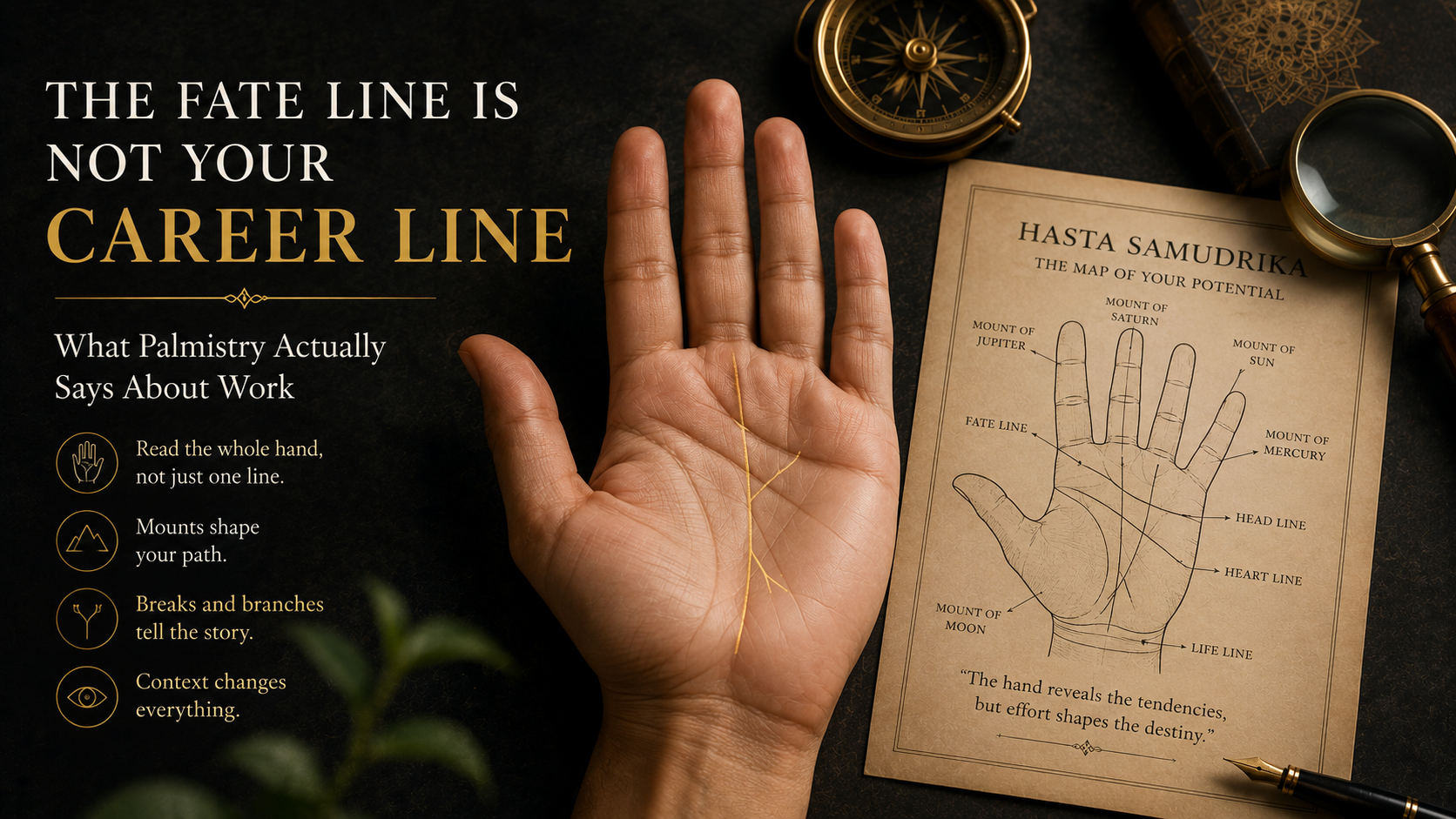
The Fate Line is not simply your "career line."
In traditional palmistry, particularly Hasta Samudrika, the Fate Line is interpreted in relation to the overall hand, its starting point, direction, interruptions, branches, mounts, and other major lines. It can be associated with themes of life direction, responsibility, circumstances, and professional development, but reading it alone is an oversimplification.
Key Takeaways
- The Fate Line is commonly associated with career and life direction, but it is not limited to employment.
- A missing Fate Line does not automatically mean career failure.
- The starting point of the line can change its traditional interpretation.
- Breaks, branches, changes in depth, and intersections require context.
- Mounts and hand shape should be read alongside the major lines.
- The dominant and non-dominant hands may be interpreted differently depending on the palmistry tradition.
- Hasta Samudrika is broader than simply reading three or four major lines.
- Palmistry is a traditional divinatory system, not a scientifically established method for predicting future events.
If you've ever searched for "Fate Line meaning," you've probably encountered the same explanation again and again:
The Fate Line = career.
It sounds simple.
It's also one of the easiest ways to produce a shallow palm reading.
A professional palmist doesn't look at one line and announce someone's career destiny.
The hand is read as a system.
The lines interact.
The mounts modify interpretation.
The shape and texture of the hand add context.
Even the condition of the line itself matters.
This broader approach is particularly relevant in the Indian tradition of Hasta Samudrika or Hasta Rekha, which sits within the wider Samudrika tradition of interpreting physical signs. Historical sources on Indian palmistry describe it as a broader discipline rather than merely a collection of predictions based on isolated lines. Varahamihira's Brihat Samhita, for example, contains material on bodily characteristics within its Samudrika-related chapters. :contentReference[oaicite:0]{index=0}
So let's stop calling the Fate Line a simple career thermometer.
And actually understand what it is supposed to represent.
What Is the Fate Line?
The Fate Line is generally described as a vertical line running upward through the palm, often toward the Mount of Saturn beneath the middle finger.
It can begin from different areas.
It may be:
- Long
- Short
- Deep
- Fine
- Straight
- Wavy
- Broken
- Branched
- Multiple
- Partially developed
- Difficult to see
And some people appear to have little or no clearly defined Fate Line.
This immediately creates a problem for the beginner.
If the Fate Line equals career success, what happens when there is no Fate Line?
Does that person never work?
Obviously not.
This is the first clue that the popular definition is incomplete.
Why "Career Line" Is an Oversimplification
Career is only one expression of a much larger idea.
Traditional palmistry often associates the Fate Line with the individual's relationship with circumstances, direction, responsibility, and the path through which life develops.
Career is an obvious modern expression of that idea.
But consider two people.
One works in a corporate job for thirty years.
Another changes industries five times, starts a business, moves abroad, becomes a consultant, and eventually teaches.
Both have careers.
But their relationship with stability, responsibility, choice, and external circumstances is completely different.
Palmistry attempts to observe those patterns rather than simply classify someone as "employed" or "unemployed."
That's why the Fate Line should be interpreted as part of a broader picture.
A Strong Fate Line Does Not Mean "Successful Career"
This is another common mistake.
A deep, straight Fate Line may traditionally be interpreted as a clearer or more consistent direction.
But consistency is not the same thing as success.
Someone can have a stable but mediocre career.
Someone else can have an unconventional path and achieve extraordinary results.
The line therefore needs context.
Ask:
What else does the hand show?
Look at:
- The Mount of Jupiter
- The Mount of Saturn
- The Mount of Sun
- The Mount of Mercury
- The Head Line
- The Heart Line
- The Life Line
- The Thumb
- Hand shape
- Finger proportions
- Texture and flexibility
- Major markings
This is where palmistry becomes considerably more interesting.
Where Does the Fate Line Begin?
The starting point of the Fate Line is one of the first things an experienced palmist examines.
Starting Near the Mount of Moon
When the Fate Line appears to rise from the lunar side of the palm, traditional interpretations often associate the life path with external influences, the public, travel, other people, or circumstances outside the immediate family environment.
For a modern professional, this might manifest through clients, audiences, partnerships, foreign connections, or public-facing work.
But again:
One indication is not a prediction.
Starting From the Life Line
A Fate Line beginning from or near the Life Line is traditionally associated with a path strongly connected to personal effort and self-development.
This can fit the archetype of the self-made person.
But it should not be reduced to:
"Self-made millionaire."
Palmistry is not a lottery ticket.
The interpretation is about tendencies and patterns.
Starting From the Middle of the Palm
A line beginning independently in the lower or middle palm can traditionally suggest that professional direction becomes more defined later rather than being established very early.
This is particularly interesting when analysing people whose careers changed significantly during adulthood.
Again, the timing should not be forced into an exact age without a consistent methodology.
What Does a Broken Fate Line Mean?
A broken line is one of the most abused features in beginner palmistry.
The usual social-media prediction is:
"Career disaster."
No.
A break does not automatically mean unemployment, bankruptcy, or professional collapse.
It may traditionally indicate a transition.
A change in environment.
A change in responsibility.
A career interruption.
A change in direction.
The surrounding markings determine how that transition should be understood.
Imagine a person leaving a corporate career at 32 and starting a business.
From one perspective, the Fate Line has "broken."
From another, the person's life direction has simply changed.
The hand doesn't have to be interpreted catastrophically.
What About Multiple Fate Lines?
Multiple vertical lines can also appear in the Saturn area.
A beginner might think:
"I have three Fate Lines, so I will have three careers."
That's not how serious palmistry should be approached.
Multiple lines may be interpreted in relation to multiple influences, responsibilities, parallel activities, or changing directions.
For example, someone may simultaneously have:
- A primary profession
- A family business
- A creative pursuit
- A consulting practice
Modern careers are rarely as linear as they were decades ago.
A sophisticated palmistry framework should be capable of dealing with that complexity.
The Mounts Change the Interpretation
One of the most important principles in traditional palmistry is that lines do not exist independently of the hand's structure.
The mounts are especially important.
Mount of Jupiter
Located beneath the index finger, Jupiter is traditionally associated with ambition, authority, leadership, confidence, and aspiration.
A strong Jupiter area can modify how ambition is expressed.
Mount of Saturn
Located beneath the middle finger, Saturn is associated traditionally with discipline, seriousness, responsibility, patience, and depth.
Since the Fate Line commonly rises toward this region, Saturn becomes particularly relevant to its interpretation.
Mount of Sun
The Mount of Sun, beneath the ring finger, is associated with recognition, creativity, reputation, visibility, and achievement.
A strong solar influence can be important when examining someone whose professional success depends heavily on public recognition.
Mount of Mercury
Mercury is traditionally associated with communication, commerce, negotiation, adaptability, and business intelligence.
For entrepreneurs and sales professionals, this area can therefore become particularly relevant.
This is why a professional reading should never be:
"Your Fate Line is strong, so you'll succeed."
The better question is:
What kind of success does the entire hand suggest?
The Head Line Matters More Than Beginners Realise
Career isn't just about opportunity.
It's also about decision-making.
That's where the Head Line becomes relevant.
Traditional palmistry associates the Head Line with mental tendencies, reasoning, concentration, and the way an individual approaches problems.
Imagine a strong Fate Line accompanied by markings traditionally associated with a highly analytical Head Line.
The interpretation could be very different from the same Fate Line combined with a hand showing a more intuitive or imaginative configuration.
Neither is automatically better.
They simply suggest different ways of operating.
The Thumb Is Not Decoration
If you're learning palmistry and ignoring the thumb, you're leaving out one of the most important parts of the hand.
Traditional palmistry gives considerable importance to the thumb, including its shape, flexibility, proportions, and phalanges.
The thumb is commonly interpreted in relation to will, reasoning, determination, and self-control.
Think about the implications.
Two people may have similar Fate Lines.
But one may show stronger indications of persistence and controlled decision-making.
The other may show greater flexibility but less consistency.
Their careers can unfold very differently.
Again:
The hand must be read as a whole.
The Dominant Hand vs the Other Hand
Different palmistry traditions interpret the two hands differently, so students should avoid treating one rule as universal.
A common modern approach is to examine one hand for inherited or underlying tendencies and the other for their current expression and development.
But the exact interpretation varies by school.
The important principle is consistency.
If you are learning a particular palmistry tradition, learn its method for comparing the hands rather than randomly combining rules from different books and traditions.
Can the Fate Line Change?
Palmists traditionally often say that the lines of the hand can change.
This is one of the most interesting ideas in the discipline.
It fits naturally with the broader Indian idea that human action and circumstances interact with destiny.
But there is an important distinction.
A changing line should not automatically be presented as scientific proof that the future has changed.
Palmistry is a traditional interpretive system, not an experimentally validated predictive science.
For Futureye students, intellectual honesty matters.
You can study and practise palmistry seriously while clearly distinguishing traditional interpretation from scientifically established fact.
The Real Skill: Reading Patterns, Not Lines
This is the biggest lesson.
If you want to become a serious palmist, stop collecting isolated meanings.
Don't memorise:
"Break = bad."
"Star = success."
"Square = protection."
"Long line = long life."
These shortcuts may help beginners recognise symbols, but they are not enough for professional interpretation.
Instead, develop a hierarchy.
Step 1: Look at the Whole Hand
Shape, size, flexibility, texture, fingers, thumb, mounts.
Step 2: Examine the Major Lines
Life, Head, Heart, Fate, and other significant markings.
Step 3: Identify Anomalies
Breaks, branches, islands, crosses, stars, chains, intersections.
Step 4: Examine Location
Where exactly does the marking occur?
Step 5: Compare Both Hands
Determine what your chosen school says about the relationship between them.
Step 6: Build the Interpretation
Only now should you form a conclusion.
This is the difference between palmistry as entertainment and palmistry as a disciplined traditional practice.
A Better Way to Think About Palmistry
Don't ask:
"What does this line mean?"
Ask:
"What pattern is the hand showing?"
That one change in thinking can completely transform your reading.
The Fate Line is not your career destiny written in stone.
It is one piece of a much larger interpretive system.
And the more you learn, the more obvious that becomes.
Frequently Asked Questions
Is the Fate Line the same as the Career Line?
The terms are often used interchangeably in popular palmistry, but "career line" is an oversimplification. Traditionally, the Fate Line has broader associations with life direction, circumstances, responsibility, and professional development.
What does a missing Fate Line mean?
It does not automatically mean career failure. Some people simply have a faint or difficult-to-see Fate Line, and traditional palmistry requires the rest of the hand to be considered.
Does a broken Fate Line mean job loss?
Not necessarily. A break may traditionally be associated with a transition or change, but its interpretation depends on surrounding lines, markings, mounts, and the overall hand.
Can palm lines change?
Palmists traditionally report changes in lines over time. However, this should be understood as part of the traditional practice rather than treated as scientifically established evidence that destiny physically changes.
Which line shows career in palmistry?
The Fate Line is the line most commonly associated with career and life direction, but professional palmistry does not judge career from this line alone.
Is palmistry scientifically proven?
No. Palmistry is a traditional divinatory practice, and its claims about predicting personality or future events have not been established as scientific facts. It should therefore be presented as a traditional interpretive system.
Final Thoughts
The biggest mistake in palmistry is not misunderstanding the Fate Line.
It is believing that any single line can tell the whole story.
The hand is more complicated than that.
The Fate Line can offer clues about direction and changing circumstances.
The Head Line adds another dimension.
The mounts provide planetary symbolism.
The thumb adds information about will and control.
The shape and texture of the hand provide further context.
And the comparison between the hands can reveal another layer depending on the tradition being used.
So don't ask:
"Do I have a good Fate Line?"
Ask:
"What is my hand actually showing me as a whole?"
That is where serious palmistry begins.
Ready to Learn Palmistry?
If you want to move beyond reading three lines from a palm and learn the broader principles of Hasta Samudrika and palmistry, explore the Futureye occult education programs.
Learn how to examine lines, mounts, hand structure, markings, and patterns as part of a complete interpretive framework.
Explore Futureye's programs and contact us to discover the right learning path for you.
About Futureye
Futureye is a practitioner-focused learning platform for serious students of astrology and occult sciences.
Our programs cover:
- Vedic Astrology
- KP Astrology
- Prashna Shastra
- Palmistry
- Tarot
- Numerology
- AI + Occult
The philosophy is simple:
Don't just learn occult knowledge. Learn how to interpret it.
Sources
- Varahamihira, Brihat Samhita, chapters traditionally associated with Samudrika and Mahapurusha-lakshana.
- Karlakkhanam Samudrik Shastra, Prafullakumar Modi, Bharatiya Jnanpith. The text discusses Indian palmistry and references to Samudrika material in classical literature. :contentReference[oaicite:1]{index=1}
- Contemporary overview of Hasta Samudrika and its relationship to Indian palmistry traditions. :contentReference[oaicite:2]{index=2}
- Academic research on computational extraction of palm-line features, illustrating that palm-line detection can be studied computationally without validating traditional predictive claims. :contentReference[oaicite:3]{index=3}
Suggested Internal Links
- Futureye Palmistry / Hastarekha category page
- What Is Hasta Samudrika Shastra? A Beginner's Guide
- Life Line vs Head Line vs Heart Line: What Each Actually Represents
- The Mounts of the Palm: A Complete Guide to Planetary Mounts
- Can Palmistry and Vedic Astrology Be Used Together?
Suggested Schema
- Article
- FAQPage
- BreadcrumbList
Content Cluster Suggestion
This article should become the first tactical article in a Futureye Palmistry cluster.
Next publish:
- What Is Hasta Samudrika Shastra?
- The 7 Planetary Mounts in Palmistry
- How to Read the Life Line Without Making Ridiculous Predictions
- Head Line in Palmistry: Intelligence, Thinking and Decision-Making
- Heart Line in Palmistry: What It Actually Represents
- How to Read Both Hands Together
- Palmistry vs Vedic Astrology: What Each System Can Tell You
Social Media Summary
The Fate Line is NOT simply your career line.
That's one of the biggest oversimplifications in modern palmistry.
A serious palmist doesn't look at one line and declare your professional destiny.
The hand has to be read as a system:
Lines. Mounts. Fingers. Thumb. Hand shape. Markings. Both hands.
In today's Futureye article, we break down what the Fate Line actually represents and why reading it in isolation can produce terrible interpretations.
LinkedIn Post
Most people think the Fate Line is simply the "career line."
That's where palmistry gets dumbed down.
A professional reading doesn't work like this:
Strong Fate Line = success.
Broken Fate Line = failure.
No Fate Line = no career.
That's not serious palmistry.
In Hasta Samudrika, the hand is interpreted as a complete system.
The Fate Line is one component.
The mounts matter.
The Head Line matters.
The thumb matters.
The structure of the hand matters.
And context matters.
The real skill isn't memorising what every line "means."
It's learning how the different features interact.
I wrote a practical breakdown of the Fate Line—and why calling it a simple Career Line misses the point.
Read the full article on Futureye.
#Palmistry #HastaSamudrika #HastRekha #Occult #Futureye
X Thread
1/ The Fate Line is NOT simply your career line.
That's one of the biggest oversimplifications in modern palmistry.
2/ A strong Fate Line doesn't automatically mean career success.
A broken Fate Line doesn't automatically mean career failure.
3/ Why?
Because serious palmistry reads the hand as a system.
Lines + mounts + fingers + thumb + hand structure + markings.
4/ The Fate Line is traditionally associated with direction, circumstances, responsibility and professional development.
Career is only one expression.
5/ A professional palmist asks:
Where does the line begin?
Where does it go?
Is it broken?
Does it branch?
What surrounds it?
6/ Then comes the rest of the hand.
The Mount of Jupiter.
Saturn.
Sun.
Mercury.
Head Line.
Thumb.
All add context.
7/ Stop asking:
"What does this line mean?"
Start asking:
"What pattern is this hand showing?"
That's where serious palmistry begins.
8/ Full article on Futureye:
The Fate Line Is Not Your Career Line: What Palmistry Actually Says About Work.
Newsletter Summary
SUBJECT: Your Fate Line Isn't Your Career Line
PREVIEW: Why serious palmistry requires more than reading one line.
BODY:
You've probably heard that the Fate Line is your "career line."
But that simple definition misses most of what traditional palmistry is actually trying to interpret.
This week's Futureye article looks at the Fate Line through the broader Hasta Samudrika framework—its starting point, breaks, branches, relationship with the mounts, and why the entire hand must be considered before making a prediction.
If you're serious about learning palmistry, this is where you should start.
Read the full article on Futureye.
Ready to Learn the Secret Vidya?
Live cohort-based occult mastery — Vedic Astrology, Prashna Shastra, KP, Palmistry, Numerology, Tarot. Taught by Kushal Agarwal, ICAS faculty, with an AI practice agent that drills you on weak topics until they become second nature.
Or reach us at: info@thefutureye.com · +91 6290 273 797